Pennisi Maria Stella, Stella Stefania, Vitale Silvia Rita, Puma Adriana, Di Gregorio Sandra, Romano Chiara, Tirrò Elena, Massimino Michele, Antolino Agostino, Siragusa Sergio, Mannina Donato, Impera Stefana, Musolino Caterina, Mineo Giuseppe, Martino Bruno, Zammit Valentina, Di Raimondo Francesco, Manzella Livia, Stagno Fabio, Vigneri Paolo
Department of Clinical and Experimental Medicine, University of Catania, Catania, Italy.
Center of Experimental Oncology and Hematology, Azienda Ospedaliera Universitaria (A.O.U.) Policlinico - Vittorio Emanuele, Catania, Italy.
Front Oncol. 2019 Aug 13;9:764. doi: 10.3389/fonc.2019.00764. eCollection 2019.
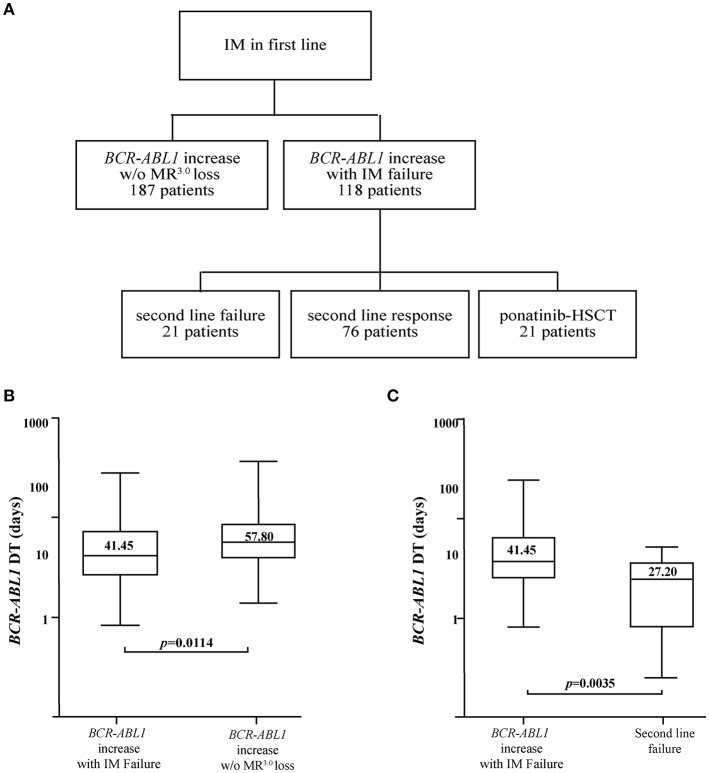
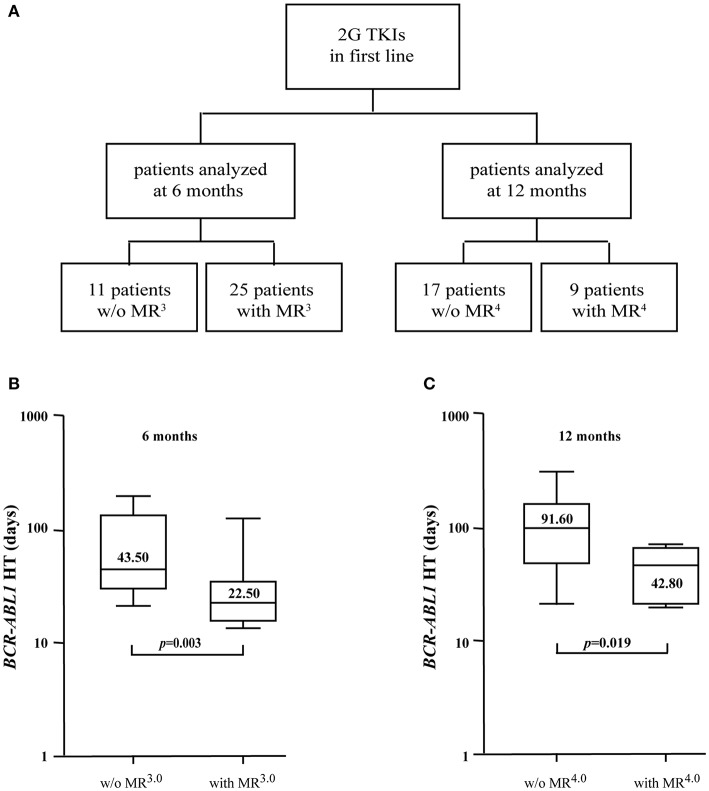
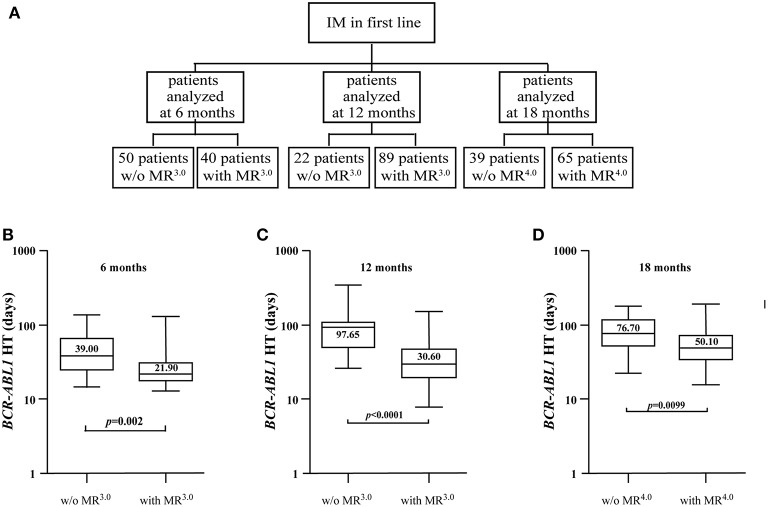
In Chronic Myeloid Leukemia (CML), successful treatment requires accurate molecular monitoring to evaluate disease response and provide timely interventions for patients failing to achieve the desired outcomes. We wanted to determine whether measuring mRNA doubling-times (DTs) could distinguish inconsequential rises in the oncogene's expression from resistance to tyrosine kinase inhibitors (TKIs). Thus, we retrospectively examined evolution in 305 chronic-phase CML patients receiving imatinib mesylate (IM) as a first line treatment. Patients were subdivided in two groups: those with a confirmed rise in transcripts without MR loss and those failing IM. We found that the DTs of the former patients were significantly longer than those of patients developing IM resistance (57.80 vs. 41.45 days, = 0.0114). Interestingly, the DT values of individuals failing second-generation (2G) TKIs after developing IM resistance were considerably shorter than those observed at the time of IM failure (27.20 vs. 41.45 days; = 0.0035). We next wanted to establish if decreases in transcripts would identify subjects likely to obtain deep molecular responses. We therefore analyzed the halving-times (HTs) of a different cohort comprising 174 individuals receiving IM in first line and observed that, regardless of the time point selected for our analyses (6, 12, or 18 months), HTs were significantly shorter in subjects achieving superior molecular responses ( = 0.002 at 6 months; < 0.001 at 12 months; = 0.0099 at 18 months). Moreover, 50 patients receiving 2G TKIs as first line therapy and obtaining an MR (after 6 months; = 0.003) or an MR (after 12 months; = 0.019) displayed significantly shorter HTs than individuals lacking these molecular responses. Our findings suggest that DTs and HTs are reliable tools to, respectively, identify subjects in MR that are failing their assigned TKI or to recognize patients likely to achieve deep molecular responses that should be considered for treatment discontinuation.
在慢性髓性白血病(CML)中,成功的治疗需要精确的分子监测,以评估疾病反应,并为未达到预期治疗效果的患者提供及时干预。我们想确定测量mRNA倍增时间(DTs)能否区分致癌基因表达的无关紧要的升高与对酪氨酸激酶抑制剂(TKIs)的耐药性。因此,我们回顾性研究了305例接受甲磺酸伊马替尼(IM)一线治疗的慢性期CML患者的病情演变。患者被分为两组:转录本确认升高但无分子学反应丧失的患者,以及IM治疗失败的患者。我们发现,前一组患者的DTs明显长于出现IM耐药的患者(57.80天对41.45天,P = 0.0114)。有趣的是,在出现IM耐药后接受第二代(2G)TKIs治疗失败的患者的DT值,比IM治疗失败时观察到的值要短得多(27.20天对41.45天;P = 0.0035)。接下来,我们想确定转录本的减少是否能识别出可能获得深度分子反应的患者。因此,我们分析了另一组174例一线接受IM治疗的患者的半衰期(HTs),并观察到,无论我们选择哪个时间点进行分析(6个月、12个月或18个月),在获得较好分子反应的患者中,HTs明显更短(6个月时P = 0.002;12个月时P < 0.001;18个月时P = 0.0099)。此外,50例一线接受2G TKIs治疗并获得主要分子反应(6个月后;P = 0.003)或次要分子反应(12个月后;P = 0.019)的患者,其HTs明显短于未获得这些分子反应的患者。我们的研究结果表明,DTs和HTs分别是可靠的工具,可用于识别处于主要分子反应但指定的TKI治疗失败的患者,或识别可能获得深度分子反应、应考虑停药的患者。