Casati Martina, Costa Andrea Saul, Capitanio Daniele, Ponzoni Luisa, Ferri Evelyn, Agostini Simone, Lori Elisa
Geriatric Unit, Fondazione IRCCS Ca' Granda, Ospedale Maggiore Policlinico, Milan, Italy.
IRCCS Fondazione Don Carlo Gnocchi, Milan, Italy.
Front Med (Lausanne). 2019 Aug 13;6:184. doi: 10.3389/fmed.2019.00184. eCollection 2019.
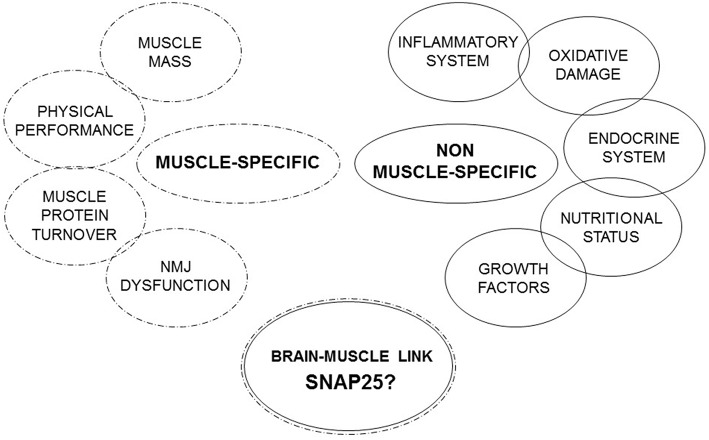
Sarcopenia, the progressive loss of muscle mass and strength, is one of the major health issues in older adults, given its high prevalence accompanied by huge clinical and socioeconomic implications. Age-related changes in skeletal muscle can be attributed to mechanisms both directly and indirectly related to muscle homeostasis. Indeed, a wide spectrum of age-related modifications in the organism was shown to play a key role in the pathogenesis of sarcopenia. Not surprisingly, sarcopenia has sometimes been indicated as a syndrome stemming from the aging process, and not as univocal standalone disease. Due to the multidimensionality of sarcopenia, a single biomarker approach is not enough to explain the biology of this condition. The aim of this review is to suggest innovative and promising sarcopenia markers investigating the link between skeletal muscle and brain. Indeed, as a neurological origin of sarcopenia has been hypothesized, a new perspective on sarcopenia biomarkers may focus on the dysfunction of the neuromuscular junctions (NMJs). The core SNARE synaptosomal-associated protein of 25 kDa (SNAP25) accumulates in the plasma membrane of nerve terminals at NMJs and regulates exocytosis at peripheral and central synapses. Interestingly, mice studies have shown that SNAP25 affects the neuromuscular function. SNARE complex and, in particular, SNAP25 may represent a promising pathway to explore the molecular and cellular mechanisms regulating muscular homeostasis and concur at profiling the sarcopenia biological background.
肌肉减少症是指肌肉质量和力量的逐渐丧失,鉴于其高患病率以及巨大的临床和社会经济影响,它是老年人面临的主要健康问题之一。骨骼肌的年龄相关变化可归因于与肌肉稳态直接和间接相关的机制。事实上,机体中广泛的年龄相关改变在肌肉减少症的发病机制中起着关键作用。毫不奇怪,肌肉减少症有时被认为是一种源于衰老过程的综合征,而不是一种明确的独立疾病。由于肌肉减少症的多维度性,单一生物标志物方法不足以解释这种病症的生物学机制。本综述的目的是提出创新且有前景的肌肉减少症标志物,研究骨骼肌与大脑之间的联系。的确,由于已假设肌肉减少症有神经学起源,关于肌肉减少症生物标志物的新观点可能聚焦于神经肌肉接头(NMJ)的功能障碍。核心的25 kDa突触小体相关蛋白(SNAP25)在神经肌肉接头处的神经末梢质膜中积累,并调节外周和中枢突触的胞吐作用。有趣的是,小鼠研究表明SNAP25会影响神经肌肉功能。SNARE复合体,尤其是SNAP25,可能代表了一条有前景的途径,用于探索调节肌肉稳态的分子和细胞机制,并有助于描绘肌肉减少症的生物学背景。