Key Laboratory of Ecosystem Network Observation and Modeling, Institute of Geographic Sciences and Natural Resources Research, Chinese Academy of Sciences, Beijing 100101, China.
College of Resources and Environment, University of Chinese Academy of Sciences, Yuquanlu, Beijing 100049, China.
Sci Adv. 2019 Aug 21;5(8):eaav1131. doi: 10.1126/sciadv.aav1131. eCollection 2019 Aug.
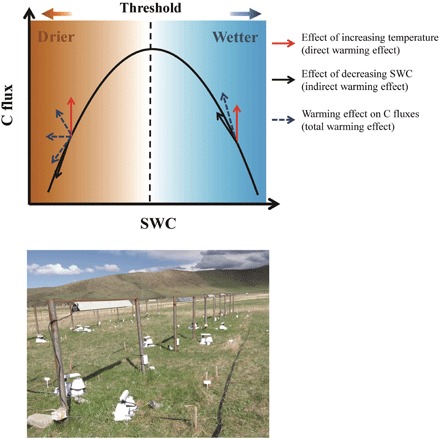
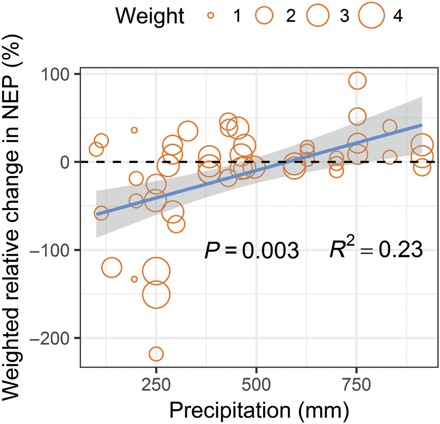
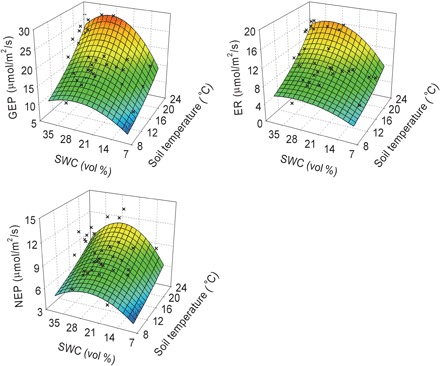
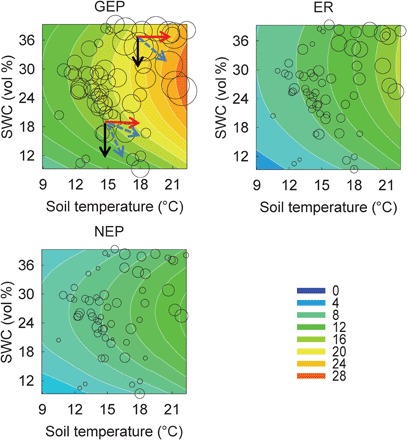
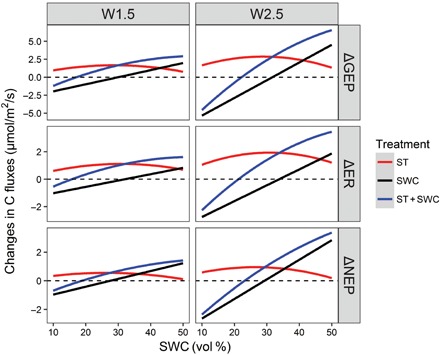
It has been well established by field experiments that warming stimulates either net ecosystem carbon uptake or release, leading to negative or positive carbon cycle-climate change feedback, respectively. This variation in carbon-climate feedback has been partially attributed to water availability. However, it remains unclear under what conditions water availability enhances or weakens carbon-climate feedback or even changes its direction. Combining a field experiment with a global synthesis, we show that warming stimulates net carbon uptake (negative feedback) under wet conditions, but depresses it (positive feedback) under very dry conditions. This switch in carbon-climate feedback direction arises mainly from scaling effects of warming-induced decreases in soil water content on net ecosystem productivity. This water scaling of warming effects offers generalizable mechanisms not only to help explain varying magnitudes and directions of observed carbon-climate feedback but also to improve model prediction of ecosystem carbon dynamics in response to climate change.
大量野外实验已经证实,气候变暖会刺激生态系统碳的净吸收或释放,从而分别导致负向或正向的碳循环-气候变化反馈。这种碳-气候反馈的差异部分归因于水分可利用性。然而,在何种条件下水分可利用性会增强或削弱碳-气候反馈,甚至改变其方向,目前仍不清楚。本研究将野外实验与全球综合分析相结合,结果表明,在湿润条件下,气候变暖会刺激生态系统的净碳吸收(负向反馈),而在非常干燥的条件下则会抑制净碳吸收(正向反馈)。这种碳-气候反馈方向的转变主要源于变暖引起的土壤含水量减少对净生态系统生产力的尺度效应。这种变暖效应的水分尺度为我们提供了可推广的机制,不仅有助于解释观测到的碳-气候反馈的不同幅度和方向,而且还有助于改进模型对生态系统碳动态响应气候变化的预测。