
气候变暖加剧了森林碳氮循环中的全球不平等现象。
Warming exacerbates global inequality in forest carbon and nitrogen cycles.
作者信息
Cui Jinglan, Deng Ouping, Zheng Miao, Zhang Xiuming, Bian Zihao, Pan Naiqing, Tian Hanqin, Xu Jianming, Gu Baojing
机构信息
College of Environmental and Resource Sciences, Zhejiang University, Hangzhou, China.
Policy Simulation Laboratory, Zhejiang University, Hangzhou, China.
出版信息
Nat Commun. 2024 Oct 24;15(1):9185. doi: 10.1038/s41467-024-53518-5.
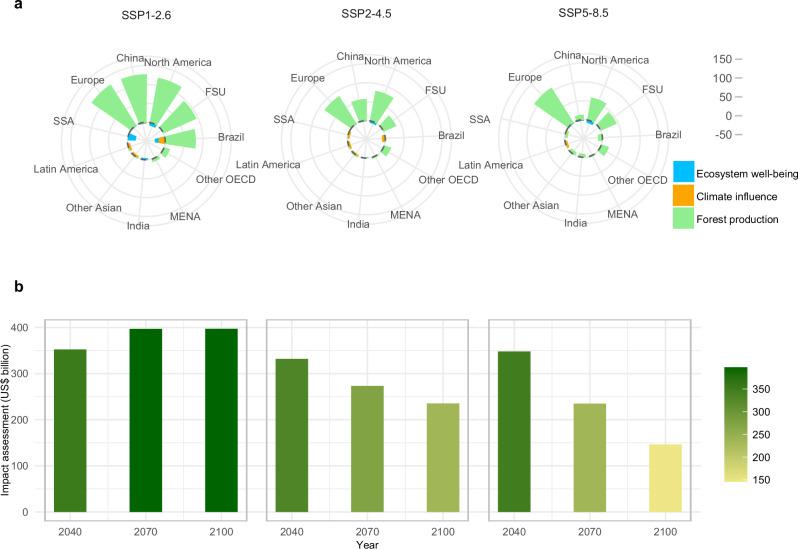
Forests are invaluable natural resources that provide essential services to humanity. However, the effects of global warming on forest carbon and nitrogen cycling remain uncertain. Here we project a decrease in total nitrogen input and accumulation by 7 ± 2 and 28 ± 9 million tonnes (Tg), respectively, and an increase in reactive nitrogen losses to the environment by 9 ± 3 Tg for 2100 due to warming in a fossil-fueled society. This would compromise the global carbon sink capacity by 0.45 ± 0.14 billion tonnes annually. Furthermore, warming-induced inequality in forest carbon and nitrogen cycles could widen the economic gap between the Global South and Global North. High-income countries are estimated to gain US$179 billion in benefits from forest assets under warming, while other regions could face net damages of US$31 billion. Implementing climate-smart forest management, such as comprehensive restoration and optimizing tree species composition, is imperative in the face of future climate change.
森林是为人类提供重要服务的宝贵自然资源。然而,全球变暖对森林碳氮循环的影响仍不确定。在此,我们预测,在以化石燃料为主的社会中,由于气候变暖,到2100年,总氮输入和积累量将分别减少7±2百万吨(Tg)和28±9百万吨,向环境中排放的活性氮将增加9±3百万吨。这将使全球碳汇能力每年降低0.45±0.14亿吨。此外,气候变暖导致的森林碳氮循环不平等可能会扩大全球南方和北方之间的经济差距。据估计,高收入国家在气候变暖的情况下将从森林资产中获得1790亿美元的收益,而其他地区可能面临310亿美元的净损失。面对未来气候变化,实施气候智能型森林管理,如全面恢复和优化树种组成,势在必行。


 Zotero 插件