Ran Qidi, Xu Xiao, Dzubiella Joachim, Haag Rainer, Ballauff Matthias
Institute of Chemistry and Biochemistry, Freie Universität Berlin, Takustr. 3, 14195 Berlin, Germany.
Institute of Soft Matter and Functional Materials, Helmholtz-Zentrum Berlin, Hahn-Meitner-Platz 1, 14109 Berlin, Germany.
ACS Omega. 2018 Aug 14;3(8):9086-9095. doi: 10.1021/acsomega.8b01493. eCollection 2018 Aug 31.
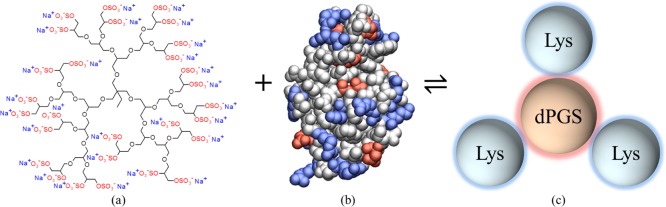
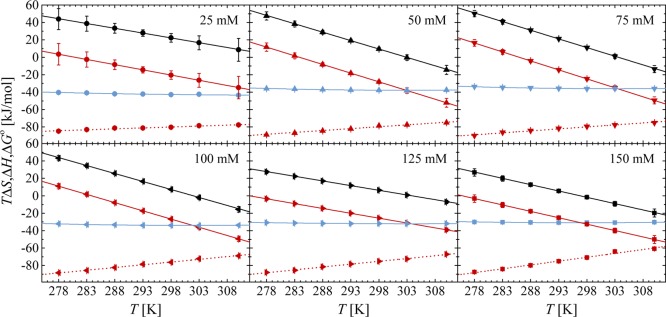
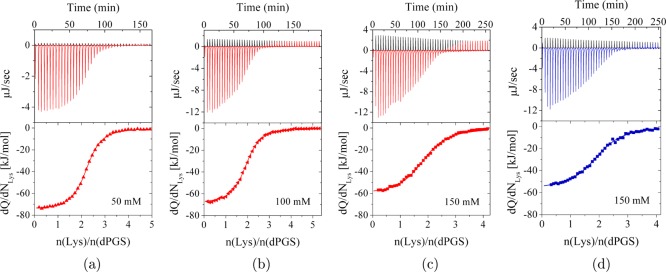
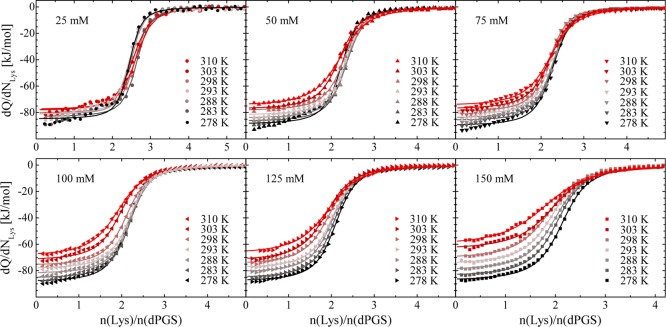
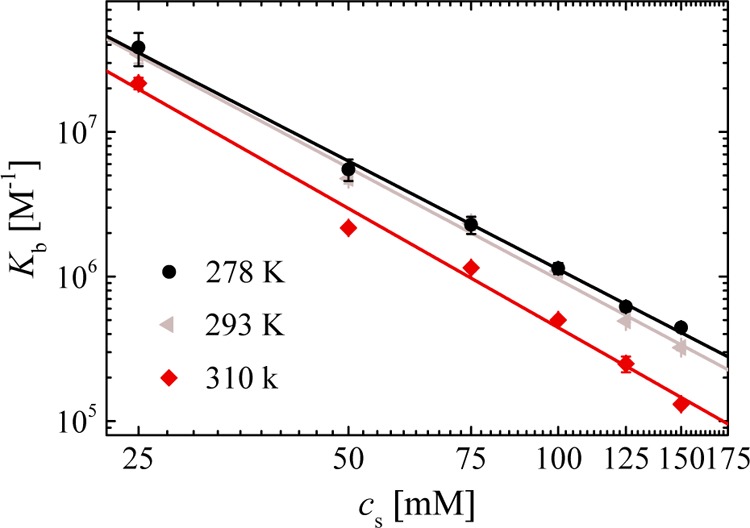
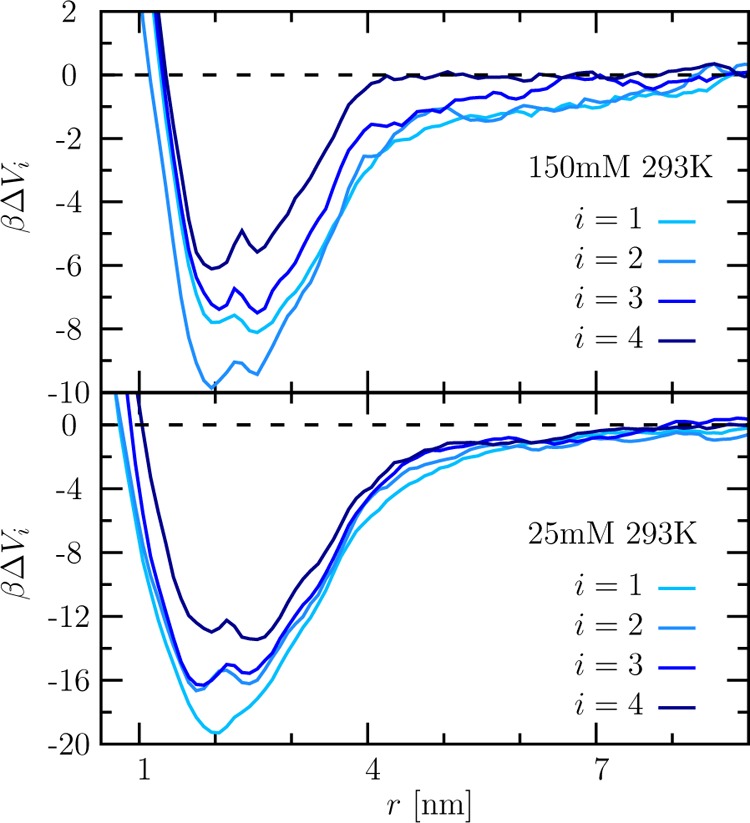
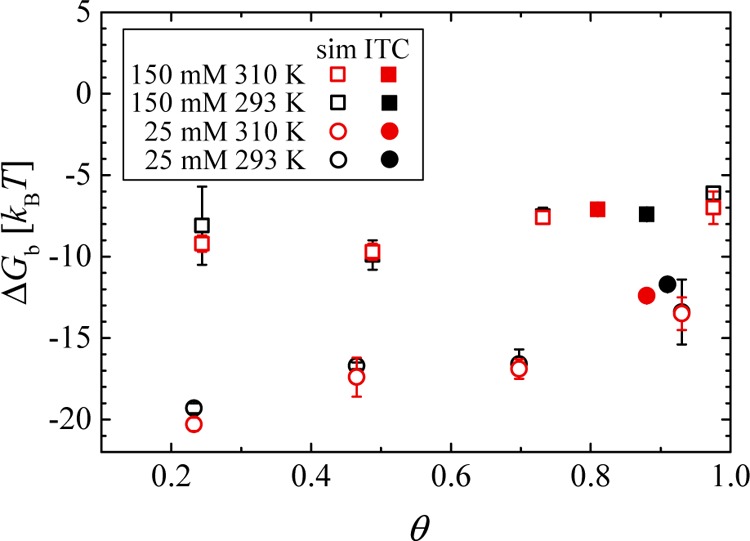
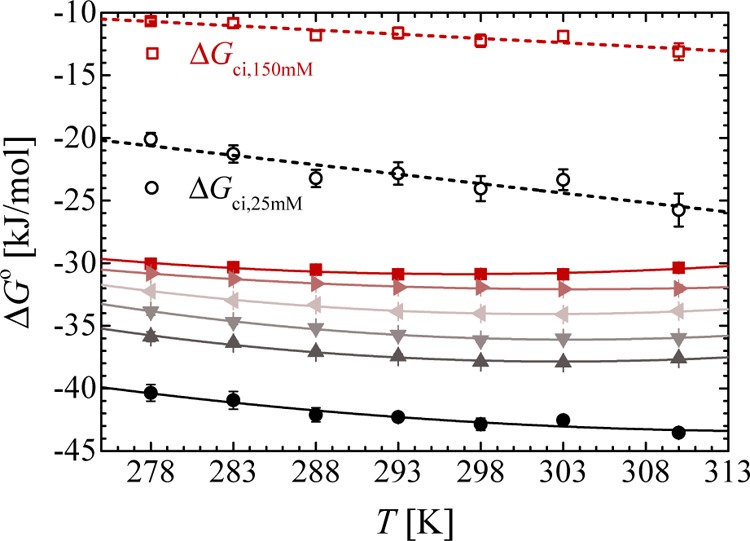
The interaction between dendritic polyglycerol sulfate (dPGS) of the second generation and lysozyme was studied by isothermal titration calorimetry (ITC) at different temperatures and salt concentrations. Analysis by ITC showed that 2-3 lysozyme molecules were bound to each dPGS. The resulting binding constant and the Gibbs free energy Δ decreased markedly with increasing salt concentration but were nearly independent of temperature. The salt dependence of led to the conclusion that ca. 3 counterions bound to dPGS were released upon complex formation. The gain in entropy Δ by this counterion-release scales logarithmically with salt concentration and is the main driving force for binding. The temperature dependence of Δ was analyzed by the nonlinear van't Hoff plot, taking into account a finite heat capacity change Δ . This evaluation led to the binding enthalpy Δ and the binding entropy Δ . Both quantities varied strongly with temperature and even changed sign, but they compensated each other throughout the entire range of temperature. Coarse-grained computer simulations with explicit salt and implicit water were used to obtain the binding free energies that agreed with ITC results. Thus, electrostatic factors were the driving forces for binding whereas all hydration contributions leading to the strongly varying Δ and Δ canceled out. The calorimetric enthalpy Δ measured directly by ITC differed largely from Δ . ITC measurements done in two buffer systems with different ionization enthalpies revealed that binding was linked to buffer ionization and a partial protonation of the protein.
通过等温滴定量热法(ITC)在不同温度和盐浓度下研究了第二代树枝状聚甘油硫酸盐(dPGS)与溶菌酶之间的相互作用。ITC分析表明,每个dPGS结合2 - 3个溶菌酶分子。所得结合常数和吉布斯自由能Δ随着盐浓度的增加而显著降低,但几乎与温度无关。结合常数对盐的依赖性得出结论,即约3个与dPGS结合的抗衡离子在复合物形成时被释放。这种抗衡离子释放引起的熵增Δ与盐浓度呈对数关系,是结合的主要驱动力。考虑到有限的热容变化Δ,通过非线性范特霍夫图分析了Δ对温度的依赖性。该评估得出了结合焓Δ和结合熵Δ。这两个量都随温度强烈变化,甚至改变符号,但在整个温度范围内它们相互补偿。使用具有明确盐和隐式水的粗粒度计算机模拟来获得与ITC结果一致的结合自由能。因此,静电因素是结合的驱动力,而导致Δ和Δ强烈变化的所有水合作用贡献相互抵消。通过ITC直接测量的量热焓Δ与Δ有很大差异。在具有不同电离焓的两种缓冲系统中进行的ITC测量表明,结合与缓冲液电离和蛋白质的部分质子化有关。