Ramadan Rehab, Romera David, Carrascón Rosalía Delgado, Cantero Miguel, Aguilera-Correa John-Jairo, García Ruiz Josefa P, Esteban Jaime, Silván Miguel Manso
Departamento de Física Aplicada and Instituto de Ciencia de Materiales Nicolás Cabrera, Departamento de Biología Molecular, and Departamento de Física de la Materia Condensada and Instituto de Ciencia de Materiales Nicolás Cabrera, Universidad Autónoma de Madrid, 28049 Madrid, Spain.
Physics Department, Faculty of Science, Minia University, 61519 Minia, Egypt.
ACS Omega. 2019 Jul 1;4(7):11354-11363. doi: 10.1021/acsomega.9b00646. eCollection 2019 Jul 31.
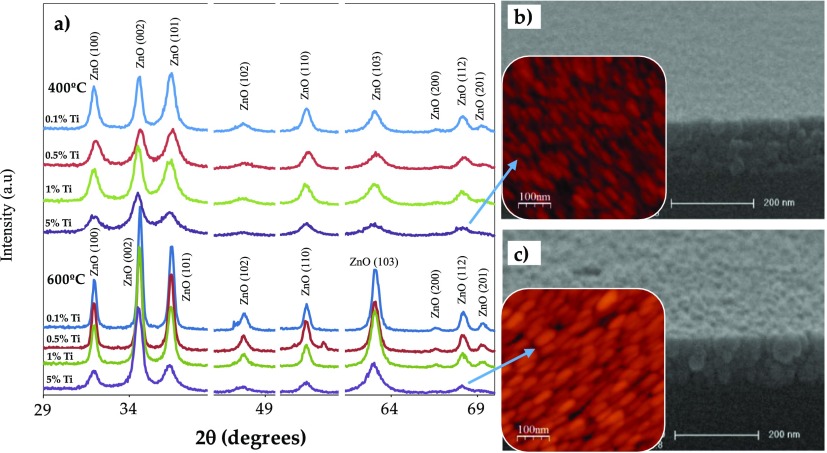
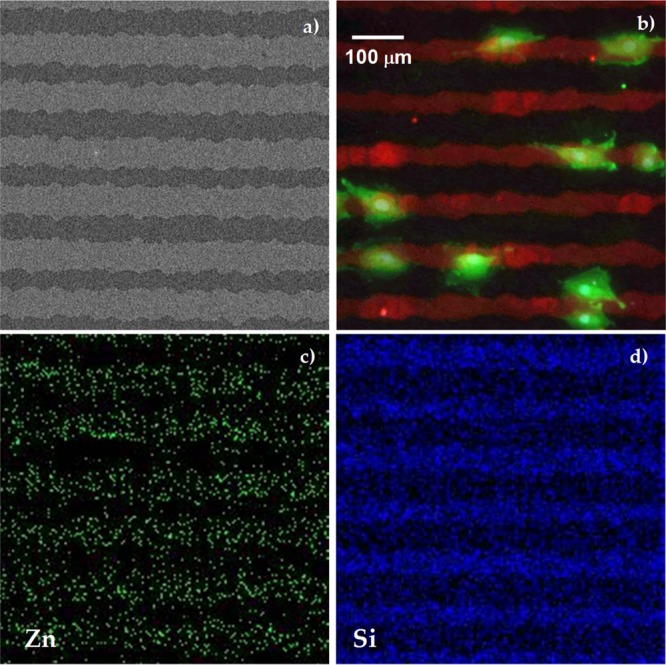
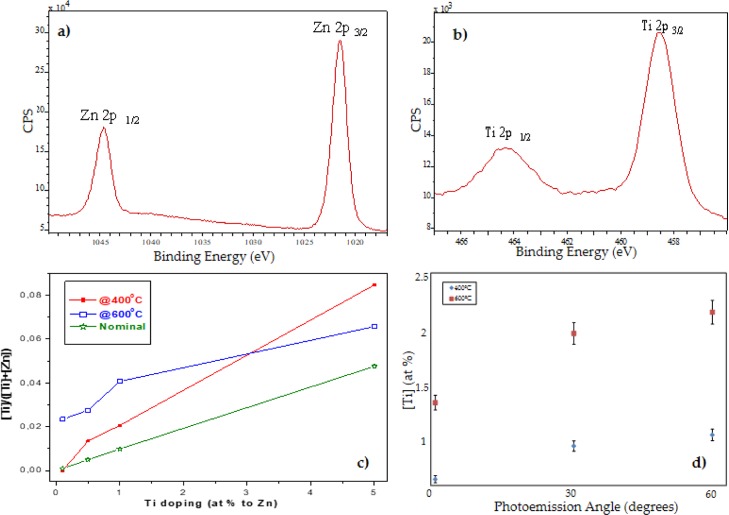
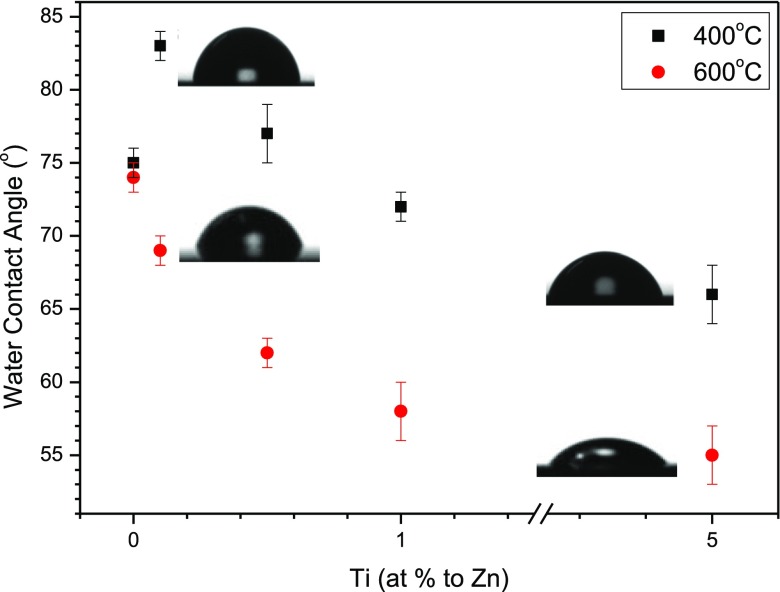
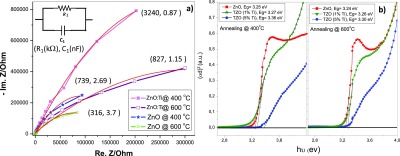
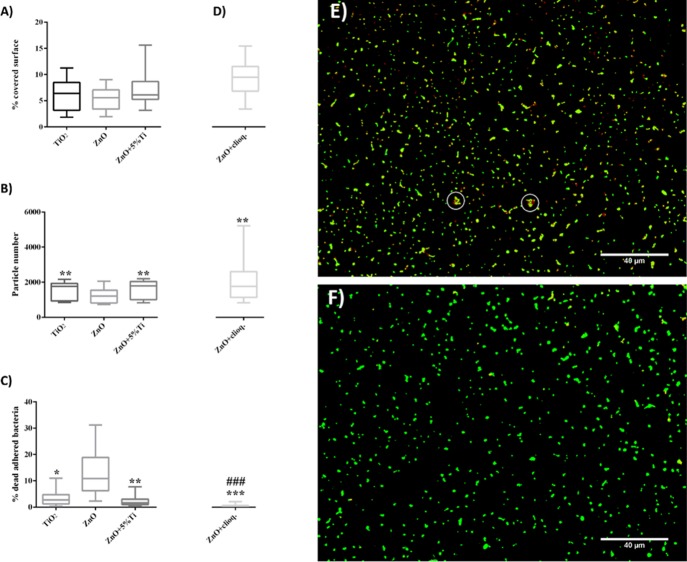
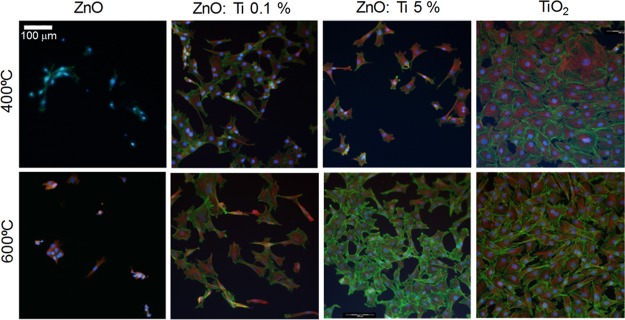
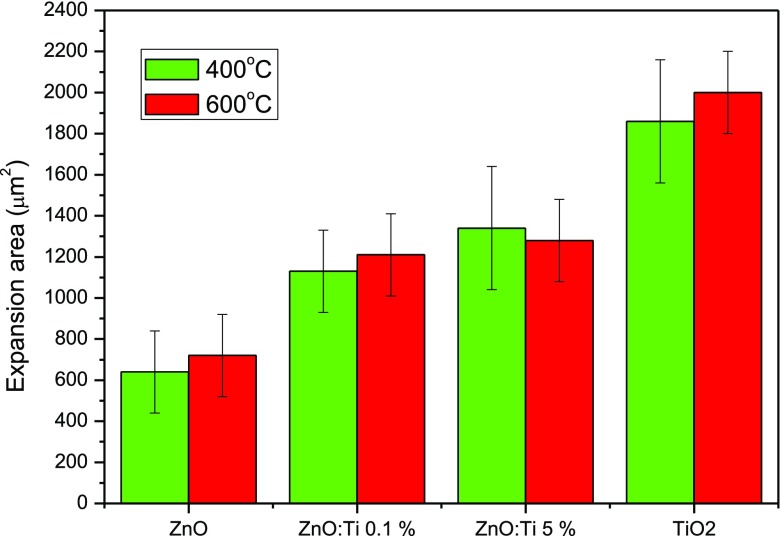
Ti-doped ZnO thin films were obtained with the aim of tailoring ZnO film bioadhesiveness and making the optoelectronic properties of ZnO materials transferable to biological environments. The films were prepared on silicon substrates by sol-gel spin-coating and subsequent annealing. A Ti-O segregation limits the ZnO crystallite growth and creates a buffer out-layer. Consequently, the Ti-doped ZnO presents slightly increased resistivity, which remains in the order of 10 Ω·cm. The strong biochemical interference of Zn ions released from pure ZnO surfaces was evidenced by culturing with and without the Zn coupling agent clioquinol. The Ti-doped ZnO surfaces showed a considerable increase of bacterial viability with respect to pure ZnO. Cell adhesion was assayed with human mesenchymal stem cells (hMSCs). Although hMSCs find difficulties to adhere to the pure ZnO surface, they progressively expand on the surface of ZnO when the Ti doping is increased. A preliminary microdevice has been built on the Si substrate with a ZnO film doped with 5% Ti. A one-dimensional micropattern with a zigzag structure shows the preference of hMSCs for adhesion on Ti-doped ZnO with respect to Si. The induced contrast of surface tension further induces a cell polarization effect on hMSCs. It is suggested that the presence of Ti-O covalent bonding on the doped surfaces provides a much more stable ground for bioadhesion. Such fouling behavior suggests an influence of Ti doping on film bioadhesiveness and sets the starting point for the selection of optimal materials for implantable optoelectronic devices.
制备掺钛氧化锌薄膜的目的是调整氧化锌薄膜的生物粘附性,并使氧化锌材料的光电特性能够转移到生物环境中。通过溶胶 - 凝胶旋涂法并随后进行退火处理,在硅衬底上制备了这些薄膜。钛 - 氧偏析限制了氧化锌微晶的生长,并形成了一个缓冲外层。因此,掺钛氧化锌的电阻率略有增加,仍保持在10Ω·cm左右。通过在有无锌离子络合剂克矽平的情况下进行培养,证明了从纯氧化锌表面释放的锌离子具有很强的生化干扰作用。相对于纯氧化锌,掺钛氧化锌表面的细菌活力显著提高。用人骨髓间充质干细胞(hMSCs)检测细胞粘附情况。尽管hMSCs难以粘附在纯氧化锌表面,但随着钛掺杂量的增加,它们在氧化锌表面逐渐增殖。在硅衬底上构建了一个初步的微型器件,其上有掺5%钛的氧化锌薄膜。具有锯齿形结构的一维微图案显示,相对于硅,hMSCs更倾向于粘附在掺钛氧化锌上。表面张力的诱导对比度进一步在hMSCs上诱导细胞极化效应。有人认为,掺杂表面上钛 - 氧共价键的存在为生物粘附提供了一个更稳定的基础。这种污垢行为表明钛掺杂对薄膜生物粘附性有影响,并为可植入光电器件的最佳材料选择奠定了基础。