Naismith Erin, Pangrazzi Luca, Grasse Marco, Keller Michael, Miggitsch Carina, Weinberger Birgit, Trieb Klemens, Grubeck-Loebenstein Beatrix
1Institute for Biomedical Aging Research, University of Innsbruck, Rennweg 10, A-6020 Innsbruck, Austria.
Department of Orthopedic Surgery, Hospital Wels-Grieskirchen, Grieskirchnerstrasse 42, Wels, Austria.
Immun Ageing. 2019 Aug 22;16:21. doi: 10.1186/s12979-019-0161-z. eCollection 2019.
Antigen-experienced immune cells migrate back to the bone marrow (BM), where they are maintained in BM survival niches for an extended period. The composition of T cell subpopulations in the BM changes with age, leading to an accumulation of highly differentiated T cells and a loss of naïve T cells. While innate immune cells are also affected by age, little is known about interactions between different adaptive immune cell populations maintained in the BM. In this study, the phenotype and function of innate and adaptive immune cells isolated from human BM and peripheral blood (PB) was analysed in detail using flow cytometry, to determine if the accumulation of highly differentiated T and B cells, supported by the BM niches, limits the maintenance of other immune cells, or affects their functions such as providing protective antibody concentrations.
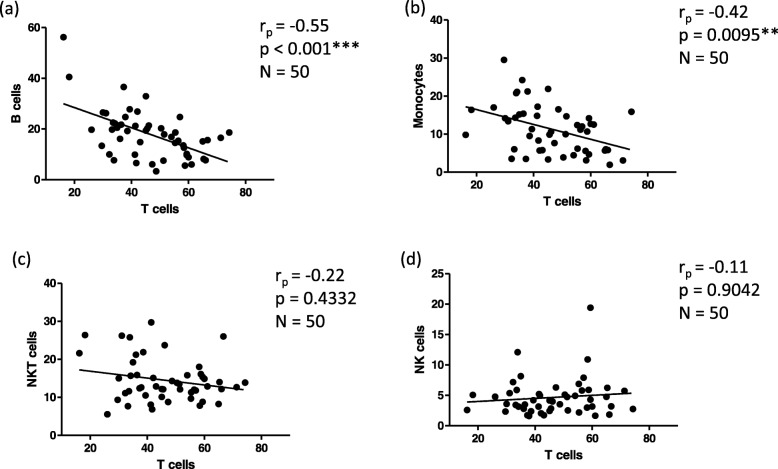
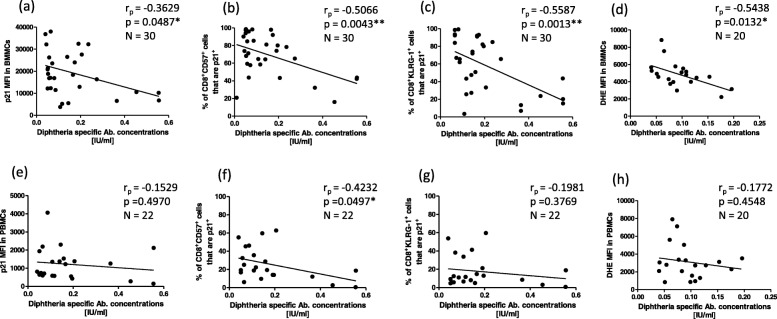
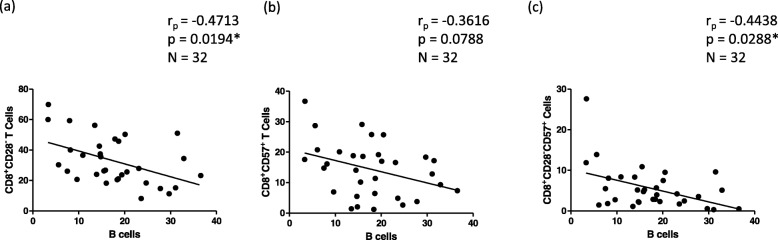
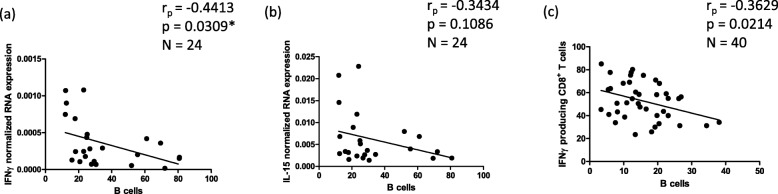
Total T cells increase in the BM with age, as do highly differentiated CD8 T cells which no longer express the co-stimulatory molecule CD28, while natural killer T (NKT) cells, monocytes, B cells, and naïve CD8 T cells all decrease in the BM with age. A negative correlation of total T cells with B cells was observed in the BM. The percentage of B cells in the BM negatively correlated with highly differentiated CD8CD28 T cells, replicative-senescent CD8CD57 T cells, as well as the CD8CD28CD57 population. Similar correlations were seen between B cells and the frequency of highly differentiated T cells producing pro-inflammatory molecules in the BM. Interestingly, plasma concentrations of diphtheria-specific antibodies negatively correlated with highly differentiated CD8CD57 T cells as well as with exhausted central memory CD8 and CD4 T cells in the BM. A negative impact on diphtheria-specific antibodies was also observed for CD8 T cells expressing senescence associated genes such as the cell cycle regulator p21 (CDKN1A), KLRG-1, and elevated levels of reactive oxygen species (ROS).
Our data suggest that the accumulation and maintenance of highly differentiated, senescent, and exhausted T cells in the BM, particularly in old age, may interfere with the survival of other cell populations resident in the BM such as monocytes and B cells, leading to reduced peripheral diphtheria antibody concentrations as a result. These findings further highlight the importance of the BM in the long-term maintenance of immunological memory.
经历过抗原刺激的免疫细胞会迁移回骨髓(BM),并在骨髓生存微环境中长时间维持。骨髓中T细胞亚群的组成会随年龄变化,导致高度分化的T细胞积累,幼稚T细胞减少。虽然固有免疫细胞也会受到年龄影响,但对于骨髓中维持的不同适应性免疫细胞群体之间的相互作用却知之甚少。在本研究中,使用流式细胞术详细分析了从人骨髓和外周血(PB)中分离出的固有免疫细胞和适应性免疫细胞的表型和功能,以确定骨髓微环境支持下高度分化的T细胞和B细胞的积累是否会限制其他免疫细胞的维持,或影响它们的功能,如提供保护性抗体浓度。
随着年龄增长,骨髓中总T细胞增加,不再表达共刺激分子CD28的高度分化的CD8 T细胞也增加,而自然杀伤T(NKT)细胞、单核细胞、B细胞和幼稚CD8 T细胞在骨髓中均随年龄减少。在骨髓中观察到总T细胞与B细胞呈负相关。骨髓中B细胞的百分比与高度分化的CD8CD28 T细胞、复制性衰老的CD8CD57 T细胞以及CD8CD28CD57群体呈负相关。在B细胞与骨髓中产生促炎分子的高度分化T细胞频率之间也观察到类似的相关性。有趣的是,白喉特异性抗体的血浆浓度与高度分化的CD8CD57 T细胞以及骨髓中耗竭的中央记忆CD8和CD4 T细胞呈负相关。对于表达衰老相关基因如细胞周期调节因子p21(CDKN1A)、KLRG-1和活性氧(ROS)水平升高的CD8 T细胞,也观察到对白喉特异性抗体有负面影响。
我们的数据表明,骨髓中高度分化、衰老和耗竭的T细胞的积累和维持,尤其是在老年时,可能会干扰骨髓中其他细胞群体如单核细胞和B细胞的存活,导致外周白喉抗体浓度降低。这些发现进一步凸显了骨髓在免疫记忆长期维持中的重要性。