Dunn Emily E, Gainforth Heather L, Robertson-Wilson Jennifer E
Department of Kinesiology & Physical Education, Wilfrid Laurier University, Canada.
School of Health & Exercise Sciences, University of British Columbia (Okanagan), Canada.
Digit Health. 2018 Jul 9;4:2055207618785798. doi: 10.1177/2055207618785798. eCollection 2018 Jan-Dec.
Mobile applications (apps) are increasingly being utilized in health behavior change interventions. To determine the presence of underlying behavior change mechanisms, apps for physical activity have been coded for behavior change techniques (BCTs). However, apps for sedentary behavior have yet to be assessed for BCTs. Thus, the purpose of the present study was to review apps designed to decrease sedentary time and determine the presence of BCTs.
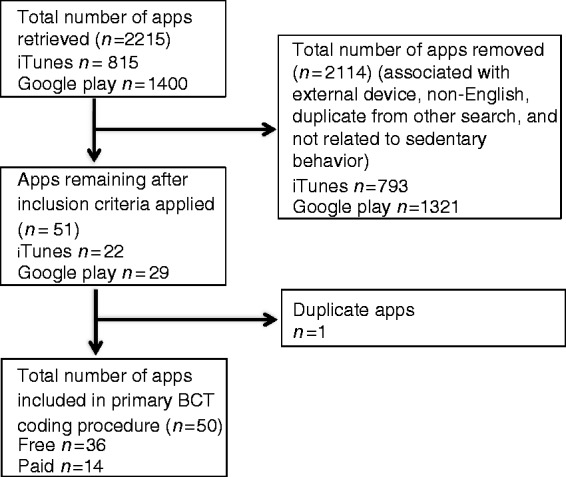
Systematic searches of the iTunes App and Google Play stores were completed using keyword searches. Two reviewers independently coded free ( = 36) and paid ( = 14) app descriptions using a taxonomy of 93 BCTs (December 2016-January 2017). A subsample ( = 4) of free apps were trialed for one week by the reviewers and coded for the presence of BCTs (February 2017).
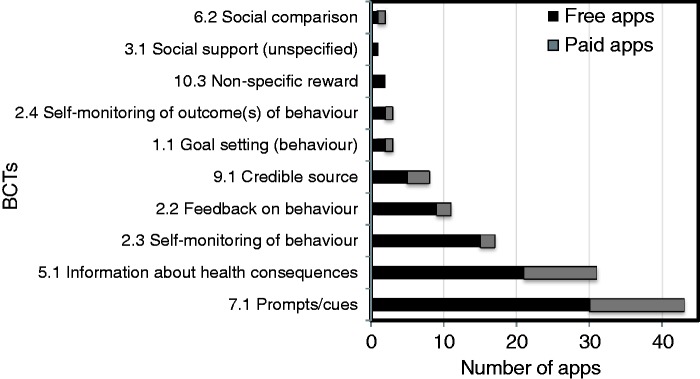
In the free and paid app descriptions, only 10 of 93 BCTs were present with a mean of 2.42 BCTs (range 0-6) per app. The BCTs coded most frequently were "prompts/cues" ( = 43), "information about health consequences" ( = 31), and "self-monitoring of behavior" ( = 17). For the four free apps that were trialed, three additional BCTs were coded that were not coded in the descriptions: "graded tasks," "focus on past successes," and "behavior substitution."
These sedentary behavior apps have fewer BCTs compared with physical activity apps and traditional (i.e., non-app) physical activity and healthy eating interventions. The present study sheds light on the behavior change potential of sedentary behavior apps and provides practical insight about coding for BCTs in apps.
移动应用程序(应用)越来越多地被用于健康行为改变干预。为了确定潜在的行为改变机制,针对身体活动的应用已根据行为改变技术(BCT)进行编码。然而,针对久坐行为的应用尚未进行BCT评估。因此,本研究的目的是回顾旨在减少久坐时间的应用,并确定BCT的存在情况。
使用关键词搜索对iTunes应用商店和谷歌Play商店进行系统检索。两名评审员使用93种BCT的分类法(2016年12月至2017年1月)对免费(=36)和付费(=14)应用描述进行独立编码。评审员对4个免费应用的子样本进行了为期一周的试用,并对BCT的存在情况进行编码(2017年2月)。
在免费和付费应用描述中,93种BCT中仅出现了其中10种,每个应用平均有2.42种BCT(范围为0 - 6)。编码最频繁的BCT是“提示/线索”(=43)、“健康后果信息”(=31)和“行为自我监测”(=17)。对于试用的4个免费应用,又编码了3种在描述中未编码的BCT:“分级任务”、“关注过去的成功”和“行为替代”。
与身体活动应用以及传统(即非应用)的身体活动和健康饮食干预相比,这些久坐行为应用的BCT较少。本研究揭示了久坐行为应用的行为改变潜力,并提供了关于应用中BCT编码的实际见解。