Department of Physical Therapy, School of Integrative Health Sciences, University of Nevada, Las Vegas, Las Vegas, NV, United States.
Department of Physical Therapy and Athletic Training, College of Health & Rehabilitation Sciences: Sargent College, Boston University, Boston, MA, United States.
JMIR Mhealth Uhealth. 2020 Oct 5;8(10):e18985. doi: 10.2196/18985.
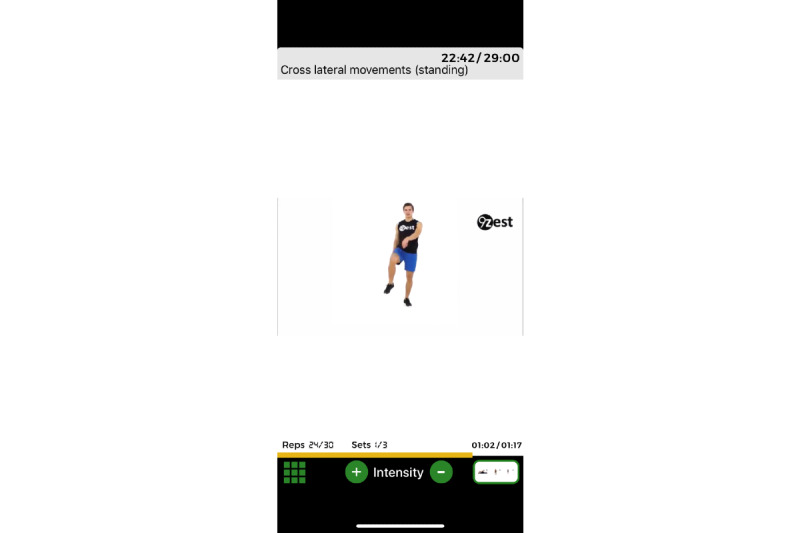
Many people with Parkinson disease do not have access to exercise programs that are specifically tailored to their needs and capabilities. This mobile app allows people with Parkinson disease to access Parkinson disease-specific exercises that are individually tailored using in-app demographic questions and performance tests which are fed into an algorithm which in turn produces a video-guided exercise program.
To test the feasibility, safety, and signal of efficacy of a mobile app that facilitates exercise for people with Parkinson disease.
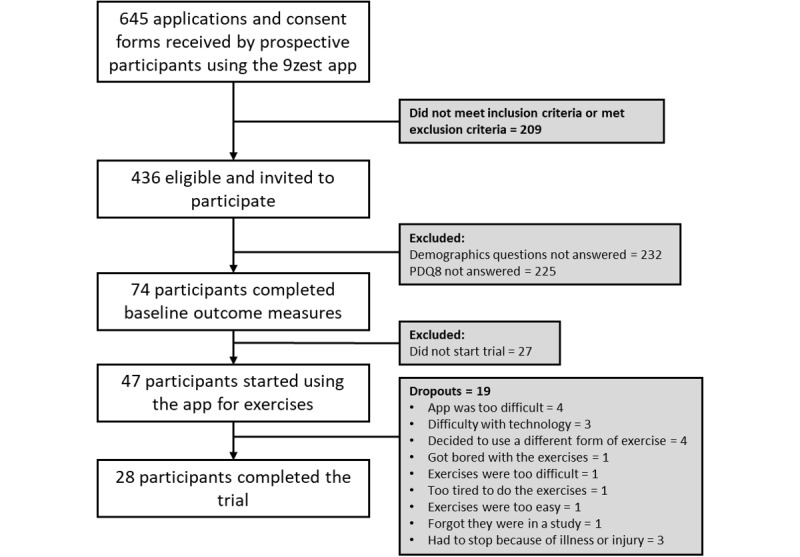
A prospective, single-cohort design of people with Parkinson disease who had downloaded the 9zest app for exercise was used for this 12-week pilot study. Participants, who were recruited online, were encouraged to exercise with the full automated app for ≥150 minutes each week. The primary endpoints were feasibility (app usage and usability questions) and safety (adverse events and falls). The primary endpoints for signal of efficacy were a comparison of the in-app baseline and 8-week outcomes on the 30-second Sit-To-Stand (STS) test, Timed Up and Go (TUG) test, and the Parkinson's Disease Questionnaire 8 (PDQ8).
For feasibility, of the 28 participants that completed the study, 12 participants averaged >150 minutes of app usage per week (3 averaged 120-150, 4 averaged 90-120, and 9 averaged less than 90 minutes). A majority of participants (>74%) felt the exercise was of value (16/19; 9 nonrespondents), provided adequate instruction (14/19; 9 nonrespondents), and was appropriate for level of function (16/19; 9 nonrespondents). For safety, there were no serious adverse events that occurred during the app-guided exercise. There were 4 reports of strain/sprain injuries while using the app among 3 participants, none of which necessitated medical attention. For signal of efficacy, there was improvement for each of the primary endpoints: STS (P=.01), TUG (P<.001), and PDQ8 (P=.01).
Independent, video-guided exercise using a mobile app designed for exercise in Parkinson disease was safe and feasible though there was variability in app usage. Despite this, the results provide evidence for a signal of efficacy as there were improvements in 3 of the 3 outcomes.
ClinicalTrials.gov NCT03459586; https://clinicaltrials.gov/ct2/show/NCT03459586.
许多帕金森病患者无法获得针对其需求和能力量身定制的运动方案。这款移动应用程序允许帕金森病患者使用个性化的帕金森病运动,这些运动是通过应用内的人口统计学问题和表现测试来定制的,这些问题和测试被输入到一个算法中,该算法反过来生成一个视频指导的锻炼计划。
测试一款方便帕金森病患者锻炼的移动应用程序的可行性、安全性和疗效信号。
这项为期 12 周的试点研究采用了前瞻性、单队列设计,纳入了下载 9zest 应用程序进行锻炼的帕金森病患者。通过在线招募参与者,鼓励他们每周使用完整的自动化应用程序进行≥150 分钟的锻炼。主要终点是可行性(应用程序使用和可用性问题)和安全性(不良事件和跌倒)。疗效信号的主要终点是比较应用程序内的基线和 8 周的 30 秒坐立站起(STS)测试、计时起立行走(TUG)测试和帕金森病问卷 8(PDQ8)的结果。
在完成研究的 28 名参与者中,有 12 名参与者平均每周使用应用程序>150 分钟(3 名平均使用 120-150 分钟,4 名平均使用 90-120 分钟,9 名平均使用少于 90 分钟)。大多数参与者(>74%)认为运动有价值(16/19;9 名未回复者),提供了足够的指导(14/19;9 名未回复者),并且适合他们的功能水平(16/19;9 名未回复者)。在安全性方面,在应用程序指导的锻炼过程中没有发生严重的不良事件。有 3 名参与者报告了 4 次在使用应用程序时拉伤/扭伤的情况,但均无需就医。在疗效信号方面,每个主要终点都有改善:STS(P=.01)、TUG(P<.001)和 PDQ8(P=.01)。
针对帕金森病患者设计的独立、视频指导的运动使用移动应用程序是安全且可行的,尽管应用程序的使用存在差异。尽管如此,结果提供了疗效信号的证据,因为在 3 项结果中有 3 项得到了改善。
ClinicalTrials.gov NCT03459586;https://clinicaltrials.gov/ct2/show/NCT03459586。