Goldberg Elizabeth M, Resnik Linda, Marks Sarah J, Merchant Roland C
1Department of Emergency Medicine, Brown University, 55 Claverick Street, Providence, RI 02903 USA.
2Department of Health Services, Practice and Policy, Brown University, 121 S. Main Street, Providence, RI 02912 USA.
Pilot Feasibility Stud. 2019 Aug 27;5:106. doi: 10.1186/s40814-019-0491-9. eCollection 2019.
Falls are the leading cause of fatal and non-fatal injuries among older adults. Older emergency department (ED) patients who present for evaluations after falls have a 30% higher risk of falling again in the subsequent 6 months than age-matched controls. Although EDs frequently evaluate older adults after their falls, the typical evaluation consists of an injury assessment alone. As such, an opportunity is lost to assess and address the potential causes of falls in this vulnerable population. In this manuscript, we present a multidisciplinary fall prevention protocol for a pilot study of older adult ED patients who recently sustained a fall (GAPcare: the Geriatric Acute and Post-acute Fall Prevention Intervention).
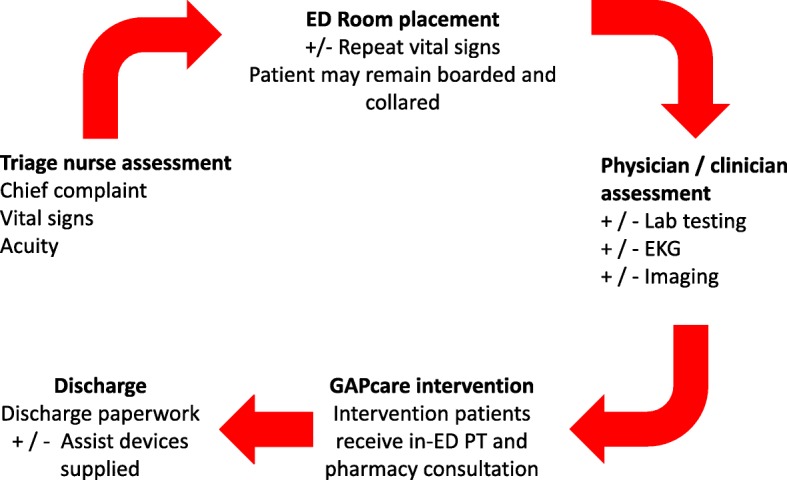
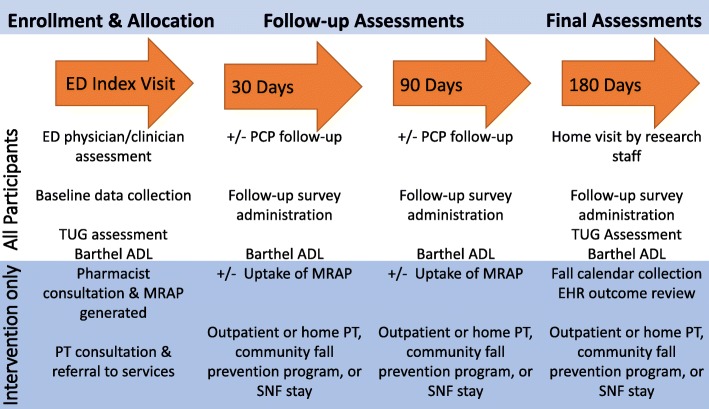
GAPcare is a randomized single-blinded pilot study. Participants in GAPcare are 120 older adults (≥ 65 years old) who present to 1 of 2 academic US EDs after a fall. We randomly assign participants 1:1 to an intervention or a usual care (control) arm. In the intervention arm, the patient's ED physician, a pharmacist, and a physical therapist (PT) collaborate to identify and address any risk factors that may have contributed to the fall. Intervention arm participants and their caregivers return home with a medication-related action plan to taper or stop potentially inappropriate medications and to address polypharmacy and a PT assessment and plan. Participants in the usual care arm receive standard assessments and care in the ED and a home safety brochure. Participants in both study arms complete fall calendars for 6 months to document the number of falls and healthcare visits during follow-up. The primary outcome is feasibility of the GAPcare fall prevention intervention (number and proportion of screened participants who are eligible, recruited, and retained; impact on ED length of stay), while the secondary outcome is to estimate its initial efficacy.
The GAPcare-ED fall prevention intervention has the potential to promote older adult-sensitive care for millions of Americans presenting to EDs after falls and establish a protocol for a future large-scale randomized controlled trial on this topic.
ClinicalTrials.gov, NCT03360305. Trial registration date: December 4, 2017. Protocol version: 1.
跌倒是老年人致命和非致命伤害的主要原因。在跌倒后到急诊科(ED)就诊的老年患者,在随后6个月内再次跌倒的风险比年龄匹配的对照组高30%。尽管急诊科经常在老年人跌倒后对其进行评估,但典型的评估仅包括损伤评估。因此,失去了评估和解决这一脆弱人群跌倒潜在原因的机会。在本手稿中,我们提出了一项多学科跌倒预防方案,用于对近期跌倒的老年急诊科患者进行的一项试点研究(GAPcare:老年急性和急性后跌倒预防干预)。
GAPcare是一项随机单盲试点研究。GAPcare的参与者为120名老年人(≥65岁),他们在美国的2个学术急诊科之一跌倒后前来就诊。我们将参与者按1:1随机分配到干预组或常规护理(对照)组。在干预组中,患者的急诊科医生、药剂师和物理治疗师(PT)合作识别并解决任何可能导致跌倒的风险因素。干预组的参与者及其护理人员带着一份与药物相关的行动计划回家,以逐渐减少或停用潜在不适当的药物,并解决多重用药问题以及接受物理治疗评估和计划。常规护理组的参与者在急诊科接受标准评估和护理,并收到一份家庭安全手册。两个研究组的参与者都要填写6个月的跌倒日历,以记录随访期间的跌倒次数和医疗就诊情况。主要结局是GAPcare跌倒预防干预的可行性(符合条件、招募并保留的筛查参与者的数量和比例;对急诊科住院时间的影响),而次要结局是估计其初始疗效。
GAPcare-ED跌倒预防干预有可能为数百万跌倒后到急诊科就诊的美国人推广对老年人敏感的护理,并为未来关于这一主题的大规模随机对照试验建立一个方案。
ClinicalTrials.gov,NCT03360305。试验注册日期:2017年12月4日。方案版本:1。