Liem Andrian
School of Psychology, The University of Queensland, Australia.
Global and Community Mental Health Research Group, Department of Psychology, Faculty of Social Sciences, University of Macau, Macao, China.
Integr Med Res. 2019 Sep;8(3):195-199. doi: 10.1016/j.imr.2019.07.004. Epub 2019 Jul 29.
The growth of complementary and alternative medicine (CAM) has been increasing, including amongst psychological clients. Therefore, it is important to investigate psychologists' attitudes towards CAM. Negative attitudes towards CAM among psychologists could be a barrier to CAM integration into psychological services and may prevent clients to trust psychologists. This study aims to compare Indonesian and Australian psychologists' attitudes towards CAM using the previously published study on Psychologists' Attitudes Towards Complementary and Alternative Therapies (PATCAT) scale validation.
The PATCAT scale was adapted from an Australian study to an Indonesian version using backward-and-forward translation. This scale was used to investigate attitudes towards: (1) CAM knowledge; (2) CAM integration; and (3) the risks associated with CAM. An online survey was sent to all Indonesian psychologists and completed by 247 participants. Afterward, the data were compared with the published data from 115 Australian psychologists.
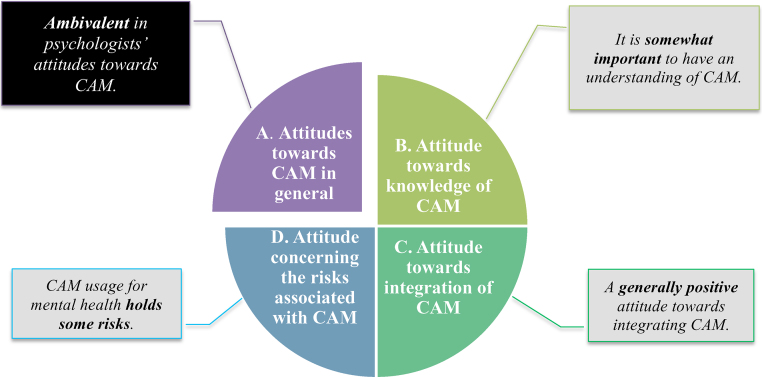
In general, psychologists in Indonesia and Australia showed relatively similar ambivalent attitudes towards CAM. This uncertainty may stem from the same Western psychology education, which is a basis for the medical models in both nations. They also considered it somewhat important to have an understanding of CAM. Participants in both nations displayed positive attitude towards CAM integration into psychological services. However, they felt that CAM usage for mental health holds some risks.
Australian and Indonesian psychologists reported ambivalent attitudes towards CAM that might be reduced with clear regulation of CAM integration into psychological services from the government and professional organizations.
补充和替代医学(CAM)的发展一直在增加,包括在心理治疗客户中。因此,调查心理学家对补充和替代医学的态度很重要。心理学家对补充和替代医学的负面态度可能是将其整合到心理服务中的障碍,并可能阻止客户信任心理学家。本研究旨在使用先前发表的关于心理学家对补充和替代疗法态度(PATCAT)量表验证的研究,比较印度尼西亚和澳大利亚心理学家对补充和替代医学的态度。
PATCAT量表通过前后翻译从澳大利亚的一项研究改编为印度尼西亚版本。该量表用于调查对以下方面的态度:(1)补充和替代医学知识;(2)补充和替代医学整合;(3)与补充和替代医学相关的风险。向印度尼西亚所有心理学家发送了在线调查问卷,247名参与者完成了调查。之后,将数据与115名澳大利亚心理学家发表的数据进行比较。
总体而言,印度尼西亚和澳大利亚的心理学家对补充和替代医学表现出相对相似的矛盾态度。这种不确定性可能源于相同的西方心理学教育,这是两国医学模式的基础。他们还认为了解补充和替代医学有点重要。两国的参与者对将补充和替代医学整合到心理服务中持积极态度。然而,他们认为将补充和替代医学用于心理健康存在一些风险。
澳大利亚和印度尼西亚的心理学家报告了对补充和替代医学的矛盾态度,政府和专业组织对将补充和替代医学整合到心理服务中的明确规定可能会减少这种态度。