School of Life Sciences, University of Warwick, Coventry, CV4 7AL, UK.
Department of Chemistry, University of Warwick, Coventry, CV4 7AL, UK.
Microb Ecol. 2020 Apr;79(3):517-526. doi: 10.1007/s00248-019-01424-5. Epub 2019 Aug 29.
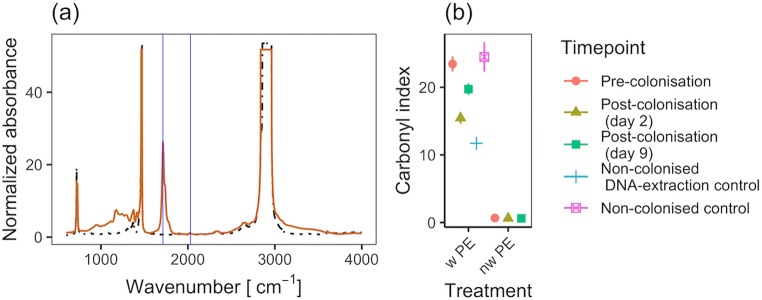
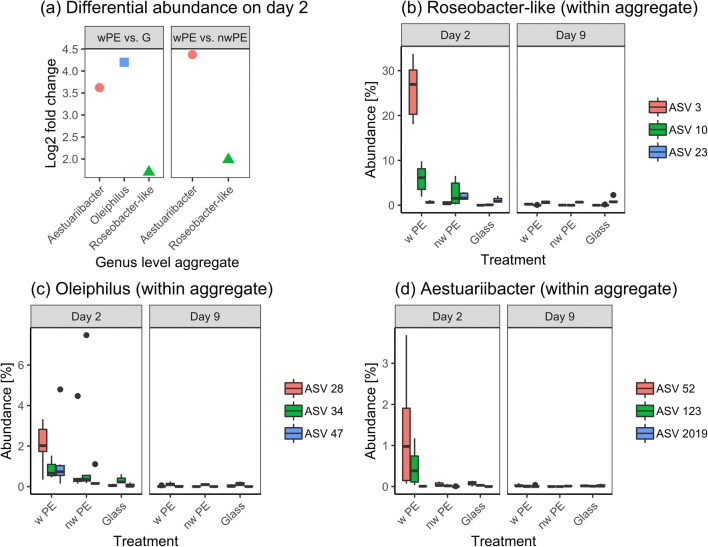
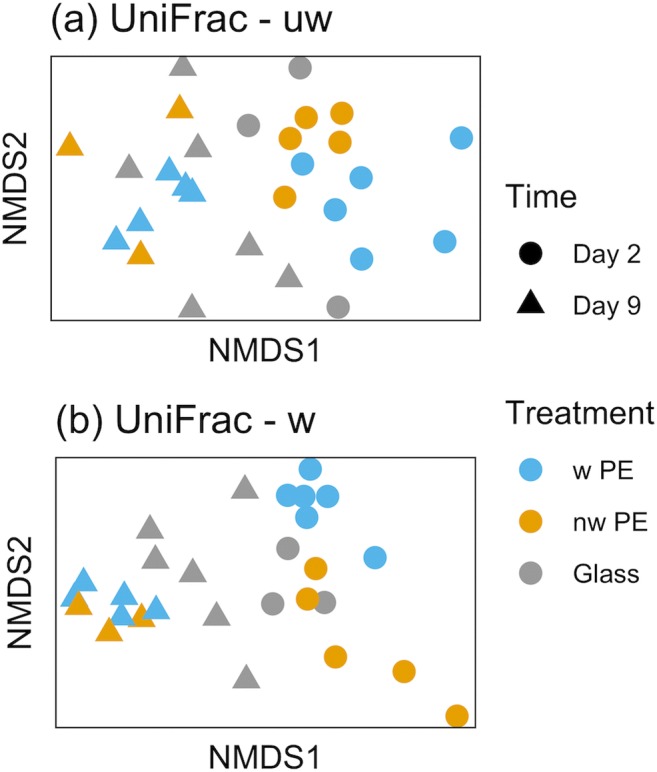
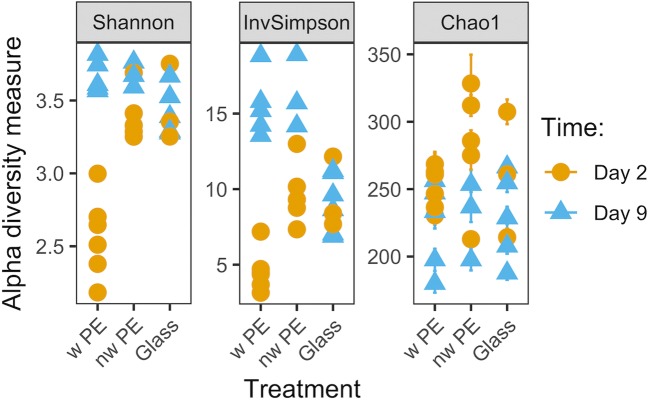
Plastic debris in aquatic environments is rapidly colonized by a diverse community of microorganisms, often referred to as the "Plastisphere." Given that common plastics are derived from fossil fuels, one would expect that Plastispheres should be enriched with obligate hydrocarbon-degrading bacteria (OHCB). So far, though, different polymer types do not seem to exert a strong effect on determining the composition of the Plastisphere, and putative biodegrading bacteria are only found as rare taxa within these biofilms. Here, we show through 16S rRNA gene sequencing that the enrichment of a prominent OHCB member on weathered and non-weathered polyethylene only occurred at early stages of colonization (i.e., after 2 days of incubation in coastal marine water; 5.8% and 3.7% of relative abundance, respectively, vs. 0.6% on glass controls). As biofilms matured, these bacteria decreased in relative abundance on all materials (< 0.3% after 9 days). Apart from OHCB, weathered polyethylene strongly enriched for other distinct organisms during early stages of colonization, such as a specific member of the Roseobacter group and a member of the genus Aestuariibacter (median 26.9% and 1.8% of the community, respectively), possibly as a consequence of the availability of short-oxidized chains generated from weathering. Our results demonstrate that Plastispheres can vary in accordance with the weathering state of the material and that very early colonizing communities are enriched with taxa that can potentially degrade hydrocarbons. Given the lack of persistent enrichment and overall community convergence between materials over time, common non-hydrolysable polymers might not serve as an important source of carbon for mature Plastispheres once the labile substrates generated from weathering have been depleted.
在水生环境中,塑料碎片会迅速被微生物群落所定植,这些微生物通常被称为“塑料体”。鉴于常见的塑料是由化石燃料衍生而来,人们会期望塑料体中应该富含专性烃类降解细菌(OHCB)。然而,到目前为止,不同的聚合物类型似乎并没有对确定塑料体的组成产生强烈影响,并且在这些生物膜中,推测的可生物降解细菌仅作为稀有分类群存在。在这里,我们通过 16S rRNA 基因测序表明,风化和未风化的聚乙烯上优势 OHCB 成员的富集仅发生在定植的早期阶段(即在沿海海水培养 2 天后;相对丰度分别为 5.8%和 3.7%,而玻璃对照为 0.6%)。随着生物膜的成熟,这些细菌在所有材料上的相对丰度都减少(9 天后均<0.3%)。除了 OHCB 之外,风化的聚乙烯在定植的早期阶段还强烈富集了其他不同的生物,例如玫瑰杆菌群的特定成员和 Aestuariibacter 属的一个成员(分别为群落的中位数 26.9%和 1.8%),这可能是由于风化产生的短氧化链的可用性。我们的研究结果表明,塑料体可以根据材料的风化状态而变化,并且非常早期定植的群落中富含具有潜在降解烃类能力的分类群。考虑到随着时间的推移,不同材料之间缺乏持久的富集和整体群落趋同,一旦风化产生的易降解底物耗尽,常见的不可水解聚合物可能不会成为成熟塑料体的重要碳源。