Department of Family & Community Medicine, University of California-San Francisco, San Francisco, CA, 94143, USA.
Department of Family Medicine, University of Colorado School of Medicine, Aurora, CO, USA.
BMC Fam Pract. 2019 Aug 29;20(1):120. doi: 10.1186/s12875-019-1012-x.
To enable delivery of high quality patient-centered care, as well as to allow primary care health systems to allocate appropriate resources that align with patients' identified self-management problems (SM-Problems) and priorities (SM-Priorities), a practical, systematic method for assessing self-management needs and priorities is needed. In the current report, we present patient reported data generated from Connection to Health (CTH), to identify the frequency of patients' reported SM-Problems and SM-Priorities; and examine the degree of alignment between patient SM-Priorities and the ultimate Patient-Healthcare team member selected Behavioral Goal.
CTH, an electronic self-management support system, was embedded into the flow of existing primary care visits in 25 primary care clinics and was used to assess patient-reported SM-Problems across 12 areas, patient identified SM-Priorities, and guide the selection of a Patient-Healthcare team member selected Behavioral Goal. SM-Problems included: BMI, diet (fruits and vegetables, salt, fat, sugar sweetened beverages), physical activity, missed medications, tobacco and alcohol use, health-related distress, general life stress, and depression symptoms. Descriptive analyses documented SM-Problems and SM-Priorities, and alignment between SM-Priorities and Goal Selection, followed by mixed models adjusting for clinic.
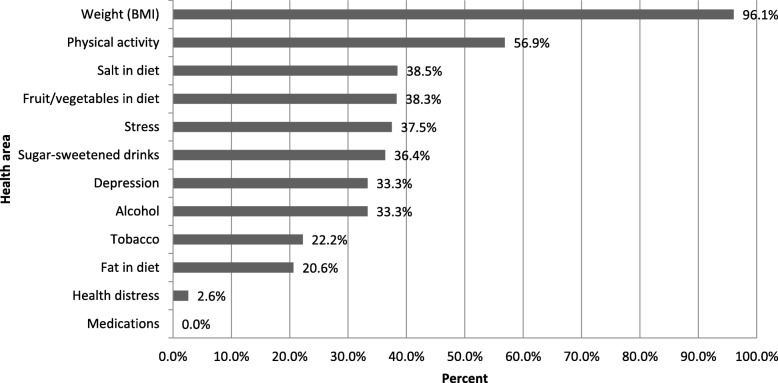
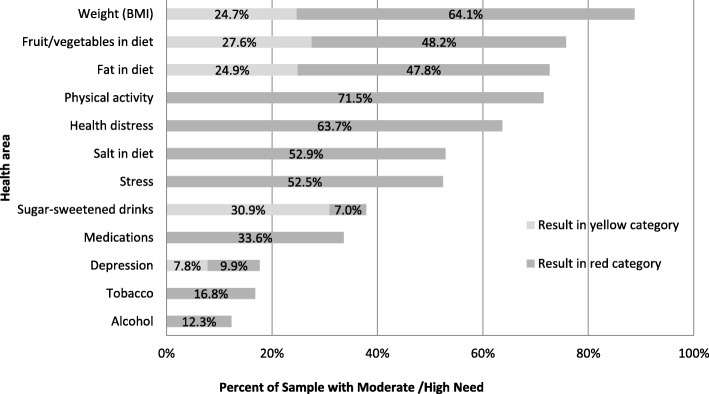
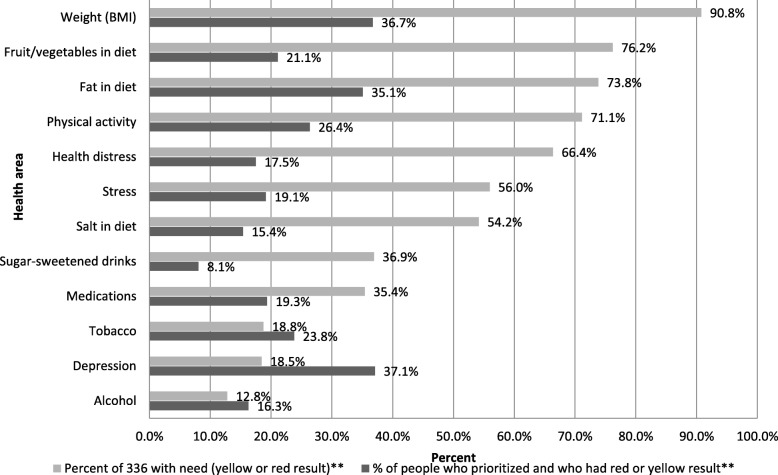
446 participants with ≥ one chronic diseases (mean age 55.4 ± 12.6; 58.5% female) participated. On average, participants reported experiencing challenges in 7 out of the 12 SM-Problems areas; with the most frequent problems including: BMI, aspects of diet, and physical activity. Patient SM-Priorities were variable across the self-management areas. Patient- Healthcare team member Goal selection aligned well with patient SM-Priorities when patients prioritized weight loss or physical activity, but not in other self-management areas.
Participants reported experiencing multiple SM-Problems. While patients show great variability in their SM-Priorities, the resulting action plan goals that patients create with their healthcare team member show a lack of diversity, with a disproportionate focus on weight loss and physical activity with missed opportunities for using goal setting to create targeted patient-centered plans focused in other SM-Priority areas. Aggregated results can assist with the identification of high frequency patient SM-Problems and SM-Priority areas, and in turn inform resource allocation to meet patient needs.
ClinicalTrials.gov ID: NCT01945918 .
为了提供高质量的以患者为中心的护理,以及使初级保健医疗系统能够分配与患者确定的自我管理问题(SM-问题)和优先级(SM-优先级)相一致的适当资源,需要一种实用的、系统的方法来评估自我管理需求和优先级。在本报告中,我们展示了来自 Connection to Health(CTH)的患者报告数据,以确定患者报告的 SM-问题和 SM-优先级的频率;并检查患者的 SM-优先级与最终患者-医疗保健团队成员选择的行为目标之间的一致性程度。
CTH 是一种电子自我管理支持系统,嵌入到 25 个初级保健诊所的现有初级保健就诊流程中,用于评估患者报告的 12 个领域的自我管理问题、患者确定的自我管理优先级,并指导选择患者-医疗保健团队成员选择的行为目标。SM-问题包括:BMI、饮食(水果和蔬菜、盐、脂肪、糖甜饮料)、身体活动、漏服药物、烟草和酒精使用、与健康相关的痛苦、一般生活压力和抑郁症状。描述性分析记录了 SM-问题和 SM-优先级,以及 SM-优先级与目标选择之间的一致性,然后调整诊所进行混合模型。
446 名患有≥1 种慢性病的参与者(平均年龄 55.4±12.6;58.5%为女性)参与了研究。平均而言,参与者报告在 12 个 SM-问题领域中的 7 个领域存在挑战;最常见的问题包括:BMI、饮食方面和身体活动。患者的 SM-优先级在自我管理领域之间存在差异。当患者将体重减轻或身体活动作为优先级时,患者-医疗保健团队成员的目标选择与患者的 SM-优先级很好地一致,但在其他自我管理领域则不一致。
参与者报告存在多种 SM-问题。虽然患者在自我管理优先级方面表现出很大的差异,但患者与他们的医疗保健团队成员一起创建的行动计划目标显示出缺乏多样性,过分关注体重减轻和身体活动,而错失了使用目标设定来制定针对其他 SM-优先级领域的以患者为中心的计划的机会。汇总结果可帮助识别高频率的患者 SM-问题和 SM-优先级领域,并相应地为满足患者需求分配资源。
ClinicalTrials.gov ID:NCT01945918。