Gabrieli F, Dooley K A, Facini M, Delaney J K
Scientific Research Department, National Gallery of Art, Washington, DC 20565, USA.
Paper Conservation Department, National Gallery of Art, Washington, DC 20565, USA.
Sci Adv. 2019 Aug 23;5(8):eaaw7794. doi: 10.1126/sciadv.aaw7794. eCollection 2019 Aug.
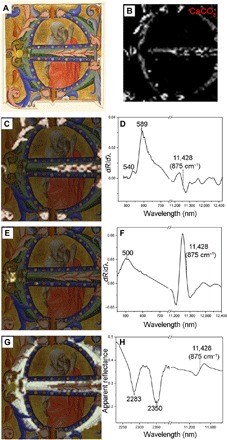
Broad spectral range reflectance imaging spectroscopy (BR-RIS) from the near UV through the mid-infrared (IR) (350 to 25,000 nm or 28,571 to 400 cm) was investigated as an imaging modality to provide maps of organic and inorganic artists' materials in paintings. While visible-to-near-IR (NIR) reflectance and elemental x-ray fluorescence (XRF) imaging spectroscopies have been used for in situ mapping, each method alone is insufficient for robust identification. Combining the two improves results but requires complex data processing. To test BR-RIS, image cubes from early Italian Renaissance illuminated manuscripts were acquired using two spectrometers. Maps of pigments, including trace minerals associated with mined azurite, and their associated binding media were made. BR-RIS has a more straightforward analysis approach as implemented here than visible-to-NIR, mid-IR, or XRF imaging spectroscopy alone and offers the largest amount of macroscale information for mapping artists' materials by comparison.
研究了从近紫外到中红外(IR)(350至25,000纳米或28,571至400厘米)的宽光谱范围反射成像光谱(BR-RIS),作为一种成像方式,用于提供绘画中有机和无机艺术家材料的图谱。虽然可见到近红外(NIR)反射率和元素X射线荧光(XRF)成像光谱已用于原位测绘,但每种方法单独使用都不足以进行可靠的识别。将两者结合可改善结果,但需要复杂的数据处理。为了测试BR-RIS,使用两台光谱仪采集了意大利文艺复兴早期 illuminated 手稿的图像立方体。绘制了颜料图谱,包括与开采的蓝铜矿相关的微量矿物质及其相关的粘结介质。与单独的可见到近红外、中红外或XRF成像光谱相比,此处实施的BR-RIS具有更直接的分析方法,并且为绘制艺术家材料提供了最多的宏观信息。