
人工智能在短波红外范围内进行色素分类任务。
Artificial Intelligence for Pigment Classification Task in the Short-Wave Infrared Range.
机构信息
Laboratoire d'Archéologie Moléculaire et Structurale (LAMS), CNRS, Sorbonne Université, 75005 Paris, France.
Laboratoire de Chimie Physique-Matière et Rayonnement (LCPMR), UMR 7614, CNRS, Sorbonne Université, 75005 Paris, France.
出版信息
Sensors (Basel). 2021 Sep 13;21(18):6150. doi: 10.3390/s21186150.
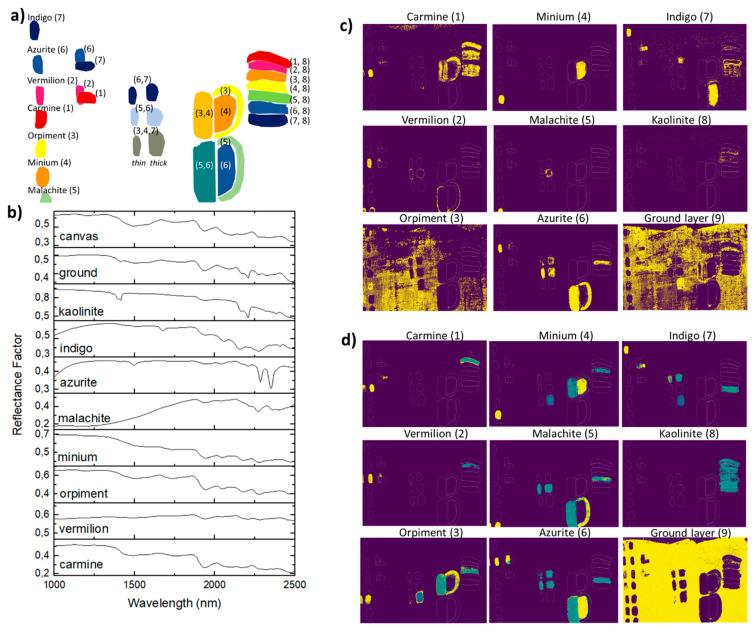
Hyperspectral reflectance imaging in the short-wave infrared range (SWIR, "extended NIR", ca. 1000 to 2500 nm) has proven to provide enhanced characterization of paint materials. However, the interpretation of the results remains challenging due to the intrinsic complexity of the SWIR spectra, presenting both broad and narrow absorption features with possible overlaps. To cope with the high dimensionality and spectral complexity of such datasets acquired in the SWIR domain, one data treatment approach is tested, inspired by innovative development in the cultural heritage field: the use of a pigment spectral database (extracted from model and historical samples) combined with a deep neural network (DNN). This approach allows for multi-label pigment classification within each pixel of the data cube. Conventional Spectral Angle Mapping and DNN results obtained on both pigment reference samples and a Buddhist painting (thangka) are discussed.
短波长红外范围内(SWIR,“扩展近红外”,约 1000 到 2500nm)的高光谱反射成像已被证明可增强对绘画材料的特征描述。然而,由于 SWIR 光谱固有的复杂性,其结果的解释仍然具有挑战性,因为 SWIR 光谱既存在宽吸收特征,也存在窄吸收特征,且可能存在重叠。为了应对在 SWIR 域中获取的此类高维数据和光谱复杂性,受文化遗产领域创新发展的启发,尝试了一种数据处理方法:使用颜料光谱数据库(从模型和历史样本中提取)与深度神经网络(DNN)相结合。该方法允许在数据立方体的每个像素内进行多标签颜料分类。讨论了基于常规光谱角制图法和 DNN 对颜料参考样本和一幅唐卡(thangka)获得的结果。

 Zotero 插件