Department of Endocrinology, Chinese PLA General Hospital, Beijing, China.
Department of Medicine, Nankai University, Tianjin, China.
PLoS One. 2019 Aug 30;14(8):e0214776. doi: 10.1371/journal.pone.0214776. eCollection 2019.
Sleep duration affects health in various ways. The objective of the present study was to investigate the relationships among sleep duration, daytime napping and kidney function in a middle-aged apparently healthy Chinese population.
According to self-reported total sleep and daytime napping durations, 33,850 participants who were 38-90 years old and recruited from eight regional centers were divided into subgroups. Height, weight, waist circumference, hip circumference, blood pressure, biochemical indexes, fasting blood glucose (FBG), postprandial blood glucose (PBG), HbA1c, creatinine and urinary albumin-creatinine ratio (UACR) were measured and recorded for each subject. Microalbuminuria was defined as UACR ≥30 mg/g, chronic kidney disease (CKD) was defined as eGFR <60 ml/min, and hyperfiltration was defined as eGFR ≥135 ml/min. Multiple logistic regression was applied to investigate the association between sleep and kidney function.
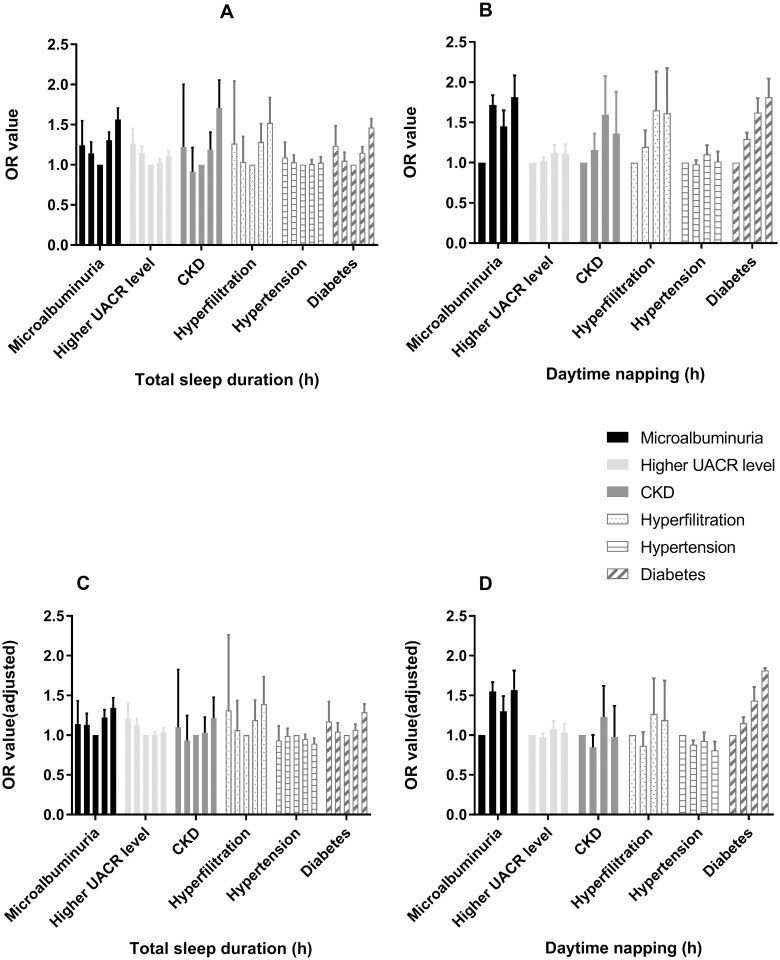
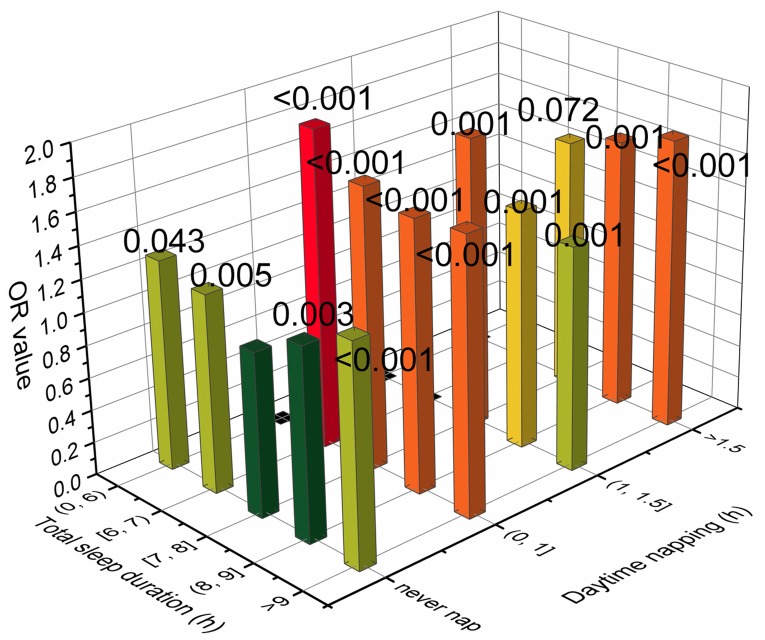
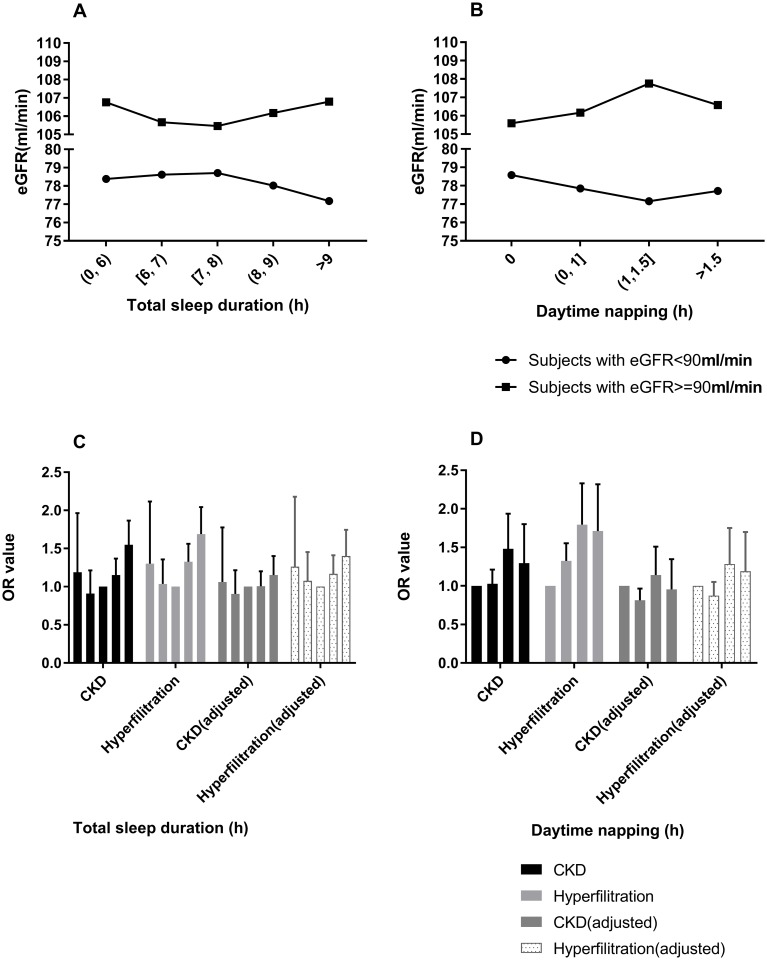
Compared to sleeping for 7-8 h/day, the ORs for microalbuminuria for sleeping for >9 h/day, 8-9 h/day 6-7 h/day and <6 h/day were 1.343 (1.228-1.470, P<0.001), 1.223 (1.134-1.320, P<0.001), 1.130 (1.003-1.273, P = 0.045) and 1.140 (0.908-1.431, P = 0.259), respectively. The eGFR levels exhibited a U-shaped association with sleep duration among subjects with an eGFR ≥90 ml/min and an N-shaped association with sleep duration among subjects with an eGFR <90 ml/min. The OR for hyperfiltration for >9 h/day of sleep was 1.400 (1.123-1.745, P = 0.003) among participants with an eGFR ≥90 ml/min. Daytime napping had a negative effect on renal health. Compared to the absence of a napping habit, the ORs for microalbuminuria for 0-1 h/day, 1-1.5 h/day and >1.5 h/day of daytime napping were 1.552 (1.444-1.668, P<0.001), 1.301 (1.135-1.491, P<0.001) and 1.567 (1.353-1.814, P<0.001), respectively.
The association of total sleep duration with renal health outcomes is U-shaped. Daytime napping has a negative effect on renal health.
睡眠时长以各种方式影响健康。本研究旨在调查中年人群中睡眠时长、白天小睡与肾功能之间的关系。
根据自报的总睡眠时间和白天小睡时长,将 33850 名年龄 38-90 岁、来自 8 个地区中心的参与者分为亚组。测量并记录每位受试者的身高、体重、腰围、臀围、血压、生化指标、空腹血糖(FBG)、餐后血糖(PBG)、HbA1c、肌酐和尿白蛋白/肌酐比值(UACR)。微量白蛋白尿定义为 UACR≥30mg/g,慢性肾脏病(CKD)定义为 eGFR<60ml/min,肾小球滤过率高滤过定义为 eGFR≥135ml/min。采用多因素 logistic 回归分析睡眠与肾脏功能之间的关系。
与每天睡眠 7-8 小时相比,每天睡眠>9 小时、8-9 小时、6-7 小时和<6 小时的微量白蛋白尿比值比(ORs)分别为 1.343(1.228-1.470,P<0.001)、1.223(1.134-1.320,P<0.001)、1.130(1.003-1.273,P=0.045)和 1.140(0.908-1.431,P=0.259)。在 eGFR≥90ml/min 的人群中,eGFR 水平与睡眠时间呈 U 型关联,在 eGFR<90ml/min 的人群中,eGFR 水平与睡眠时间呈 N 型关联。在 eGFR≥90ml/min 的人群中,每天睡眠>9 小时的高滤过 OR 为 1.400(1.123-1.745,P=0.003)。白天小睡对肾脏健康有负面影响。与没有小睡习惯相比,每天小睡 0-1 小时、1-1.5 小时和>1.5 小时的微量白蛋白尿比值比(ORs)分别为 1.552(1.444-1.668,P<0.001)、1.301(1.135-1.491,P<0.001)和 1.567(1.353-1.814,P<0.001)。
总的睡眠时间与肾脏健康结果呈 U 型相关。白天小睡对肾脏健康有负面影响。