Rubenstein School of the Environment and Natural Resources, 81 Carrigan Dr., University of Vermont, Burlington, VT, 05405, USA.
Merrimack Citizens for Clean Water, 16 French Court, Merrimack, NH, 03054, USA.
Environ Health. 2019 Aug 30;18(1):79. doi: 10.1186/s12940-019-0513-3.
In March 2016, citizens of Merrimack, New Hampshire, learned that their public water supply was contaminated with perfluorooctanoic acid (PFOA). A subsequent state-led investigation revealed widespread contamination of both public and private well water with PFOA and several related chemicals, broadly termed per- and polyfluoroalkyl substances (PFAS). This research examines the local response to PFAS contamination of the public water system and well water in Merrimack and the results from the health survey administered by a local advocacy group, Merrimack Citizens for Clean Water (MCFCW).
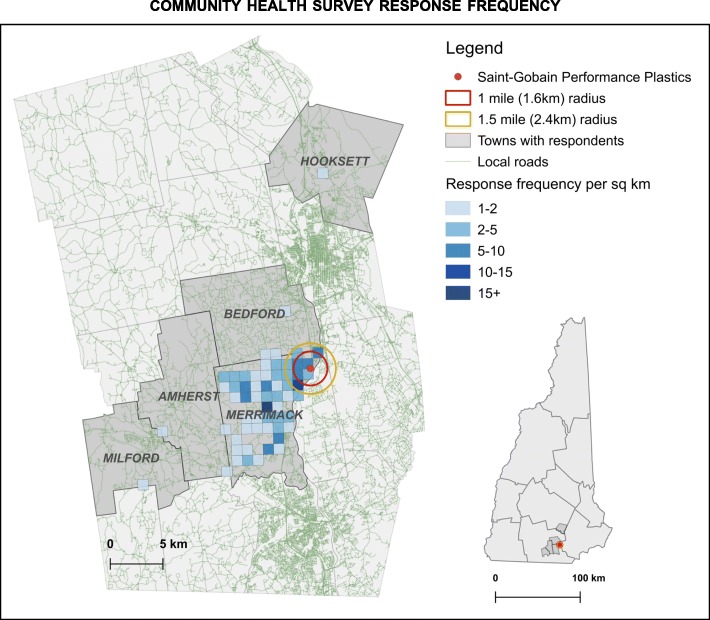
MCFCW designed and implemented a community health survey (n = 596) representing 213 households exposed to PFAS through drinking water. The surveys were conducted in the summer of 2017. Respondents used an online survey platform to report demographic information, exposure sources, and health conditions. Logistic regression was used to analyze the community-based health survey results .
There were several important associations that warrant further investigation and more immediate attention, especially: 1) elevated incidence of developmental, autoimmune and kidney disorders among those under 18 years of age; 2) elevated levels of health concerns, multiple health concerns, autoimmune disorders, and reproductive disorders among women, 3) elevated levels of health concerns, multiple health conditions, cardiovascular, respiratory, reproductive, and liver disorders in those with industrial occupational exposures, and; 4) elevated incidence of health concerns, cardiovascular, and developmental disorders among those who have been living in Merrimack for a long time versus newer residents.
The limitations inherent in the study design warrant caution in interpreting the results, however the associations found in this study merit further investigation. This health survey highlights foremost the critical gap in information-lack of access to blood testing, medical monitoring and physician guidance of PFAS-exposed residents. This study provides a model for conducting community-based health studies to advocate for pathways to state supported biomonitoring and medical monitoring for those exposed to industrial toxins and to take into consideration the human health burden in shaping the future of chemical regulation.
2016 年 3 月,新罕布什尔州梅里马克市的市民得知,他们的公共供水系统受到全氟辛酸(PFOA)污染。随后,一项由州政府主导的调查显示,公共和私人井水都受到 PFOA 和几种相关化学物质的广泛污染,这些化学物质统称为全氟和多氟烷基物质(PFAS)。本研究考察了梅里马克市公共供水系统和井水受到 PFAS 污染后的当地应对措施,以及当地一个倡导组织梅里马克公民清洁水组织(MCFCW)进行的健康调查结果。
MCFCW 设计并实施了一项社区健康调查(n=596),代表了通过饮用水暴露于 PFAS 的 213 户家庭。调查于 2017 年夏季进行。受访者使用在线调查平台报告人口统计信息、暴露源和健康状况。使用逻辑回归分析社区为基础的健康调查结果。
有几个重要的关联值得进一步调查和更直接的关注,特别是:1)18 岁以下人群中发育、自身免疫和肾脏疾病的发病率升高;2)女性健康问题、多种健康问题、自身免疫疾病和生殖疾病的发生率升高;3)有工业职业暴露人群的健康问题、多种健康状况、心血管、呼吸、生殖和肝脏疾病的发生率升高;4)在长期居住在梅里马克市的人群中,健康问题、心血管疾病和发育障碍的发病率较高。
研究设计固有的局限性使得在解释结果时需要谨慎,但本研究中发现的关联值得进一步调查。这项健康调查突出表明,缺乏获取血液检测、医学监测和 PFAS 暴露居民医生指导的信息是一个关键的信息缺口。本研究为开展社区为基础的健康研究提供了一个范例,倡导为接触工业毒素的人群建立州支持的生物监测和医学监测途径,并考虑到在制定化学监管未来时对人类健康负担的影响。