Department of Interventional Neuroradiology, Fondation Ophtalmologique Adolphe de Rothschild, Paris, France.
Department of Neuroradiology, Centre Hospitalier Universitaire de Nancy, Nancy, France.
J Neurointerv Surg. 2020 Apr;12(4):386-391. doi: 10.1136/neurintsurg-2019-015215. Epub 2019 Aug 30.
The 'first pass effect' (FPE), which was originally described with stent retrievers, designates a (near-)complete revascularization obtained after a single device pass with no rescue therapy, and is associated with improved clinical outcome and decreased mortality.
We report the rate and benefits of FPE in the Aspiration versus Stent Retriever (ASTER) trial.
ASTER is a randomized trial comparing angiographic revascularization with the stent retriever (SR) and contact aspiration (CA) thrombectomy techniques, assessed by an external core laboratory using the modified Thrombolysis in Cerebral Infarction (mTICI) scale. Rates of FPE (defined by mTICI 2c/3 after a single pass with no rescue therapy) were compared between patients treated with SR and CA techniques. Outcomes were compared between FPE-SR and FPE-CA patients, and between FPE and non-FPE patients.
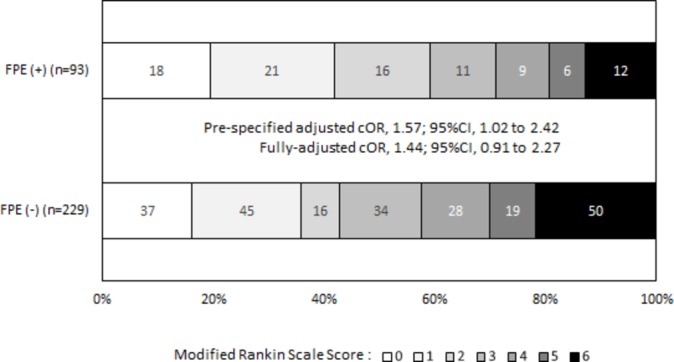
FPE was achieved in 97/336 patients (28.9%), with no significant difference between SR and CA (respectively 53/169 patients (31.3%) vs 44/167 patients (26.3%), adjusted RR for CA versus SR 0.84, 95% CI 0.54 to 1.31; p=0.44). After prespecified adjustment for allocated arm and randomization stratification factors, FPE in patients was associated with a significantly improved clinical outcome and a decreased mortality, and a significantly lower rate of hemorrhagic transformation and procedural complications than in non-FPE patients.
In the ASTER trial, similar rates of FPE were achieved with SR and CA, and FPE was associated with a significantly improved outcome. New techniques and devices to improve the rate of FPE are warranted.
Unique identifier: NCT02523261.
“首次通过效应”(FPE)最初是在支架取栓器中描述的,它指定了在单次通过且没有挽救治疗的情况下获得的(近乎)完全再血管化,与改善临床结局和降低死亡率相关。
我们报告了抽吸与支架取栓术(ASTER)试验中 FPE 的发生率和获益。
ASTER 是一项比较支架取栓器(SR)和接触抽吸(CA)血栓切除术技术的随机试验,由一个外部核心实验室使用改良脑梗死溶栓(mTICI)评分进行评估。比较接受 SR 和 CA 技术治疗的患者中 FPE(定义为单次通过且无挽救治疗后 mTICI 2c/3)的发生率。比较 FPE-SR 和 FPE-CA 患者以及 FPE 和非 FPE 患者之间的结局。
97/336 例(28.9%)患者达到 FPE,SR 和 CA 之间无显著差异(分别为 169 例患者中的 53 例(31.3%)和 167 例患者中的 44 例(26.3%),CA 与 SR 的调整 RR 为 0.84,95%CI 为 0.54 至 1.31;p=0.44)。在按分配臂和随机分组因素进行预设调整后,患者的 FPE 与临床结局显著改善和死亡率降低相关,与非 FPE 患者相比,其出血性转化和手术并发症的发生率也显著降低。
在 ASTER 试验中,SR 和 CA 达到 FPE 的比例相似,且 FPE 与显著改善的结局相关。需要新的技术和设备来提高 FPE 的比例。
独特标识符:NCT02523261。