Experimental Medicine and Immunotherapeutics, University of Cambridge, Level 6, Centre for Clinical Investigation, Box 110, Addenbrooke's Hospital, Cambridge, CB2 0QQ, UK.
Research and Early Development, Cardiovascular, Renal and Metabolism (CVRM), BioPharmaceuticals R&D, AstraZeneca, Cambridge, UK.
Peptides. 2019 Nov;121:170139. doi: 10.1016/j.peptides.2019.170139. Epub 2019 Aug 28.
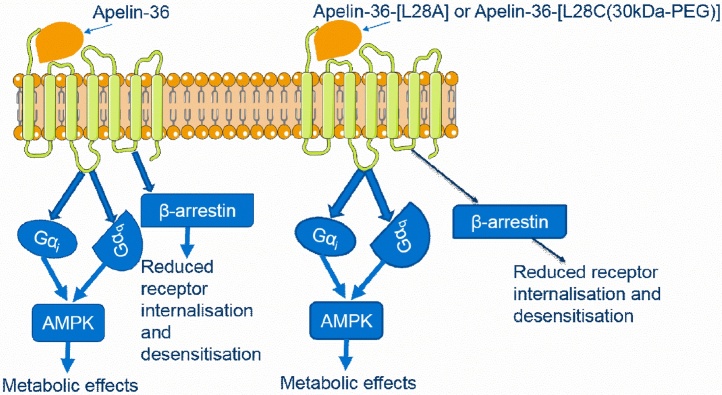
Apelin signalling pathways have important cardiovascular and metabolic functions. Recently, apelin-36-[L28A] and apelin-36-[L28C(30kDa-PEG)], were reported to function independent of the apelin receptor in vivo to produce beneficial metabolic effects without modulating blood pressure. We aimed to show that these peptides bound to the apelin receptor and to further characterise their pharmacology in vitro at the human apelin receptor.
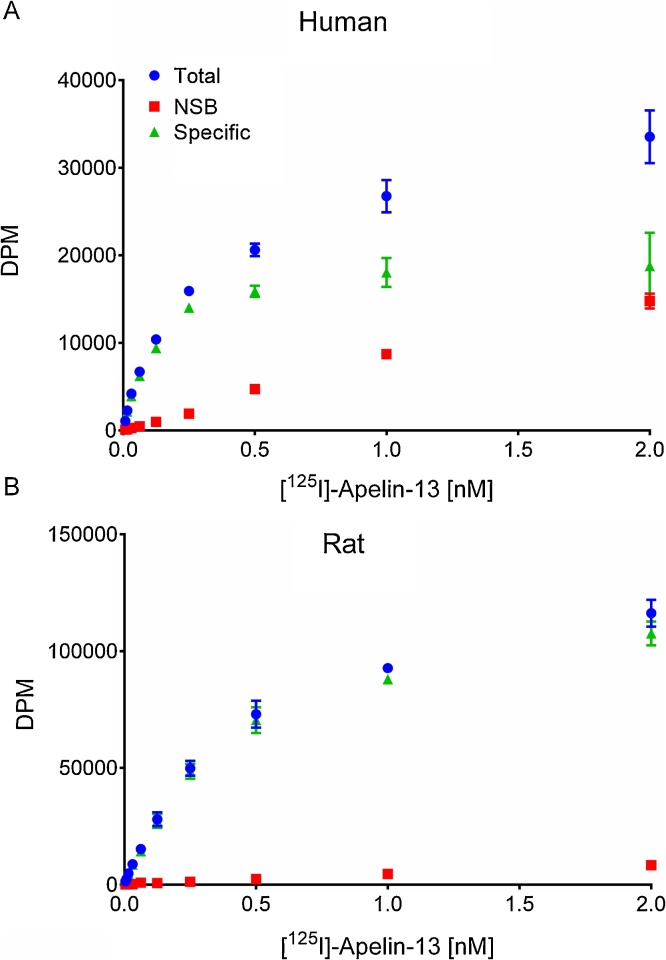
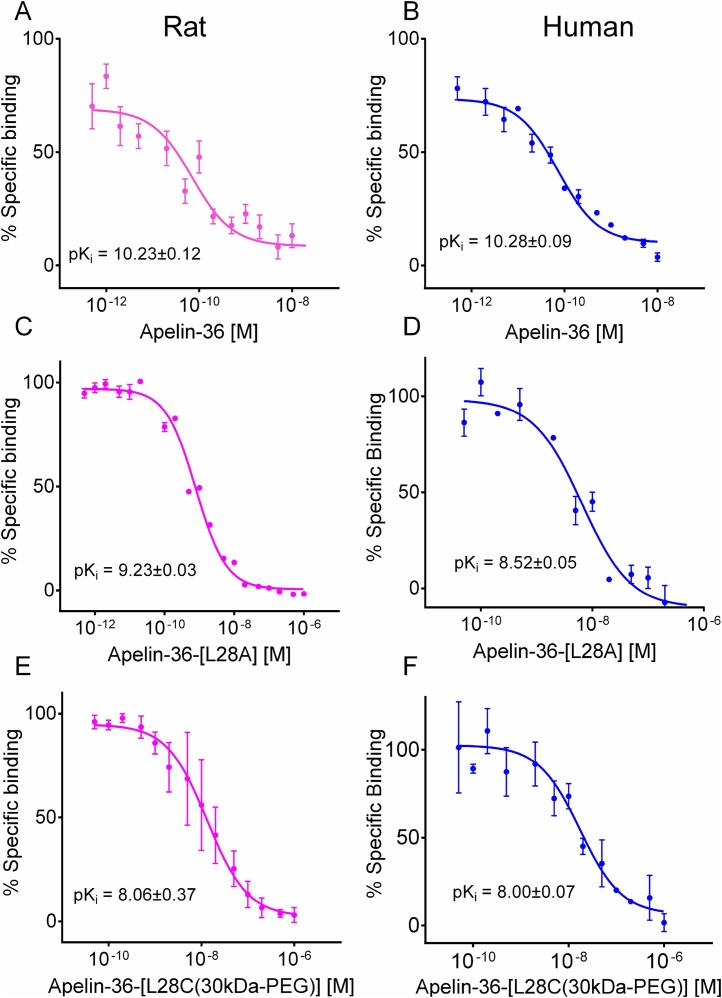
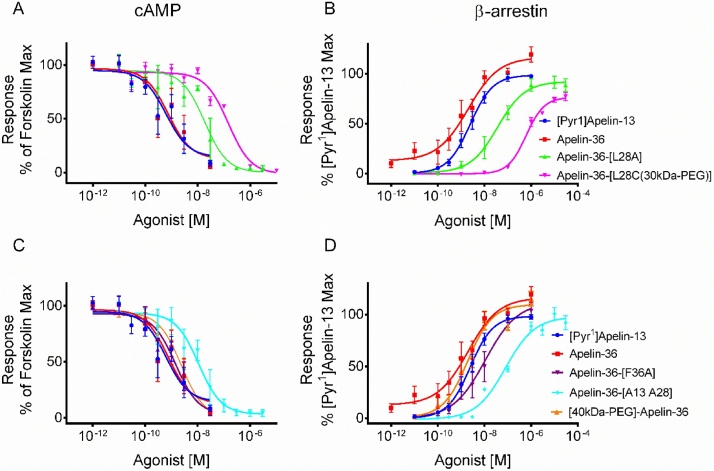
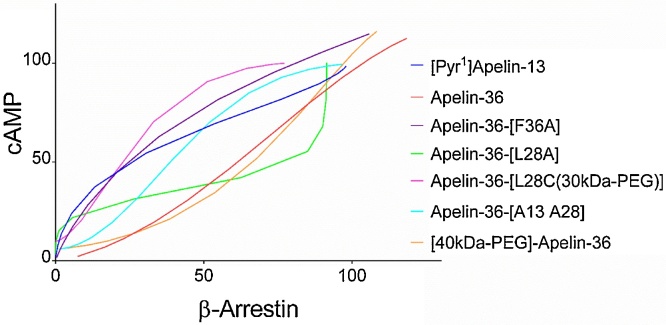
[Pyr]apelin-13 saturation binding experiments and competition binding experiments were performed in rat and human heart homogenates using [I]apelin-13 (0.1 nM), and/or increasing concentrations of apelin-36, apelin-36-[L28A] and apelin-36-[L28C(30kDa-PEG)] (50pM-100μM). Apelin-36 and its analogues apelin-36-[F36A], apelin-36-[L28A], apelin-36-[L28C(30kDa-PEG)], apelin-36-[A28 A13] and [40kDa-PEG]-apelin-36 were tested in forskolin-induced cAMP inhibition and β-arrestin assays in CHO-K1 cells heterologously expressing the human apelin receptor. Bias signaling was quantified using the operational model for bias.
In both species, [Pyr]apelin-13 had comparable subnanomolar affinity and the apelin receptor density was similar. Apelin-36, apelin-36-[L28A] and apelin-36-[L28C(30kDa-PEG)] competed for binding of [I]apelin-13 with nanomolar affinities. Apelin-36-[L28A] and apelin-36-[L28C(30kDa-PEG)] inhibited forskolin-induced cAMP release, with nanomolar potencies but they were less potent compared to apelin-36 at recruiting β-arrestin. Bias analysis suggested that these peptides were G protein biased. Additionally, [40kDa-PEG]-apelin-36 and apelin-36-[F36A] retained nanomolar potencies in both cAMP and β-arrestin assays whilst apelin-36-[A13 A28] exhibited a similar profile to apelin-36-[L28C(30kDa-PEG)] in the β-arrestin assay but was more potent in the cAMP assay.
Apelin-36-[L28A] and apelin-36-[L28C(30kDa-PEG)] are G protein biased ligands of the apelin receptor, suggesting that the apelin receptor is an important therapeutic target in metabolic diseases.
Apelin 信号通路在心血管和代谢方面具有重要功能。最近,apelin-36-[L28A] 和 apelin-36-[L28C(30kDa-PEG)] 被报道在体内独立于 Apelin 受体发挥作用,产生有益的代谢效应,而不调节血压。我们旨在证明这些肽与 Apelin 受体结合,并进一步研究它们在人 Apelin 受体上的体外药理学特性。
使用 [I]apelin-13(0.1nM)和/或增加浓度的 apelin-36、apelin-36-[L28A] 和 apelin-36-[L28C(30kDa-PEG)](50pM-100μM),在大鼠和人心肌匀浆中进行 [Pyr]apelin-13 饱和结合实验和竞争结合实验。apelin-36 及其类似物 apelin-36-[F36A]、apelin-36-[L28A]、apelin-36-[L28C(30kDa-PEG)]、apelin-36-[A28 A13] 和 [40kDa-PEG]-apelin-36 在 CHO-K1 细胞中进行了 forskolin诱导的 cAMP 抑制和 β-arrestin 测定,CHO-K1 细胞异源表达人 Apelin 受体。使用偏倚操作模型对偏倚信号进行量化。
在这两个物种中,[Pyr]apelin-13 具有可比的亚纳摩尔亲和力,Apelin 受体密度相似。Apelin-36、apelin-36-[L28A] 和 apelin-36-[L28C(30kDa-PEG)] 以纳摩尔亲和力竞争 [I]apelin-13 的结合。Apelin-36-[L28A] 和 apelin-36-[L28C(30kDa-PEG)] 抑制了 forskolin诱导的 cAMP 释放,具有纳摩尔效力,但与 apelin-36 相比,它们在招募 β-arrestin 方面的效力较低。偏倚分析表明,这些肽是 G 蛋白偏向配体。此外,[40kDa-PEG]-apelin-36 和 apelin-36-[F36A] 在 cAMP 和 β-arrestin 测定中保留了纳摩尔效力,而 apelin-36-[A13 A28] 在 β-arrestin 测定中表现出与 apelin-36-[L28C(30kDa-PEG)] 相似的特征,但在 cAMP 测定中更有效。
Apelin-36-[L28A] 和 apelin-36-[L28C(30kDa-PEG)] 是 Apelin 受体的 G 蛋白偏向配体,这表明 Apelin 受体是代谢疾病的重要治疗靶点。