Wan Hailin, Ge Liang, Huang Lei, Jiang Yeqing, Leng Xiaochang, Feng Xiaoyuan, Xiang Jianping, Zhang Xiaolong
Department of Radiology, Huashan Hospital, Fudan University, Shanghai, China.
ArteryFlow Technology Co., Ltd., Hangzhou, China.
Front Neurol. 2019 Aug 14;10:841. doi: 10.3389/fneur.2019.00841. eCollection 2019.
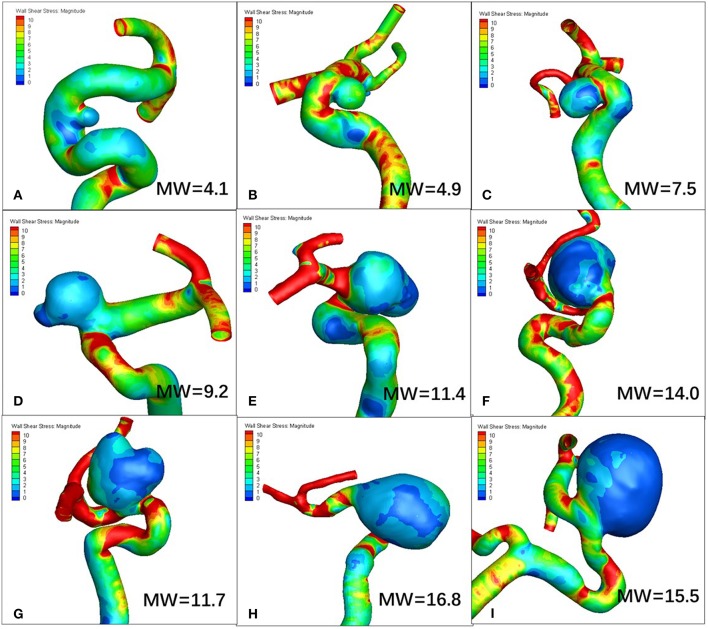
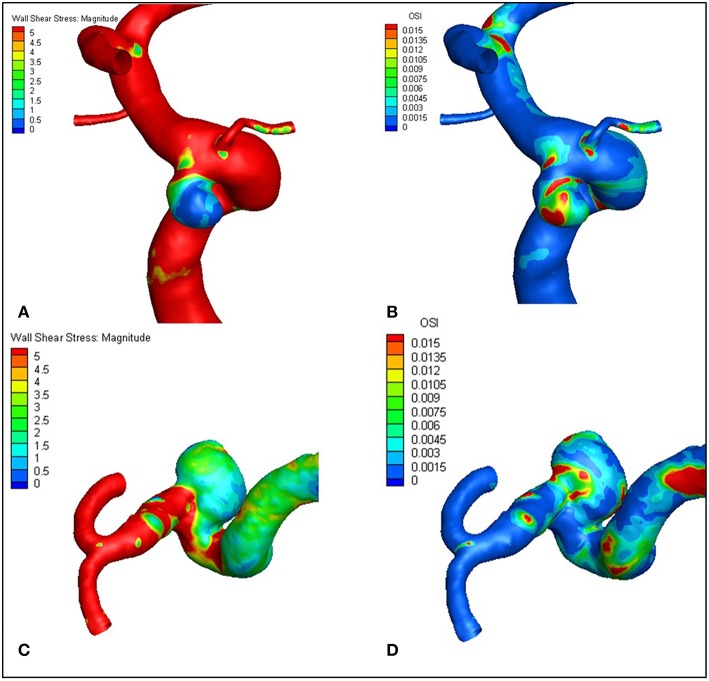
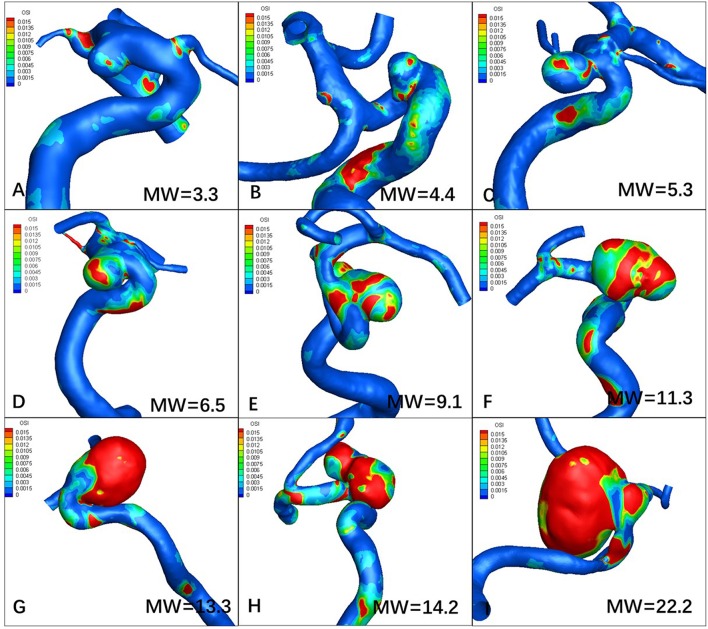
Hemodynamics play an important role in intracranial aneurysm (IA) initiation, growth, and rupture. Yet there remains no definitive quantitative analysis between abnormal hemodynamics and geometrical risk of IA development. The present study aims to investigate whether abnormal hemodynamics in IA sacs can be predicted by surrogate geometric markers. Computational fluid dynamics (CFD) simulations were performed on paraclinoid aneurysms derived from digital subtraction angiography (DSA) of 104 IAs in 104 patients. Four basic IA geometric parameters including maximum height, perpendicular height, maximum width, and neck diameter were measured. Abnormal hemodynamics were defined and quantified as the surface area exposed to low wall shear stress (WSS) and high oscillatory shear index (OSI) using objectively-defined thresholds. Relationships between abnormal hemodynamics and specific geometric parameters were analyzed via multiple linear regression. Adjusting for age, sex, and other clinical characteristics, multiple linear regression revealed a significant relationship ( < 0.001) between abnormal hemodynamics and both maximum width (β ≈ 1.2) and neck diameter (β ≈ -0.4), but not maximum height or perpendicular height. These findings were shown to be independent of the choice of abnormal hemodynamic indicators and threshold levels. Maximum width and neck diameter of IA sacs are robust surrogates of exposure to abnormal hemodynamics. Risk of rupture may be increased with wider aneurysms with narrower necks for paraclinoid aneurysms.
血流动力学在颅内动脉瘤(IA)的起始、生长和破裂过程中起着重要作用。然而,异常血流动力学与IA发生的几何风险之间仍没有明确的定量分析。本研究旨在探讨IA瘤腔内的异常血流动力学是否可以通过替代几何标志物来预测。对104例患者的104个IA的数字减影血管造影(DSA)衍生的床突旁动脉瘤进行了计算流体动力学(CFD)模拟。测量了四个基本的IA几何参数,包括最大高度、垂直高度、最大宽度和颈部直径。使用客观定义的阈值,将异常血流动力学定义并量化为暴露于低壁面切应力(WSS)和高振荡切变指数(OSI)的表面积。通过多元线性回归分析异常血流动力学与特定几何参数之间的关系。在调整年龄、性别和其他临床特征后,多元线性回归显示异常血流动力学与最大宽度(β≈1.2)和颈部直径(β≈ -0.4)之间存在显著关系(<0.001),但与最大高度或垂直高度无关。这些发现表明与异常血流动力学指标和阈值水平的选择无关。IA瘤腔的最大宽度和颈部直径是暴露于异常血流动力学的可靠替代指标。对于床突旁动脉瘤,瘤体较宽且颈部较窄可能会增加破裂风险。