Forschungscampus STIMULATE, University of Magdeburg, Magdeburg, Germany.
Department of Fluid Dynamics and Technical Flows, University of Magdeburg, Magdeburg, Germany.
Cardiovasc Eng Technol. 2023 Oct;14(5):617-630. doi: 10.1007/s13239-023-00675-1. Epub 2023 Aug 15.
Image-based blood flow simulations are increasingly used to investigate the hemodynamics in intracranial aneurysms (IAs). However, a strong variability in segmentation approaches as well as the absence of individualized boundary conditions (BCs) influence the quality of these simulation results leading to imprecision and decreased reliability. This study aims to analyze these influences on relevant hemodynamic parameters within IAs.
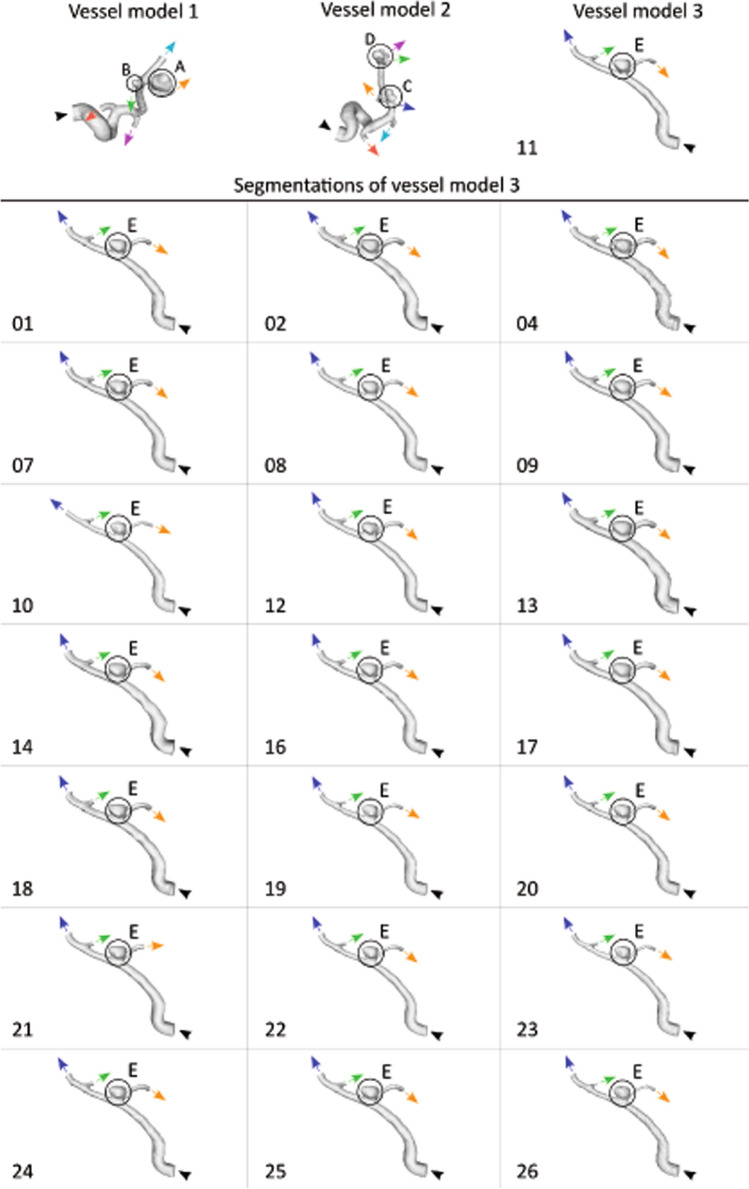
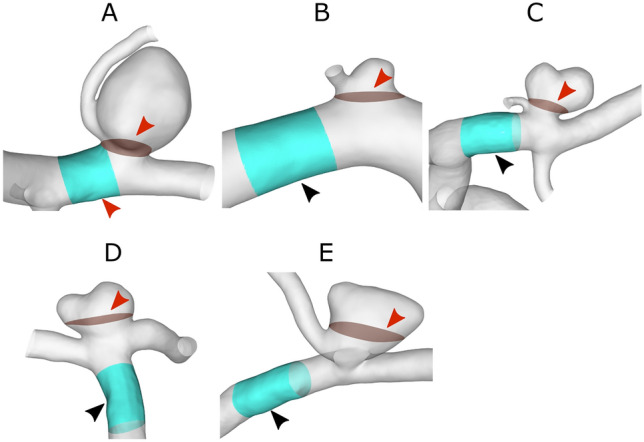
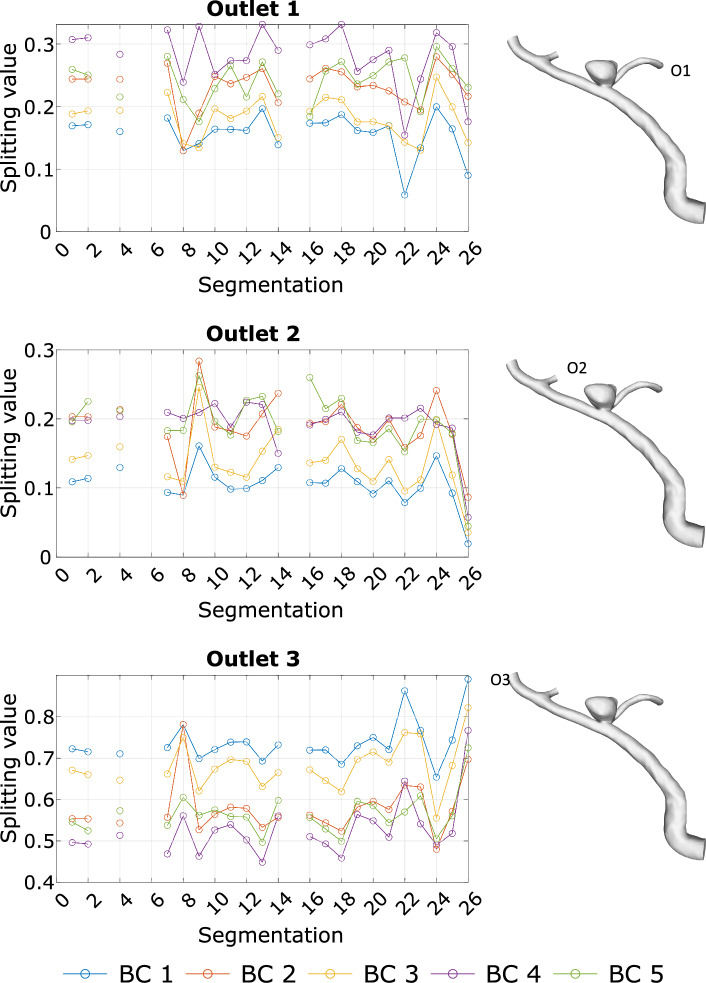
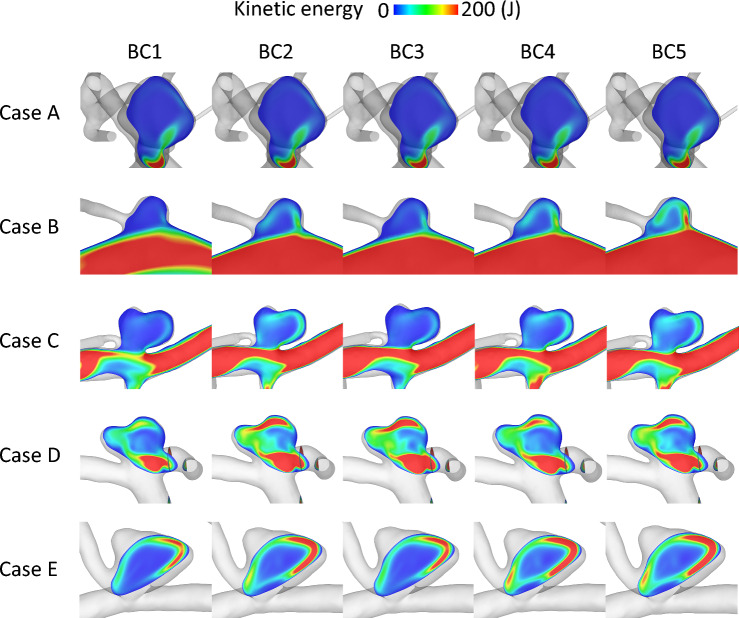
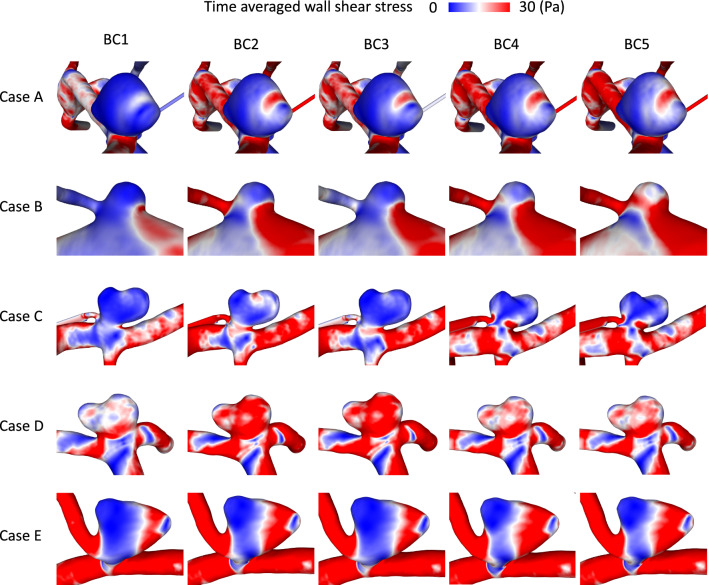
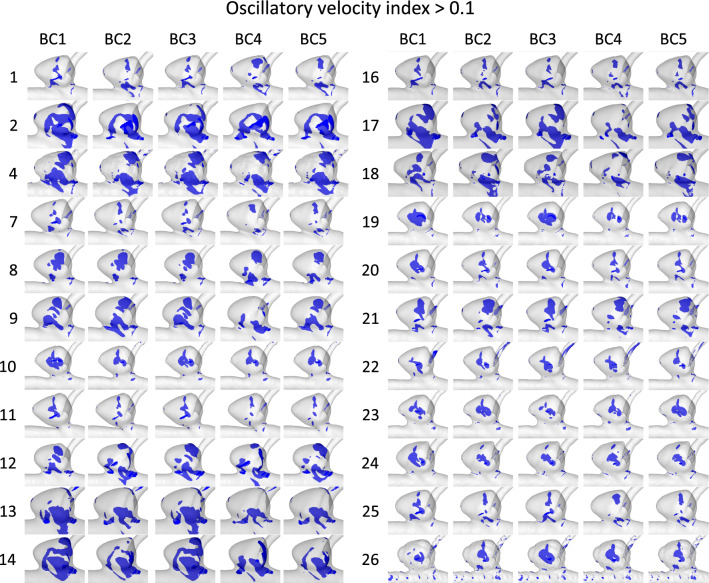
As a follow-up study of an international multiple aneurysms challenge, the segmentation results of five IAs differing in size and location were investigated. Specifically, five possible outlet BCs were considered in each of the IAs. These are comprised of the zero-pressure condition (BC1), a flow distribution based on Murray's law with the exponents n = 2 (BC2) and n = 3 (BC3) as well as two advanced flow-splitting models considering the real vessels by including circular cross sections (BC4) or anatomical cross sections (BC5), respectively. In total, 120 time-dependent blood flow simulations were analyzed qualitatively and quantitatively, focusing on five representative intra-aneurysmal flow and five shear parameters such as vorticity and wall shear stress.
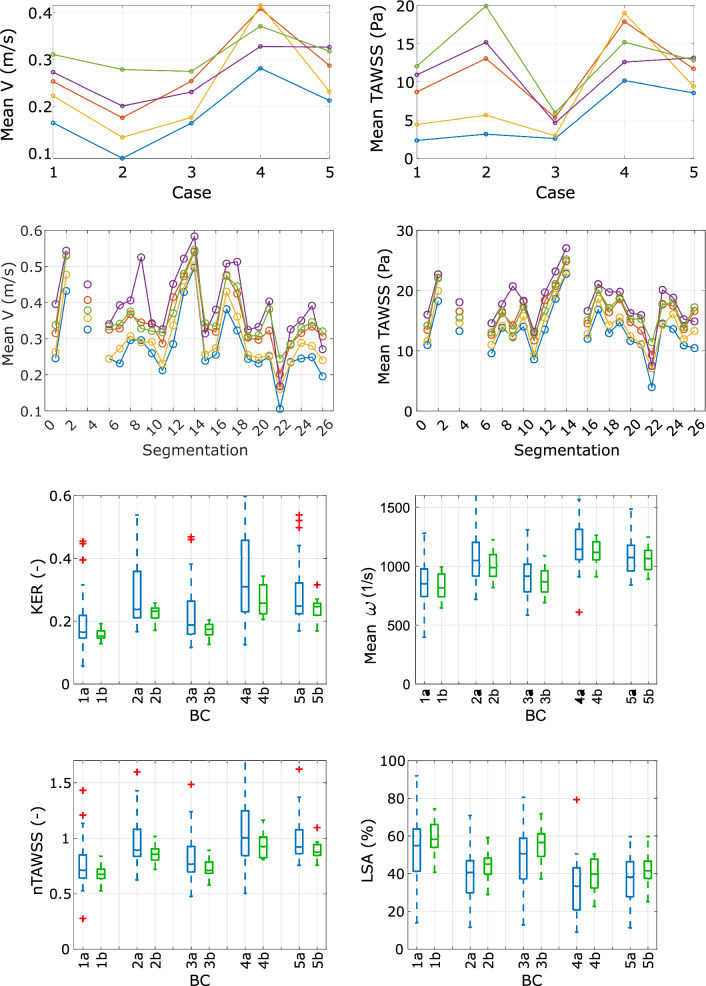
The outlet BC variation revealed substantial differences. Higher shear stresses (up to Δ9.69 Pa), intrasaccular velocities (up to Δ0.15 m/s) and vorticities (up to Δ629.22 1/s) were detected when advanced flow-splitting was applied compared to the widely used zero-pressure BC. The tendency of outlets BCs to over- or underestimate hemodynamic parameters is consistent across different segmentations of a single aneurysm model. Segmentation-induced variability reaches Δ19.58 Pa, Δ0.42 m/s and Δ957.27 1/s, respectively. Excluding low fidelity segmentations, however, (a) reduces the deviation drastically (>43%) and (b) leads to a lower impact of the outlet BC on hemodynamic predictions.
With a more realistic lumen segmentation, the influence of the BC on the resulting hemodynamics is decreased. A realistic lumen segmentation can be ensured, e.g., by using high-resolved 2D images. Furthermore, the selection of an advanced outflow-splitting model is advised and the use of a zero-pressure BC and BC based on Murray's law with exponent n = 3 should be avoided.
基于影像的血流模拟越来越多地用于研究颅内动脉瘤(IA)中的血液动力学。然而,分割方法的高度可变性以及缺乏个体化边界条件(BC)会影响这些模拟结果的质量,导致不精确和可靠性降低。本研究旨在分析这些因素对 IA 内相关血液动力学参数的影响。
作为国际多动脉瘤挑战的后续研究,本研究对五个大小和位置不同的 IA 的分割结果进行了研究。具体而言,在每个 IA 中考虑了五个可能的出口 BC。这些包括零压力条件(BC1)、基于 Murray 定律的流量分布(指数 n=2(BC2)和 n=3(BC3))以及两种先进的流量分割模型,通过包含圆形横截面(BC4)或解剖横截面(BC5)分别考虑真实血管。总共分析了 120 个时变血流模拟,重点关注五个代表性的瘤内血流和五个剪切参数,如涡度和壁面剪切应力。
出口 BC 的变化显示出显著的差异。与广泛使用的零压力 BC 相比,应用先进的流量分割时,检测到更高的剪切应力(高达Δ9.69 Pa)、瘤内速度(高达Δ0.15 m/s)和涡度(高达Δ629.22 1/s)。不同 IA 模型的单个分割出口 BC 倾向于高估或低估血液动力学参数。分割引起的变异性分别达到Δ19.58 Pa、Δ0.42 m/s 和Δ957.27 1/s。然而,排除低保真度分割会(a)大大降低偏差(>43%),(b)降低出口 BC 对血流动力学预测的影响。
通过更真实的管腔分割,BC 对血流动力学的影响会降低。可以通过使用高分辨率的 2D 图像来确保真实的管腔分割。此外,建议选择先进的出口分割模型,并避免使用零压力 BC 和基于 Murray 定律的指数 n=3 的 BC。