Department of Neurosurgery, The Second Affiliated Hospital and Yuying Children's Hospital of Wenzhou Medical University, Wenzhou, China.
Department of Orthopaedics, The Second Affiliated Hospital and Yuying Children's Hospital of Wenzhou Medical University, Wenzhou, China.
Cancer Med. 2019 Oct;8(14):6458-6467. doi: 10.1002/cam4.2516. Epub 2019 Sep 1.
Meningioma incidence was reported to have risen substantially in the United States during the first decade of the 21st century. There are few reports about subsequent incidence trends. This study provides updated data to investigate trends in meningioma incidence by demographic and tumor characteristics at diagnosis in the United states from 2004 to 2015.
Trends in meningioma incidence were analyzed using data from the Surveillance, Epidemiology, and End Results-18 (SEER-18) registry database of the National Cancer Institute. The joinpoint program was used to calculate annual percent change (APC) in incidence rates.
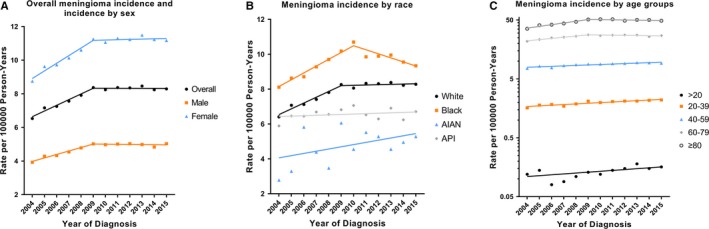
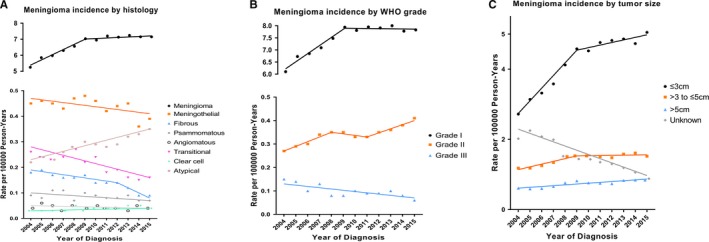
The overall incidence of meningioma increased by 4.6% (95% CI, 3.4-5.9) annually in 2004-2009, but remained stable from 2009 to 2015 (APC, 0; 95% CI, -0.8 to 0.8). Females (10.66 per 100 000 person-years) and blacks (9.52 per 100 000 person-years) had significant predominance in meningioma incidence. Incidence in many subgroups increased significantly up to 2009 and then remained stable until 2015. However, meningioma incidence in young and middle-aged people increased significantly throughout the entire time period from 2004 to 2015 (APC: 3.6% for <20-year-olds; 2.5% for 20-39-year-olds; 1.8% for 40-59-year-olds). The incidence of WHO II meningioma increased during 2011-2015 (APC = 5.4%), while the incidence of WHO III meningioma decreased during 2004-2015 (APC = -5.6%).
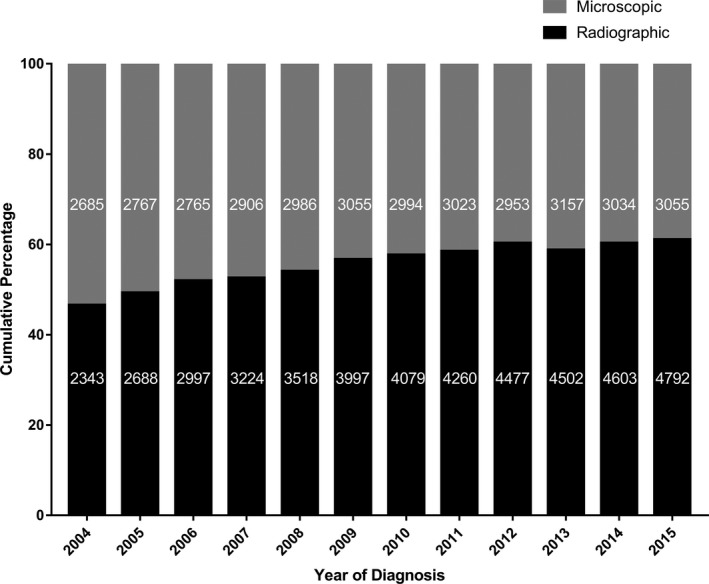
In this study, the incidence of meningioma was found to be stable in recent years. Possible reasons for this finding include changes in population characteristics, the widespread use of diagnostic techniques, and changes in tumor classification and risk factors in the US population.
据报道,21 世纪初的第一个十年,美国的脑膜瘤发病率大幅上升。此后发病率趋势的相关报道较少。本研究提供了最新数据,旨在调查 2004 年至 2015 年美国脑膜瘤发病率随人口统计学和肿瘤特征的变化趋势。
利用美国国家癌症研究所监测、流行病学和最终结果-18(SEER-18)登记数据库中的数据,分析脑膜瘤发病率的变化趋势。采用 Joinpoint 程序计算发病率的年变化百分比(APC)。
2004-2009 年脑膜瘤的总体发病率每年增长 4.6%(95%CI,3.4-5.9),但 2009 年至 2015 年保持稳定(APC,0;95%CI,-0.8 至 0.8)。女性(10.66/10 万人口年)和黑人(9.52/10 万人口年)脑膜瘤发病率明显较高。许多亚组的发病率在 2009 年前显著增加,之后直到 2015 年保持稳定。然而,2004 年至 2015 年期间,年轻人和中年人脑膜瘤的发病率显著增加(APC:<20 岁为 3.6%;20-39 岁为 2.5%;40-59 岁为 1.8%)。2011-2015 年,WHO II 级脑膜瘤的发病率增加(APC=5.4%),而 2004-2015 年,WHO III 级脑膜瘤的发病率下降(APC=-5.6%)。
本研究发现近年来脑膜瘤的发病率保持稳定。造成这一发现的可能原因包括人口特征的变化、诊断技术的广泛应用以及美国人群肿瘤分类和危险因素的变化。