Gao Dunfeng, Sinev Ilya, Scholten Fabian, Arán-Ais Rosa M, Divins Nuria J, Kvashnina Kristina, Timoshenko Janis, Roldan Cuenya Beatriz
Department of Interface Science, Fritz Haber Institute of the Max Planck Society, 14195, Berlin, Germany.
Department of Physics, Ruhr-University Bochum, 44780, Bochum, Germany.
Angew Chem Int Ed Engl. 2019 Nov 18;58(47):17047-17053. doi: 10.1002/anie.201910155. Epub 2019 Oct 8.
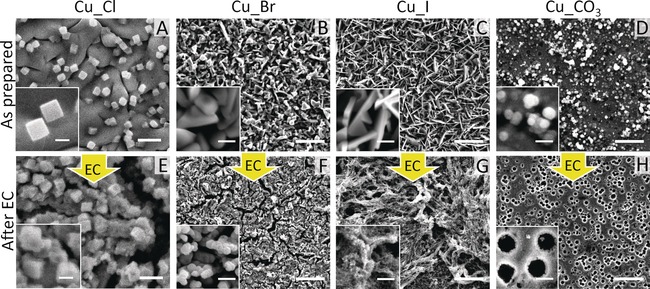
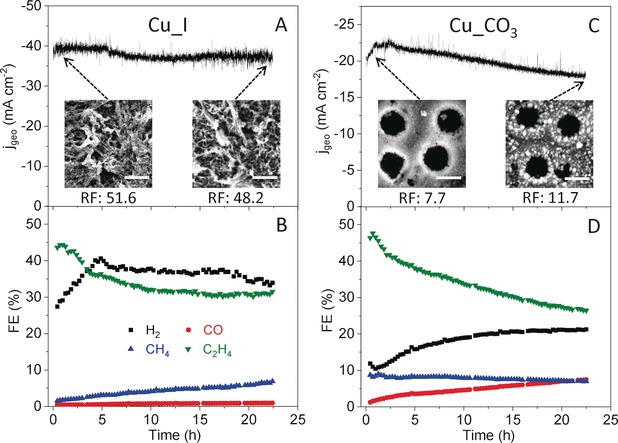
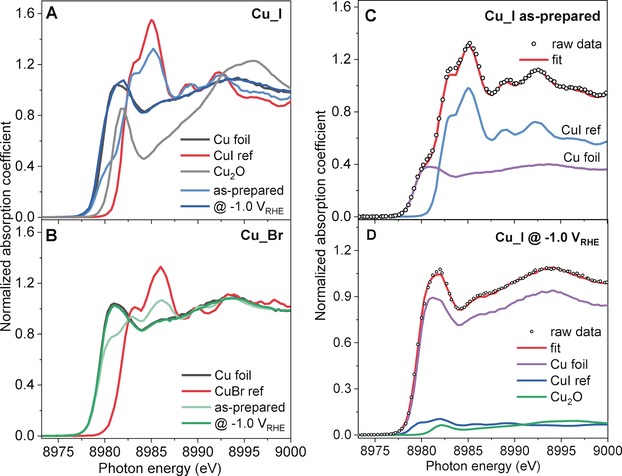
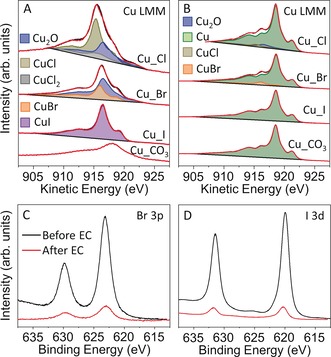
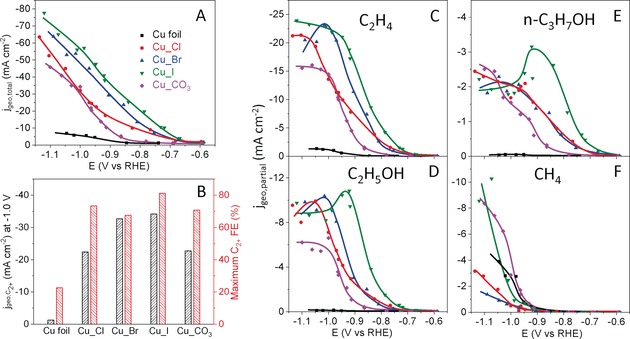
Production of multicarbon products (C ) from CO electroreduction reaction (CO RR) is highly desirable for storing renewable energy and reducing carbon emission. The electrochemical synthesis of CO RR catalysts that are highly selective for C products via electrolyte-driven nanostructuring is presented. Nanostructured Cu catalysts synthesized in the presence of specific anions selectively convert CO into ethylene and multicarbon alcohols in aqueous 0.1 m KHCO solution, with the iodine-modified catalyst displaying the highest Faradaic efficiency of 80 % and a partial geometric current density of ca. 31.2 mA cm for C products at -0.9 V vs. RHE. Operando X-ray absorption spectroscopy and quasi in situ X-ray photoelectron spectroscopy measurements revealed that the high C selectivity of these nanostructured Cu catalysts can be attributed to the highly roughened surface morphology induced by the synthesis, presence of subsurface oxygen and Cu species, and the adsorbed halides.
通过CO电还原反应(CO RR)生产多碳产物(C )对于储存可再生能源和减少碳排放非常有意义。本文介绍了通过电解质驱动的纳米结构化来电化学合成对C产物具有高选择性的CO RR催化剂。在特定阴离子存在下合成的纳米结构化铜催化剂在0.1 m KHCO水溶液中能选择性地将CO转化为乙烯和多碳醇,其中碘改性催化剂表现出最高的法拉第效率,为80%,在相对于可逆氢电极(RHE)为-0.9 V时,C产物的部分几何电流密度约为31.2 mA cm 。原位X射线吸收光谱和准原位X射线光电子能谱测量表明,这些纳米结构化铜催化剂对C的高选择性可归因于合成过程中诱导的高度粗糙的表面形态、次表面氧和铜物种的存在以及吸附的卤化物。