Department of Virology, School of Public Health, Shandong University, Jinan, 250012, China.
Division of Infectious Diseases of Special Animal, Institute of Special Animal and Plant Sciences, The Chinese Academy of Agricultural Sciences, Changchun, 130112, China.
BMC Vet Res. 2019 Sep 2;15(1):316. doi: 10.1186/s12917-019-2057-8.
Canine distemper (CD) is an acute infectious disease with high morbidity rates caused by a highly contagious pathogen (Canine Morbillivirus, also known as canine distemper virus, CDV). CDV can infect a broad range of carnivores resulting in complex clinical signs. Currently, there is no effective method to treat for CDV infections. Favipiravir (T-705), a pyrazine derivative, was shown to be an effective antiviral drug against RNA viruses, acting on RNA-dependent RNA polymerase (RdRp). However, whether the T-705 has antiviral effects following CDV infection is unclear. Here, we investigated the antiviral effect of T-705 against CDV-3 and CDV-11 strains in Vero and DH82 cell lines.
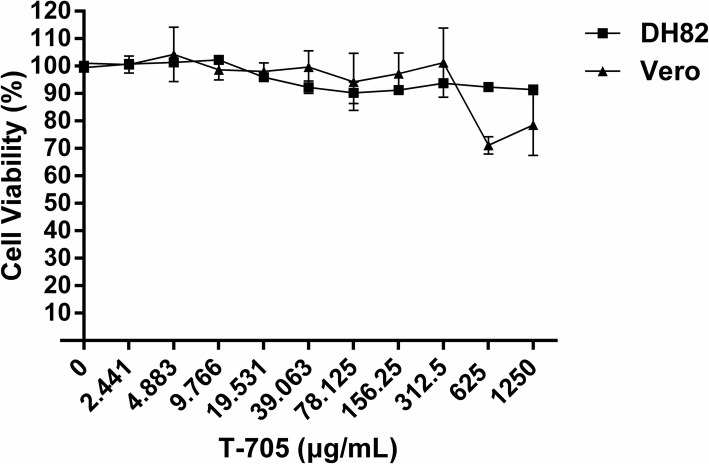
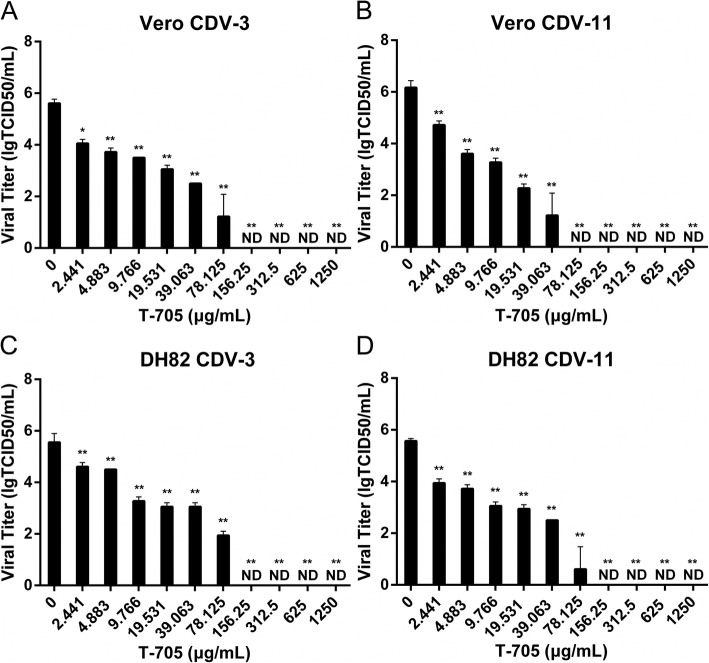
Our data demonstrated that T-705 significantly inhibited the replication of CDV-3 and CDV-11 in both Vero and DH82 cells at different concentrations, ranging from 2.441 μg/ml to 1250 μg/ml. Additionally, T-705 exhibited efficacious antiviral effects when administered at different time points after virus infection. Cytotoxicity tests showed a slight decline in viability in Vero cells after T-705 treatment, and no apparent cytotoxicity was detected in T-705 treated DH82 cells. Comparison of anti-CDV polyclonal serum only inhibition of CDV in supernatant, T-705 directly inhibited viral replication in cells, and indirectly reduced the amount of virions in supernatant. The combination application of T-705 and anti-CDV polyclonal serum exhibited a rapid and robust inhibition against virions in supernatant and virus replication in cells.
Our data strongly indicated that T-705 effectively inhibited viral replication following CDV infection in vitro, and could be a potential candidate for treatment for CD.
犬瘟热(CD)是一种由高度传染性病原体(犬瘟热病毒,也称为犬瘟热病毒,CDV)引起的高发病率急性传染病。CDV 可感染多种肉食动物,导致复杂的临床症状。目前,尚无有效的方法治疗 CDV 感染。吡嗪衍生物法匹拉韦(T-705)被证明是一种有效的抗 RNA 病毒药物,作用于 RNA 依赖性 RNA 聚合酶(RdRp)。然而,T-705 对 CDV 感染后的抗病毒作用尚不清楚。在这里,我们研究了 T-705 对 Vero 和 DH82 细胞系中 CDV-3 和 CDV-11 株的抗病毒作用。
我们的数据表明,T-705 在不同浓度(2.441μg/ml 至 1250μg/ml)下显著抑制了 Vero 和 DH82 细胞中 CDV-3 和 CDV-11 的复制。此外,T-705 在病毒感染后不同时间点给药均表现出有效的抗病毒作用。细胞毒性试验表明,T-705 处理后 Vero 细胞活力略有下降,而 T-705 处理的 DH82 细胞未检测到明显的细胞毒性。比较抗 CDV 多克隆血清仅抑制上清液中的 CDV,T-705 直接抑制细胞中的病毒复制,并间接减少上清液中病毒粒子的数量。T-705 与抗 CDV 多克隆血清的联合应用对上清液中的病毒粒子和细胞中的病毒复制表现出快速而强大的抑制作用。
我们的数据强烈表明,T-705 可有效抑制 CDV 感染后的病毒复制,可能是治疗 CD 的潜在候选药物。