Department of Medical Microbiology, College of Health Sciences, University of Zimbabwe, P. O. Box A178, Avondale, Harare, Zimbabwe.
National Institute of Health Research, Ministry of Health and Child Care, P.O. Box CY573, Causeway, Harare, Zimbabwe.
Parasit Vectors. 2019 Sep 2;12(1):427. doi: 10.1186/s13071-019-3667-5.
To design appropriate schistosomiasis control programmes that include women and preschool-aged children (PSAC) it is essential to assess their disease profile and the risk factors predisposing them to infection. This study aimed to determine the prevalence of urogenital schistosomiasis and the risk factors of infection among PSAC and their caregivers in an endemic area of Zimbabwe.
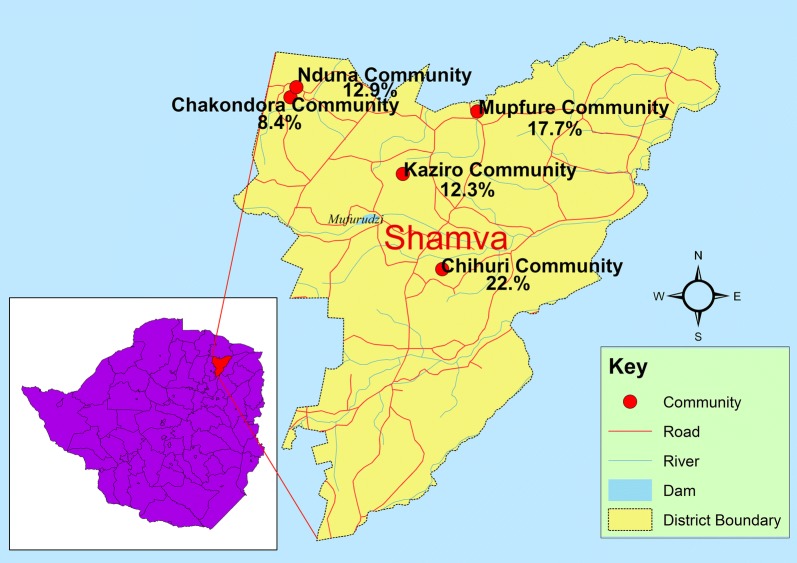
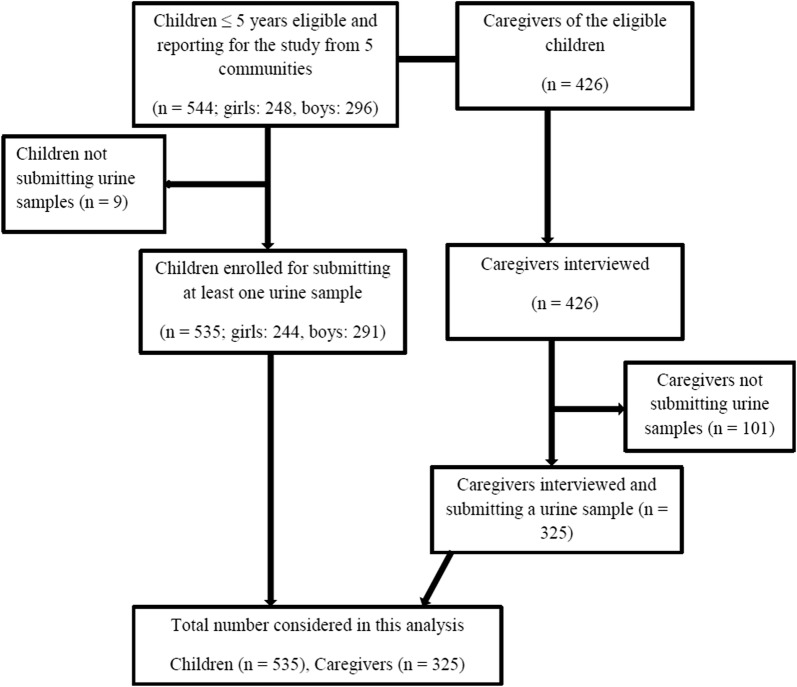
A cross-sectional study involving screening for urogenital schistosomiasis infections and treatment of 860 participants [535 children aged ≤ 5 years and 325 caregivers (≥ 15 years)] was carried out in five communities, namely Chihuri, Mupfure, Chakondora, Nduna and Kaziro, in February 2016. Haematuria was recorded for each participant and urine filtration was performed to determine the presence and infection intensity of Schistosoma haematobium. A pre-tested questionnaire was administered to the caregivers seeking knowledge, practices and perceptions regarding schistosomiasis. Data analysis was performed using descriptive statistics and logistic regression.
Overall 132 (15.4%) of the 860 participants had S. haematobium infections. Among these, 61 (18.7%) of the 325 caregivers and 71 (13.3%) of the 535 children were infected. The infection prevalence was significantly different between caregivers and PSAC (χ = 4.7040, df = 1, P = 0.030). Children whose caregivers used river water for bathing were more likely to be infected compared to children whose caregivers used protected well water (OR: 2.2, 95% CI: 1.3-3.7). The risks of being infected with schistosomiasis were higher in children whose caregivers were infected compared to children whose caregivers had no infection (AOR: 3.9, 95% CI: 1.7-8.6). In caregivers, those who bathed in river water were at higher risk of schistosomiasis infection compared to those who used water from a protected well (AOR: 3.0, 95% CI: 1.4-6.4).
According to the World Health Organization guidelines, the observed overall prevalence of urogenital schistosomiasis qualifies this area as a moderate risk area requiring mass chemotherapy once every two years. Water contact practices of caregivers, and their perceptions and knowledge regarding schistosomiasis are risk factors for infection in both themselves and PSAC. Thus, disease control efforts targeting caregivers or PSAC should include health education and provision of alternative clean and safe water sources.
为了设计包括妇女和学龄前儿童(PSAC)在内的适当的血吸虫病控制方案,评估他们的疾病状况和感染风险因素至关重要。本研究旨在确定津巴布韦流行地区 PSAC 及其照顾者的泌尿生殖道血吸虫病患病率和感染风险因素。
2016 年 2 月,在五个社区(Chihuri、Mupfure、Chakondora、Nduna 和 Kaziro)进行了一项横断面研究,共筛查了 860 名参与者(535 名年龄≤5 岁的儿童和 325 名照顾者(≥15 岁)),以筛查泌尿生殖道血吸虫病感染并进行治疗。每位参与者均记录血尿,并进行尿液过滤以确定是否存在并确定感染强度 Schistosoma haematobium。向照顾者发放经过预测试的问卷,以了解他们对血吸虫病的知识、做法和看法。使用描述性统计和逻辑回归进行数据分析。
860 名参与者中,共有 132 名(15.4%)患有 S. haematobium 感染。其中,325 名照顾者中有 61 名(18.7%)和 535 名儿童中有 71 名(13.3%)感染。照顾者和 PSAC 之间的感染率差异有统计学意义(χ2=4.7040,df=1,P=0.030)。与使用保护水井水洗澡的儿童相比,使用河水洗澡的儿童更有可能感染(OR:2.2,95%CI:1.3-3.7)。与没有感染的照顾者相比,感染了 schistosomiasis 的照顾者的孩子更有可能感染 schistosomiasis(AOR:3.9,95%CI:1.7-8.6)。在照顾者中,与使用保护水井水洗澡的人相比,使用河水洗澡的人更有可能感染血吸虫病(AOR:3.0,95%CI:1.4-6.4)。
根据世界卫生组织的指导方针,观察到的泌尿生殖道血吸虫病总患病率使该地区成为需要每两年进行一次大规模化疗的中度风险地区。照顾者的水接触行为以及他们对血吸虫病的看法和知识是他们自身和 PSAC 感染的危险因素。因此,针对照顾者或 PSAC 的疾病控制工作应包括健康教育和提供替代的清洁安全水源。