Schistosomiasis Control Initiative, Department of Infectious Disease Epidemiology, Imperial College London, W2 1PG, London, UK.
Faculdade of Health Sciences, Universidade Católica de Moçambique (UCM), Beira, Mozambique.
Parasit Vectors. 2018 Jan 10;11(1):30. doi: 10.1186/s13071-017-2592-8.
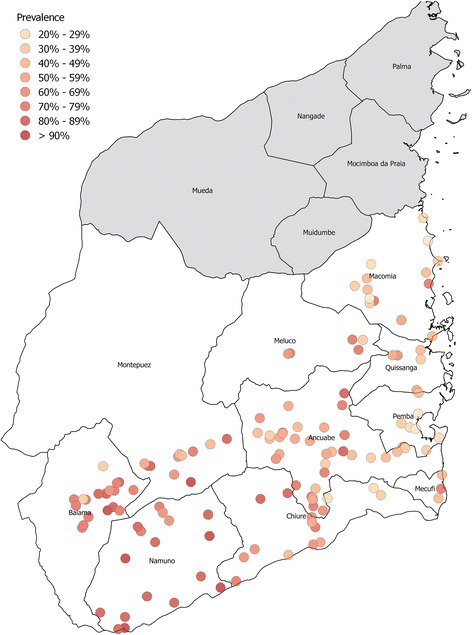
The results presented here are part of a five-year cluster-randomised intervention trial that was implemented to understand how best to gain and sustain control of schistosomiasis through different preventive chemotherapy strategies. This paper presents baseline data that were collected in ten districts of Cabo Delgado province, northern Mozambique, before treatment.
A cross-sectional study of 19,039 individuals was sampled from 144 villages from May to September 2011. In each village prevalence and intensity of S. haematobium were investigated in 100 children first-year students (aged 5-8 years), 100 school children aged 9-12 years (from classes 2 to 7) and 50 adults (20-55 years). Prevalence and intensity of S. haematobium infection were evaluated microscopically by two filtrations, each of 10 ml, from a single urine specimen. Given that individual and community perceptions of schistosomiasis influence control efforts, community knowledge and environmental risk factors were collected using a face-to-face interview. Data were entered onto mobile phones using EpiCollect. Data summary was made using descriptive statistics. Chi-square and logistic regression were used to determine the association between dependent and independent variables.
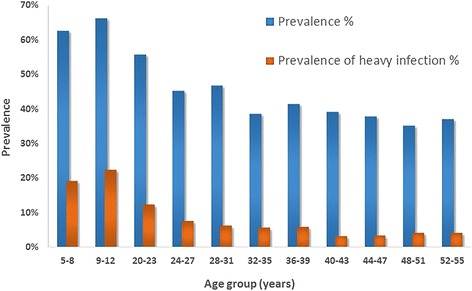
The overall prevalence of urogenital schistosomiasis was 60.4% with an arithmetic mean intensity of infection of 55.8 eggs/10 ml of urine. Heavy infections were detected in 17.7%, of which 235 individuals (6.97%) had an egg count of 1000 eggs/10 ml or more. There was a significantly higher likelihood of males being infected than females across all ages (62% vs 58%; P < 0.0005). Adolescents aged 9-12 years had a higher prevalence (66.6%) and mean infection intensity (71.9 eggs/10 ml) than first-year students (63.1%; 58.2 eggs/10 ml). This is the first study in Mozambique looking at infection rates among adults. Although children had higher levels of infection, it was found here that adults had a high average prevalence and intensity of infection (44.5%; 23.9 eggs/10 ml). Awareness of schistosomiasis was relatively high (68.6%); however, correct knowledge of how schistosomiasis is acquired was low (23.2%) among those who had heard of the disease. Schistosomiasis risk behaviour such as washing (91.3%) and bathing (86.7%) in open water sources likely to be infested with host snails was high.
Urogenital schistosomiasis is widespread in Cabo Delgado. In addition, poor community knowledge about the causes of schistosomiasis and how to prevent it increases the significant public health challenge for the national control program. This was the first study in Mozambique that examined infection levels among adults, where results showed that S. haematobium infection was also extremely high. Given that this controlled trial aims to understand the impact of different combinations of schistosomiasis control through treatment of communities, schools, and treatment holidays over a five-year period, these findings highlight the importance of examining the impact of different treatment approaches also in adults.
The trials have been registered with the International Standard Randomised Controlled Trial registry under ISRCT 14117624 Mozambique (14 December 2015).
本研究结果来自一项为期五年的整群随机干预试验,旨在了解通过不同的预防性化疗策略,如何最好地控制血吸虫病。本文介绍了在莫桑比克北部德尔加杜角省的十个地区进行的基线数据,这些数据是在治疗前于 2011 年 5 月至 9 月期间采集的。
采用横断面研究方法,在 2011 年 5 月至 9 月期间,从 144 个村庄抽取了 19039 名 5-8 岁的一年级小学生(100 人)、9-12 岁的在校儿童(2-7 年级,100 人)和 20-55 岁的 50 名成年人作为样本。在每个村庄,用两个滤器各收集 10 毫升尿液,对 100 名 5-8 岁的一年级小学生、100 名 9-12 岁的在校儿童和 50 名 20-55 岁的成年人进行调查,以评估 S. haematobium 的感染率和强度。显微镜检查采集的尿液样本,以确定是否存在感染。由于个体和社区对血吸虫病的认识会影响控制工作,因此使用面对面访谈收集了社区知识和环境风险因素。数据通过 EpiCollect 输入到手机中。使用描述性统计对数据进行总结。使用卡方检验和逻辑回归来确定因变量和自变量之间的关系。
总感染率为 60.4%,平均感染强度为 55.8 个/10 毫升尿液。检测到重度感染的有 17.7%,其中 235 人(6.97%)的尿液样本中含有 1000 个或更多的虫卵/10 毫升。各年龄段男性感染的可能性均高于女性(62%比 58%;P<0.0005)。9-12 岁的青少年(66.6%)的感染率和平均感染强度(71.9 个/10 毫升)均高于一年级小学生(63.1%;58.2 个/10 毫升)。这是莫桑比克首次研究成年人的感染率。虽然儿童的感染水平较高,但研究发现,成年人的感染率和平均感染强度也很高(44.5%;23.9 个/10 毫升)。虽然对血吸虫病的认识程度相对较高(68.6%),但对如何感染血吸虫病的正确认识程度较低(23.2%)。在听说过这种疾病的人中,在有宿主蜗牛的开放性水源中洗澡(91.3%)和洗澡(86.7%)的血吸虫病风险行为很高。
德尔加杜角的尿路血吸虫病很普遍。此外,社区对血吸虫病病因和预防方法的认识不足,这给国家控制项目带来了重大的公共卫生挑战。这是莫桑比克首次研究成年人的感染水平,结果表明,S. haematobium 的感染率也非常高。由于该对照试验旨在了解通过五年社区、学校和治疗假期的不同组合治疗来控制血吸虫病的影响,这些发现强调了在成年人中也检查不同治疗方法的影响的重要性。
该试验已在国际随机对照试验注册中心(ISRCTN)注册,注册号为 ISRCTN14117624(2015 年 12 月 14 日)。