Department of Psychology.
Emotion. 2021 Feb;21(1):39-51. doi: 10.1037/emo0000672. Epub 2019 Sep 2.
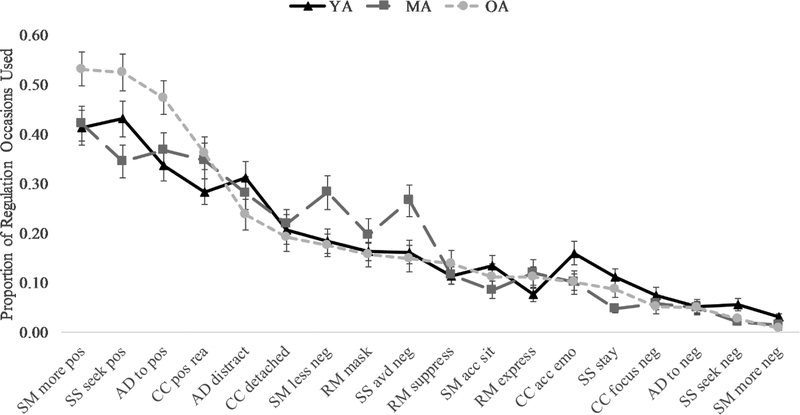
Models of aging and emotion hypothesize age differences in emotion regulation-in frequency, use of strategies, and/or effectiveness-but research to date has been mixed. In the current experience sampling study, younger, middle-aged, and older adults ( = 149), were prompted 5 times a day for 10 days to report on both general strategies (e.g., situation selection, cognitive change) and specific tactics. For each of the 5 strategies proposed by Gross's process model, tactics included those that introduced/increased positive aspects, avoided/decreased negative, and engaged with negative. Consistent with socioemotional selectivity theory, older adults reported less contra-hedonic motivation than younger, but this did not necessarily translate into age differences in regulation frequency or strategy use. Across the sample, strong preferences emerged for strategies intervening early in the emotional process and for tactics that introduced/increased positive aspects; a pattern that was even stronger in older adults. Middle-aged people more often avoided and reduced negative situations, whereas younger adults more often (though rarely) sought out or exacerbated negative situations. Effectiveness varied across strategies and tactics, but age differences only emerged for situation selection and reducing negative aspects of the situation (both less effective for older than younger adults). This research highlights the importance of studying how emotion regulation strategies are implemented in real life situations and suggests that age differences in emotion regulation, when they do emerge, may be more a matter of degree than of type. (PsycInfo Database Record (c) 2021 APA, all rights reserved).
衰老和情绪模型假设情绪调节在频率、策略的使用和/或效果方面存在年龄差异,但迄今为止的研究结果喜忧参半。在当前的经验抽样研究中,年轻、中年和老年成年人(=149)每天被提示 5 次,连续 10 天报告一般策略(例如,情境选择、认知改变)和具体策略。对于 Gross 过程模型提出的 5 种策略中的每一种,策略都包括引入/增加积极方面、避免/减少消极方面和应对消极方面的策略。与社会情绪选择理论一致,老年人报告的反享乐动机低于年轻人,但这并不一定转化为调节频率或策略使用方面的年龄差异。在整个样本中,早期干预情绪过程的策略和引入/增加积极方面的策略出现了强烈偏好;这种模式在老年人中更为明显。中年人更经常避免和减少消极情境,而年轻人更经常(尽管很少)寻求或加剧消极情境。策略和策略的有效性因情况而异,但仅在情境选择和减少情境的消极方面出现年龄差异(老年人的效果均不如年轻人)。这项研究强调了研究情绪调节策略如何在现实生活情境中实施的重要性,并表明情绪调节的年龄差异,当它们确实出现时,可能更多的是程度上的差异,而不是类型上的差异。