Masumoto Kouhei, Taishi Nozomi, Shiozaki Mariko
Kobe University, Japan.
Osaka University, Japan.
Gerontol Geriatr Med. 2016 Mar 16;2:2333721416637022. doi: 10.1177/2333721416637022. eCollection 2016 Jan-Dec.
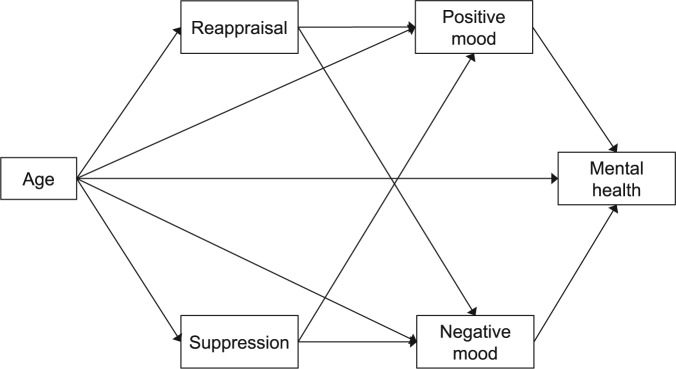
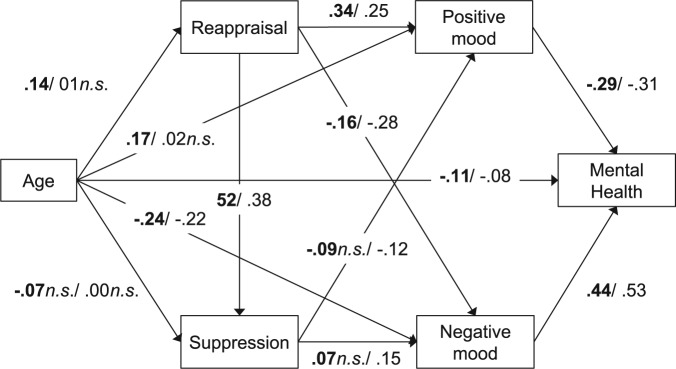
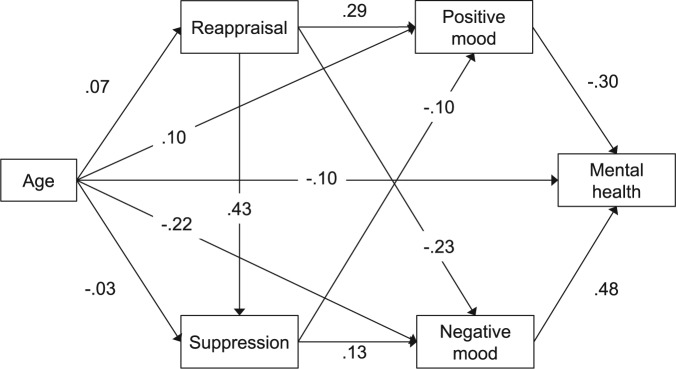
We investigated the effects of age on mood and mental health-mediated emotion regulation, such as cognitive reappraisal and expressive suppression, and examined whether these relationships differ according to gender. We recruited 936 Japanese participants. They comprised six age groups ranging from 20 to 70 years old, with 156 participants in each age group and equal numbers of men and women. Structural equation model analysis showed that older participants were more likely to use cognitive reappraisal, further enhancing positive mood and reducing negative mood, whereas, age did not affect expressive suppression. Moreover, expressive suppression had a smaller impact on mood than cognitive reappraisal. A multi-group analysis showed significant gender differences. In men, cognitive reappraisal increased with age and influenced mood more positively than in women. Our findings indicated gender differences in aging effects on emotion regulation. We discussed about these results from the cognitive process, motivation to emotion regulation, and cultural differences.
我们研究了年龄对情绪以及心理健康介导的情绪调节(如认知重评和表达抑制)的影响,并考察了这些关系是否因性别而异。我们招募了936名日本参与者。他们分为六个年龄组,年龄范围从20岁到70岁,每个年龄组有156名参与者,且男女数量相等。结构方程模型分析表明,年龄较大的参与者更有可能使用认知重评,这进一步增强了积极情绪并减少了消极情绪,而年龄对表达抑制没有影响。此外,表达抑制对情绪的影响比对认知重评的影响更小。多组分析显示出显著的性别差异。在男性中,认知重评随着年龄的增长而增加,并且对情绪的影响比女性更积极。我们的研究结果表明了年龄对情绪调节影响的性别差异。我们从认知过程、情绪调节动机和文化差异等方面讨论了这些结果。