Departamento de Genética e Evolução, Universidade Federal de São Carlos (UFSCar), São Carlos, SP 13565-090, Brazil.
Laboratory of Fish Genetics, Institute of Animal Physiology and Genetics, Czech Academy of Sciences, 27721 Liběchov, Czech Republic.
Int J Mol Sci. 2019 Sep 2;20(17):4296. doi: 10.3390/ijms20174296.
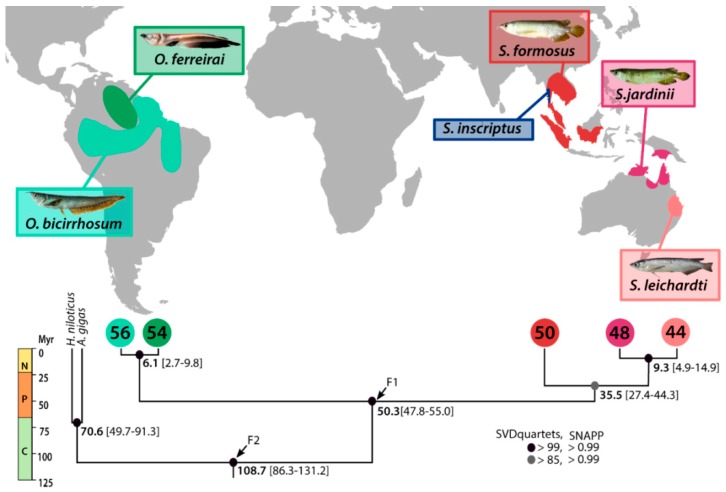
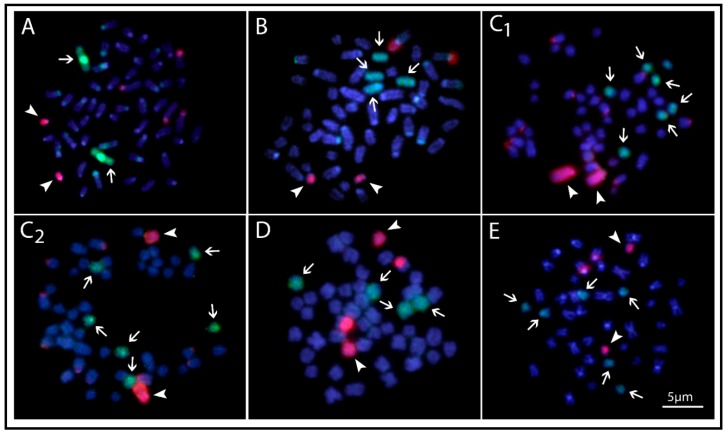
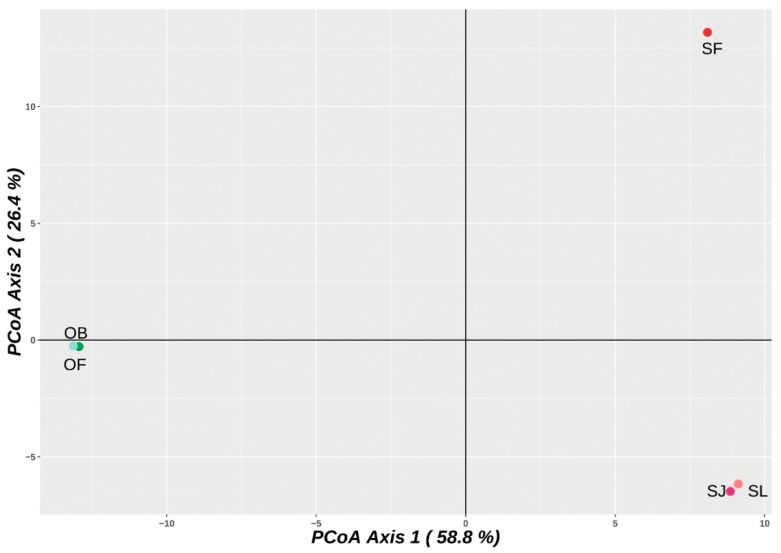
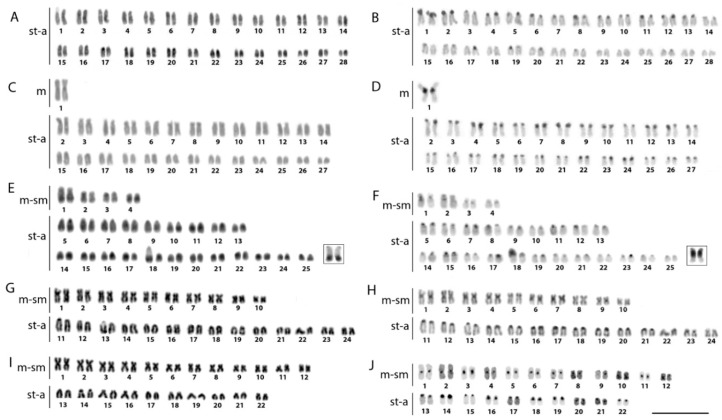
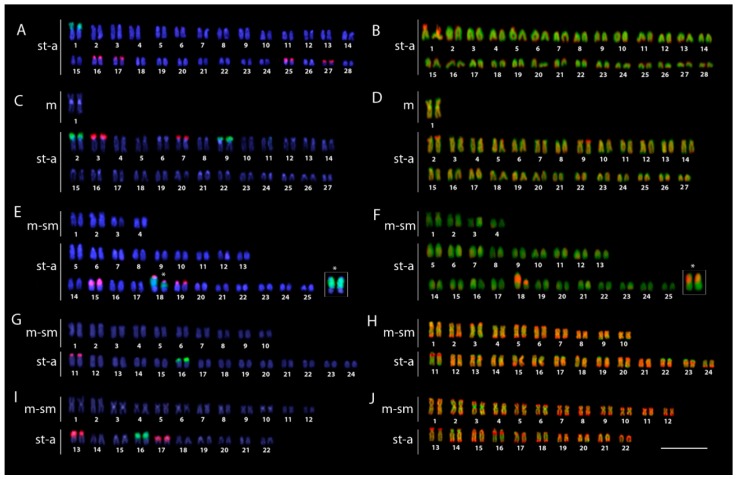
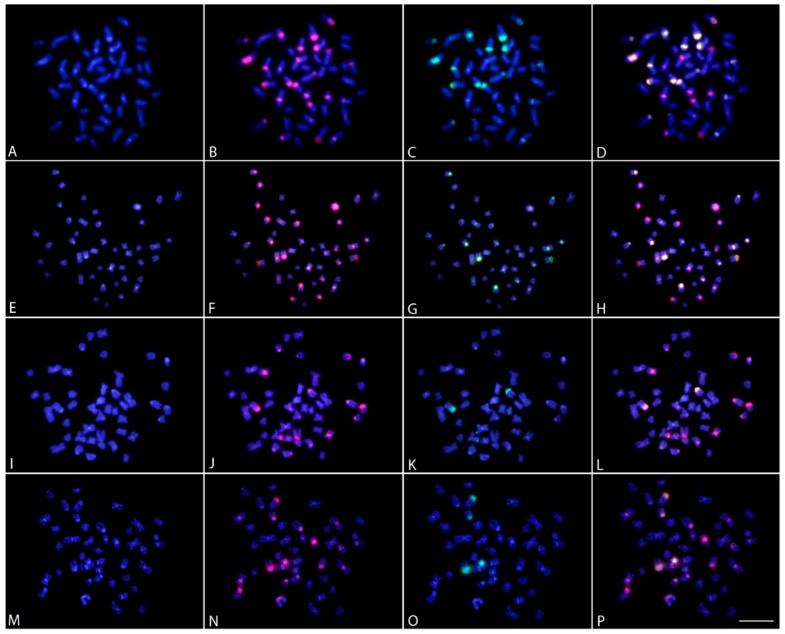
Arowanas (Osteoglossinae) are charismatic freshwater fishes with six species and two genera ( and ) distributed in South America, Asia, and Australia. In an attempt to provide a better assessment of the processes shaping their evolution, we employed a set of cytogenetic and genomic approaches, including i) molecular cytogenetic analyses using C- and CMA/DAPI staining, repetitive DNA mapping, comparative genomic hybridization (CGH), and Zoo-FISH, along with ii) the genotypic analyses of single nucleotide polymorphisms (SNPs) generated by diversity array technology sequencing (DArTseq). We observed diploid chromosome numbers of 2 = 56 and 54 in and , respectively, and 2 = 50 in while and presented 2 = 48 and 44, respectively. A time-calibrated phylogenetic tree revealed that and divergence occurred approximately 50 million years ago (MYA), at the time of the final separation of Australia and South America (with Antarctica). Asian and Australian diverged about 35.5 MYA, substantially after the latest terrestrial connection between Australia and Southeast Asia through the Indian plate movement. Our combined data provided a comprehensive perspective of the cytogenomic diversity and evolution of arowana species on a timescale.
骨舌鱼科(Osteoglossinae)鱼类是具有魅力的淡水鱼类,分布于南美洲、亚洲和澳大利亚,有 6 个种和 2 个属(和)。为了更好地评估塑造其进化的过程,我们采用了一套细胞遗传学和基因组学方法,包括 i)使用 C-和 CMA/DAPI 染色、重复 DNA 作图、比较基因组杂交 (CGH) 和 Zoo-FISH 的分子细胞遗传学分析,以及 ii)通过多样性阵列技术测序 (DArTseq) 生成的单核苷酸多态性 (SNP) 的基因型分析。我们观察到和的二倍体染色体数分别为 2 = 56 和 54,而 2 = 50,而 和 分别呈现 2 = 48 和 44。一个时间校准的系统发育树表明,和的分化大约发生在 5000 万年前(Mya),即澳大利亚和南美洲(与南极洲)最终分离的时候。亚洲的和澳大利亚的分化大约发生在 3550 万年前,远在澳大利亚和东南亚通过印度板块运动发生最新的陆地连接之后。我们的综合数据为骨舌鱼物种在时间尺度上的细胞基因组多样性和进化提供了全面的视角。