Cieślińska Mirosława
Department of Plant Pathology, Research Institute of Horticulture, Konstytucji 3 Maja 1/3, 96-100 Skierniewice, Poland.
Plant Pathol J. 2019 Aug;35(4):389-392. doi: 10.5423/PPJ.NT.12.2018.0306. Epub 2019 Aug 1.
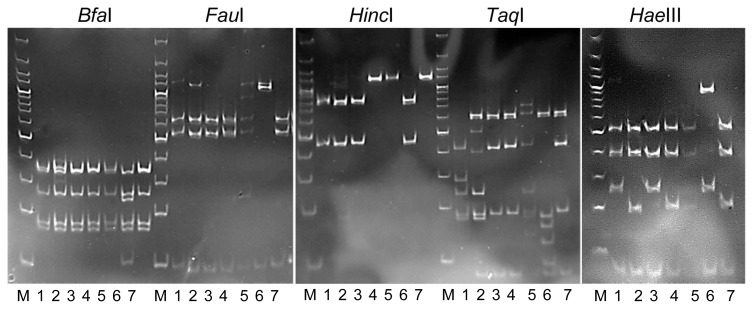
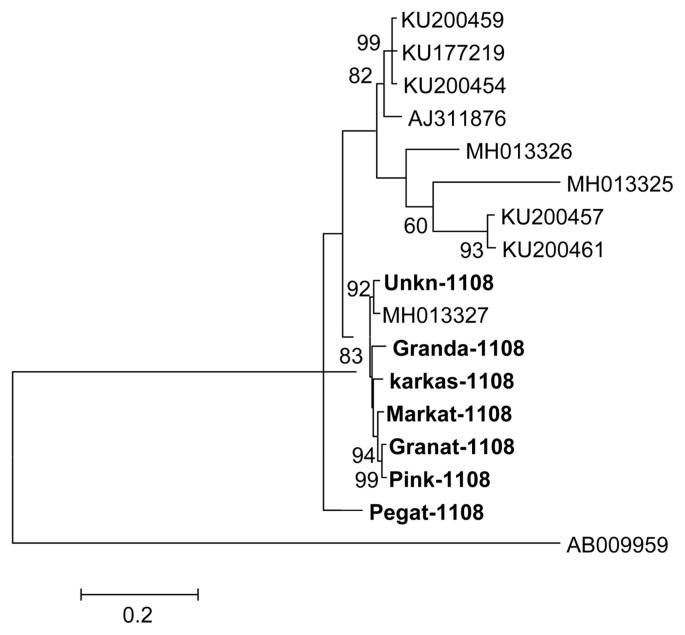
The studies on detection of the (SMoV) have been conducted in Poland for breeding programme purpose and for producers of strawberry plant material. Leaf samples collected from infected strawberry plants were grafted on sp. Indicators which were maintained in greenhouse for further study. Seven var. 'Alpine' indicators infected by SMoV were used for the study aimed on molecular characterization of virus isolates. Partial RNA2 was amplified from total nucleic acids using the RT-PCR method. The obtained amplicons separately digested with I, I, III, I, and I enzymes showed different restriction profiles. The nucleotide sequences analysis of RNA2 fragment confirmed the genetic diversity of the SMoV isolates as their similarity ranged from 94.7 to 100%. Polish isolates shared 75.7-99.2% identity with sequence of the virus strains from the Czech Republic, the Netherlands, and Canada. Phylogenetic analysis resulted in grouping of the isolates found in Poland together with one of the Czech strain whereas two other from the Czech and the strains from the Netherlands and Canada created the separate cluster.
在波兰,为了育种计划以及草莓种植材料生产商的目的,开展了对草莓潜隐环斑病毒(SMoV)的检测研究。从受感染的草莓植株上采集叶片样本,嫁接到指示植物上,这些指示植物在温室中保存以进行进一步研究。七个受SMoV感染的“高山”品种指示植物被用于旨在对病毒分离株进行分子特征分析的研究。使用RT-PCR方法从总核酸中扩增出部分RNA2。用I、I、III,、I和I酶分别消化获得的扩增子,显示出不同的限制性图谱。RNA2片段的核苷酸序列分析证实了SMoV分离株的遗传多样性,因为它们的相似性范围为94.7%至100%。波兰分离株与来自捷克共和国、荷兰和加拿大的病毒株序列具有75.7%-99.2%的同一性。系统发育分析结果是,波兰发现的分离株与捷克的一个菌株归为一组,而来自捷克的另外两个菌株以及来自荷兰和加拿大的菌株形成了单独的簇。