Salem Esam S B, Vonberg Andrew D, Borra Vishnupriya J, Gill Rupinder K, Nakamura Takahisa
Division of Endocrinology, Cincinnati Children's Hospital Medical Center, Cincinnati, OH, United States.
Department of Pharmacology and Systems Physiology, University of Cincinnati College of Medicine, Cincinnati, OH, United States.
Front Cardiovasc Med. 2019 Aug 20;6:106. doi: 10.3389/fcvm.2019.00106. eCollection 2019.
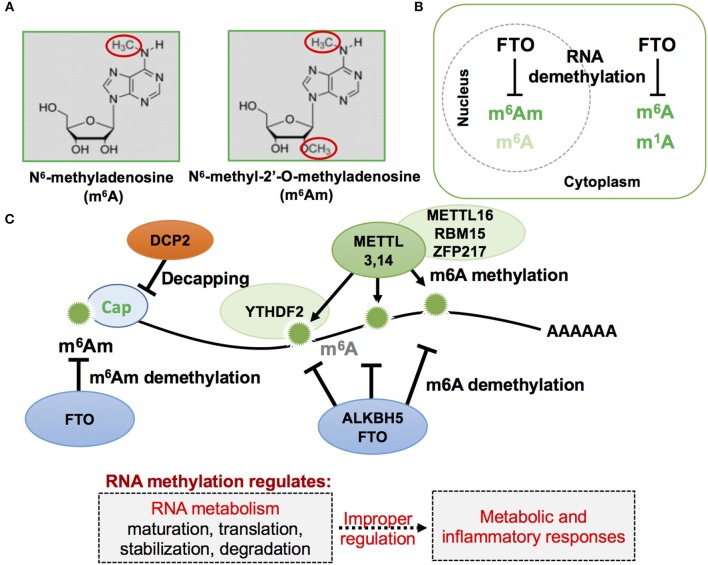
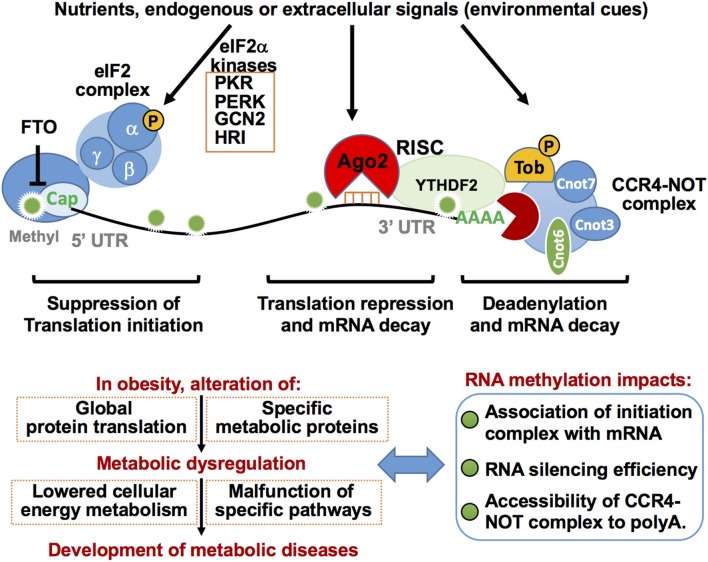
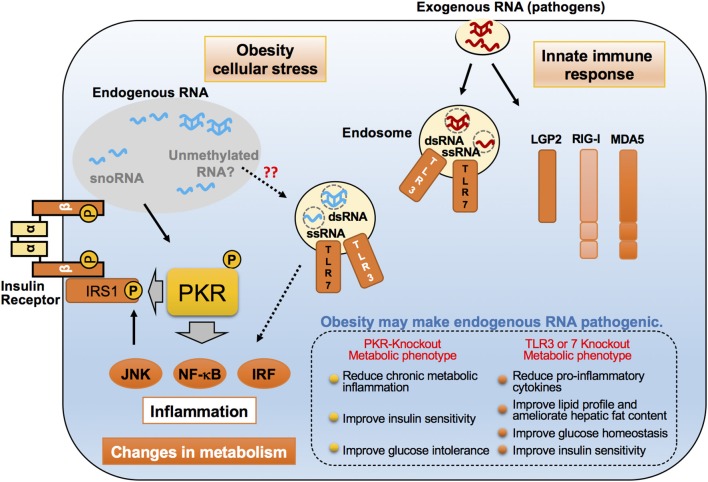
The increasing prevalence of worldwide obesity has emerged as a major risk factor for type 2 diabetes (T2D), hepatosteatosis, and cardiovascular disease. Accumulating evidence indicates that obesity has strong inflammatory underpinnings tightly linked to the development of metabolic diseases. However, the molecular mechanisms by which obesity induces aberrant inflammation associated with metabolic diseases are not yet clearly defined. Recently, RNAs have emerged as important regulators of stress responses and metabolism. RNAs are subject to changes in modification status, higher-order structure, and cellular localization; all of which could affect the affinity for RNA-binding proteins (RBPs) and thereby modify the RNA-RBP networks. Proper regulation and management of RNA characteristics are fundamental to cellular and organismal homeostasis, as well as paramount to health. Identification of multiple single nucleotide polymorphisms (SNPs) within loci of fat mass- and obesity-associated protein (FTO) gene, an RNA demethylase, through genome-wide association studies (GWAS) of T2D, and functional assessments of FTO in mice, support the concept that disruption in RNA modifications leads to the development of human diseases including obesity and metabolic disorder. In obesity, dynamic alterations in modification and localization of RNAs appear to modulate the RNA-RBP networks and activate proinflammatory RBPs, such as double-stranded RNA (dsRNA)-dependent protein kinase (PKR), Toll-like receptor (TLR) 3 and TLR7, and RNA silencing machinery. These changes induce aberrant inflammation and the development of metabolic diseases. This review will describe the current understanding of the underlying causes of these common and altered characteristics of RNA-RBP networks which will pave the way for developing novel approaches to tackle the pandemic issue of obesity.
全球肥胖率的不断上升已成为2型糖尿病(T2D)、肝脂肪变性和心血管疾病的主要危险因素。越来越多的证据表明,肥胖具有强烈的炎症基础,与代谢性疾病的发展紧密相关。然而,肥胖诱导与代谢性疾病相关的异常炎症的分子机制尚未明确。最近,RNA已成为应激反应和代谢的重要调节因子。RNA的修饰状态、高级结构和细胞定位会发生变化;所有这些都可能影响其与RNA结合蛋白(RBP)的亲和力,从而改变RNA-RBP网络。对RNA特征进行适当的调控和管理是细胞和机体稳态的基础,对健康也至关重要。通过对T2D的全基因组关联研究(GWAS)以及对小鼠中FTO的功能评估,在脂肪量和肥胖相关蛋白(FTO)基因(一种RNA去甲基化酶)的基因座内鉴定出多个单核苷酸多态性(SNP),这支持了RNA修饰破坏会导致包括肥胖和代谢紊乱在内的人类疾病发展的概念。在肥胖状态下,RNA修饰和定位的动态变化似乎会调节RNA-RBP网络并激活促炎RBP,如双链RNA(dsRNA)依赖性蛋白激酶(PKR)、Toll样受体(TLR)3和TLR7以及RNA沉默机制。这些变化会引发异常炎症和代谢性疾病的发展。本综述将描述目前对这些RNA-RBP网络常见和改变特征的潜在原因的理解,这将为开发应对肥胖这一全球性问题的新方法铺平道路。