Rasool Mahmood, Malik Arif, Butt Tariq Tahir, Ashraf Muhammad Abdul Basit, Rasool Rabia, Zahid Ayesha, Waquar Sulayman, Asif Muhammad, Zaheer Ahmad, Jabbar Abdul, Zain Maryam, Mehmood Asim, Qaisrani Tahira Batool, Malik Imran Riaz, Khan Sami Ullah, Mirza Zeenat, Haque Absarul, Al-Qahtani Mohammed Hussein, Karim Sajjad
Center of Excellence in Genomic Medicine Research, King Abdulaziz University, Jeddah, Saudi Arabia.
Institute of Molecular Biology and Biotechnology, The University of Lahore, Lahore, Pakistan.
Saudi J Biol Sci. 2019 Feb;26(2):334-339. doi: 10.1016/j.sjbs.2018.08.024. Epub 2018 Aug 27.
To study the putative effects of Advanced Oxidation Protein Products (AOPPs) and Advanced Glycation End Products (AGEs) in the development and progression of cardiovascular disease (CVD).
AGEs, AOPPs, e-NOS, lipid profile, circulating stress and inflammatory biomarkers were evaluated among fifty cardiovascular patients and fifty controls. Independent student's -test was done for statistical analysis.
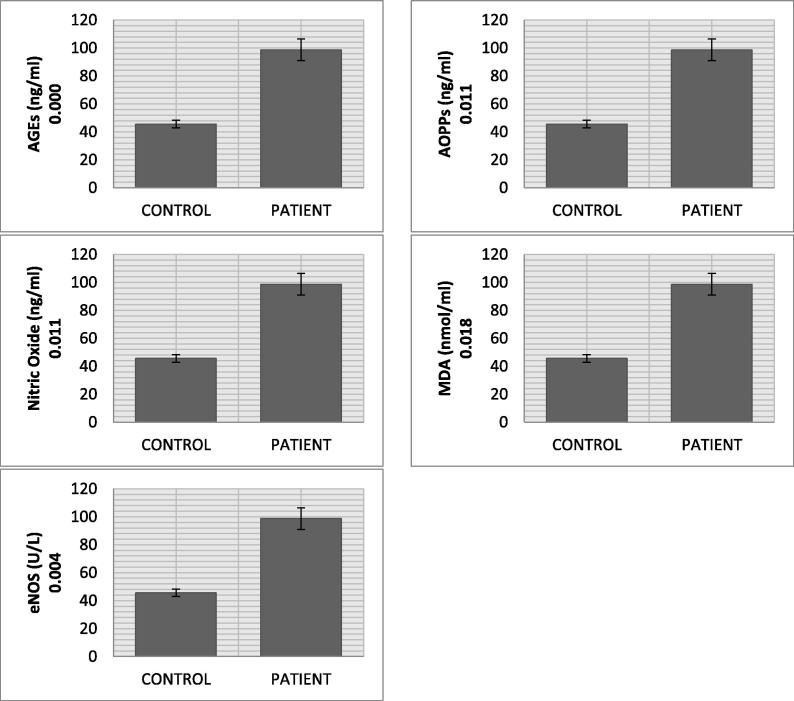
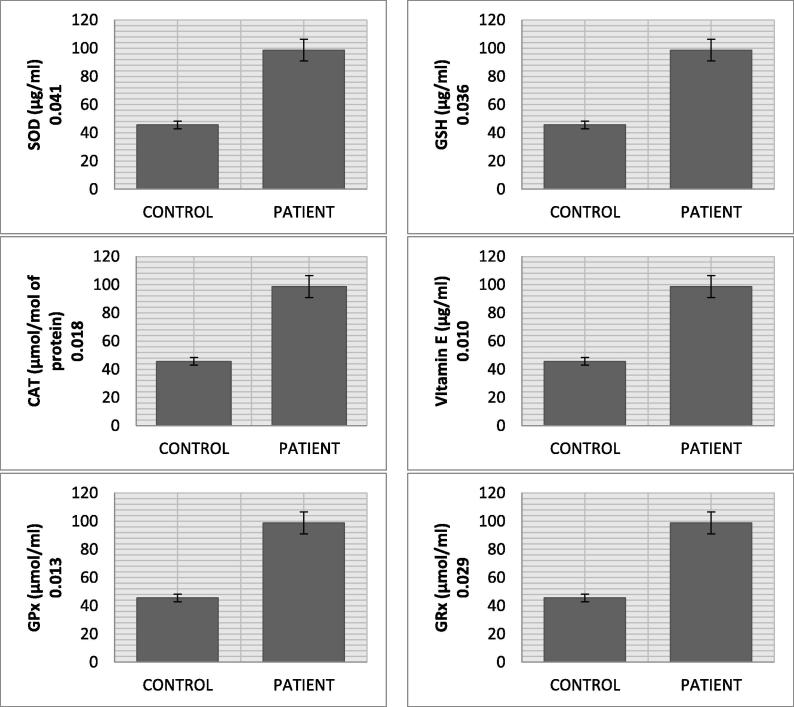
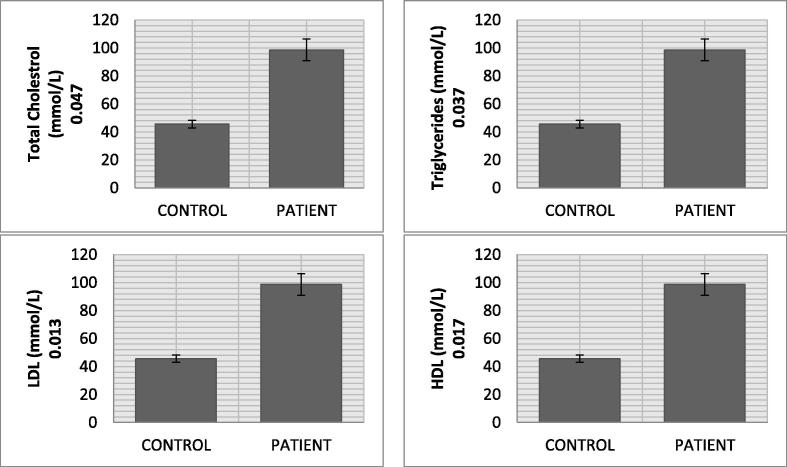
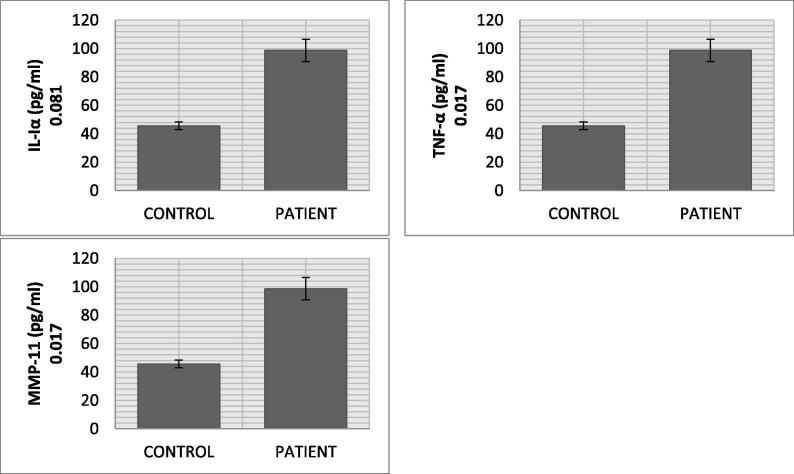
The malondialdehyde mean level in CVD patients (5.45 nmol/ml) was significantly higher than control (1.36 nmol/ml) (p value = 0.018). Nitric oxide in CVD patients (55.72 ng/ml) was remarkably increased as compared to normal subjects (19.19 ng/ml). A significant change in the mean serum level of AGEs in CVD patients (2.74 ng/ml) and normal individuals (0.85 ng/ml) was recorded (p value = 0.000). The AOPPs also showed significant increased levels in CVD group (132.07 ng/ml) in comparison with normal subjects (83.05 ng/ml) (p value = 0.011). The mean eNOS serum level in CVD group (15.50 U/L) was higher than control group (11.28 U/L) (p value = 0.004). Cardiovascular disease patients, in comparison with healthy controls, showed increased level of total cholesterol (5.48 mmol/L vs 4.45 mmol/L), triglycerides (2.59 mmol/L vs 1.24 mmol/L), and low density lipoprotein (2.47 mmol/L vs 2.31 mmol/L) along with decrease in high density lipoprotein (1.39 mmol/L vs 1.74 mmol/L). The mean MMP-11 serum levels in CVD group (98.69 ng/ml) was almost double of control group (45.60 ng/ml) (p value = 0.017). The mean serum level of TNF-α and IL1-α were 32.16 pg/ml and 6.64 pg/ml in CVD patient. The significant decreasing trend of SOD (p value = 0.041), CAT (p value = 0.018), GSH (p value = 0.036) and GRx (p value = 0.029) but increasing drift of GPx (0.023) level was observed in CVD patients.
This study provides strong evidence that CVD patients presented with elevated oxidative stress, enhanced inflammation and lipid profile in their serum. Therefore, the study strongly approves that AGEs, AOPPs, inflammatory and lipoxidative biomarkers hold predictive potential in causing and aggravating the disease, thus by controlling these factors CVD progression can be inhibited.
研究晚期氧化蛋白产物(AOPPs)和晚期糖基化终末产物(AGEs)在心血管疾病(CVD)发生发展过程中的假定作用。
对50例心血管疾病患者和50例对照者进行AGEs、AOPPs、内皮型一氧化氮合酶(e-NOS)、血脂谱、循环应激和炎症生物标志物的评估。采用独立样本t检验进行统计分析。
CVD患者丙二醛平均水平(5.45 nmol/ml)显著高于对照组(1.36 nmol/ml)(p值 = 0.018)。与正常受试者(19.19 ng/ml)相比,CVD患者的一氧化氮(55.72 ng/ml)显著升高。记录到CVD患者(2.74 ng/ml)和正常个体(0.85 ng/ml)血清AGEs平均水平有显著变化(p值 = 0.000)。与正常受试者(83.05 ng/ml)相比,CVD组AOPPs水平也显著升高(132.07 ng/ml)(p值 = 0.011)。CVD组eNOS血清平均水平(15.50 U/L)高于对照组(11.28 U/L)(p值 = 0.004)。与健康对照组相比,心血管疾病患者的总胆固醇(5.48 mmol/L对4.45 mmol/L)、甘油三酯(2.59 mmol/L对1.24 mmol/L)和低密度脂蛋白(2.47 mmol/L对2.31 mmol/L)水平升高,同时高密度脂蛋白水平降低(1.39 mmol/L对1.74 mmol/L)。CVD组MMP-11血清平均水平(98.69 ng/ml)几乎是对照组(45.60 ng/ml)的两倍(p值 = 0.017)。CVD患者血清TNF-α和IL1-α的平均水平分别为32.16 pg/ml和6.64 pg/ml。观察到CVD患者超氧化物歧化酶(SOD)(p值 = 0.041)、过氧化氢酶(CAT)(p值 = 0.018)、谷胱甘肽(GSH)(p值 = 0.036)和谷氧还蛋白(GRx)(p值 = 0.029)水平呈显著下降趋势,但谷胱甘肽过氧化物酶(GPx)水平呈上升趋势(0.023)。
本研究提供了强有力的证据,表明CVD患者血清中氧化应激升高、炎症增强且血脂谱异常。因此,该研究强烈支持AGEs、AOPPs、炎症和脂氧化生物标志物在引发和加重疾病方面具有预测潜力,通过控制这些因素可抑制CVD的进展。