Pacurari Maricica, Kafoury Ramzi, Tchounwou Paul B, Ndebele Kenneth
Biology Department, College of Engineering, Science, and Technology, Jackson State University, Jackson, MS 39217, USA ; NIH RCMI-Center for Environmental Health, College of Engineering, Science, and Technology, Jackson State University, Jackson, MS 39217, USA.
Int J Inflam. 2014;2014:689360. doi: 10.1155/2014/689360. Epub 2014 Apr 6.
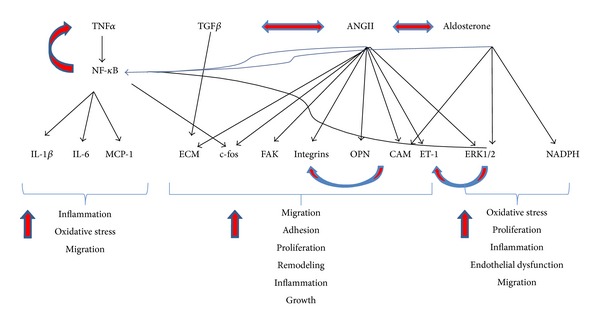
The RAAS through its physiological effectors plays a key role in promoting and maintaining inflammation. Inflammation is an important mechanism in the development and progression of CVD such as hypertension and atherosclerosis. In addition to its main role in regulating blood pressure and its role in hypertension, RAAS has proinflammatory and profibrotic effects at cellular and molecular levels. Blocking RAAS provides beneficial effects for the treatment of cardiovascular and renal diseases. Evidence shows that inhibition of RAAS positively influences vascular remodeling thus improving CVD outcomes. The beneficial vascular effects of RAAS inhibition are likely due to decreasing vascular inflammation, oxidative stress, endothelial dysfunction, and positive effects on regeneration of endothelial progenitor cells. Inflammatory factors such as ICAM-1, VCAM-1, TNFα, IL-6, and CRP have key roles in mediating vascular inflammation and blocking RAAS negatively modulates the levels of these inflammatory molecules. Some of these inflammatory markers are clinically associated with CVD events. More studies are required to establish long-term effects of RAAS inhibition on vascular inflammation, vascular cells regeneration, and CVD clinical outcomes. This review presents important information on RAAS's role on vascular inflammation, vascular cells responses to RAAS, and inhibition of RAAS signaling in the context of vascular inflammation, vascular remodeling, and vascular inflammation-associated CVD. Nevertheless, the review also equates the need to rethink and rediscover new RAAS inhibitors.
肾素-血管紧张素-醛固酮系统(RAAS)通过其生理效应器在促进和维持炎症方面发挥关键作用。炎症是诸如高血压和动脉粥样硬化等心血管疾病(CVD)发生和发展的重要机制。除了在调节血压方面的主要作用及其在高血压中的作用外,RAAS在细胞和分子水平上还具有促炎和促纤维化作用。阻断RAAS对心血管和肾脏疾病的治疗具有有益效果。证据表明,抑制RAAS对血管重塑有积极影响,从而改善心血管疾病的预后。抑制RAAS对血管的有益作用可能是由于减少了血管炎症、氧化应激、内皮功能障碍,以及对内皮祖细胞再生的积极作用。细胞间黏附分子-1(ICAM-1)、血管细胞黏附分子-1(VCAM-1)、肿瘤坏死因子α(TNFα)、白细胞介素-6(IL-6)和C反应蛋白(CRP)等炎症因子在介导血管炎症中起关键作用,而阻断RAAS可负向调节这些炎症分子的水平。其中一些炎症标志物在临床上与心血管疾病事件相关。需要更多的研究来确定抑制RAAS对血管炎症、血管细胞再生和心血管疾病临床结局的长期影响。本综述介绍了关于RAAS在血管炎症中的作用、血管细胞对RAAS的反应,以及在血管炎症、血管重塑和与血管炎症相关的心血管疾病背景下抑制RAAS信号传导的重要信息。然而,该综述也强调了重新思考和发现新型RAAS抑制剂的必要性。