
通过科室病例回顾确定实体器官移植不良事件的模式
Identifying Patterns of Adverse Events of Solid Organ Transplantation Through Departmental Case Reviews.
作者信息
Mathur Amit K, Stemper-Bartkus Cynthia, Engholdt Kevin, Thorp Andrea, Dosmann Melissa, Khamash Hasan, Reddy Kunam S, Aqel Bashar, Moss Adyr, Chakkera Harini, Steidley D Eric, Pajaro Octavio, Shah Sadia, Oakley Elizabeth J, Douglas David
机构信息
Transplant Surgery, Mayo Clinic Arizona, Phoenix.
Transplant Center, Mayo Clinic Arizona, Phoenix.
出版信息
Mayo Clin Proc Innov Qual Outcomes. 2019 Jul 19;3(3):335-343. doi: 10.1016/j.mayocpiqo.2019.04.007. eCollection 2019 Sep.
UNLABELLED
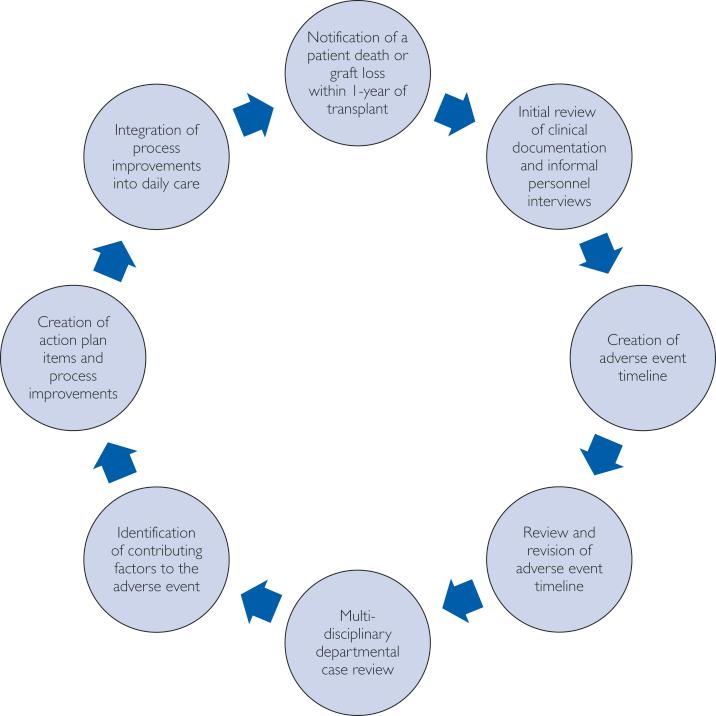
The best approach to adverse-event review in solid organ transplantation is unknown. We initiated a departmental case review (DCR) method based on root-cause analysis methods in a high-volume multiorgan transplant center. We aimed to describe this process and its contributions to process improvement.
METHODS
Using our prospectively maintained transplant center quality portfolio, we performed a retrospective review of a 30-month period (October 26, 2015, to May 14, 2018) after DCR-process initiation at our center. We used univariate statistics to identify counts of adverse events, DCRs, death and graft-loss events, and quality improvement action-plan items identified during case review. We evaluated variation among organ groups in action-plan items, associated phase of transplant care, and quality improvement theme.
RESULTS
Over 30 months, we performed 1449 transplant and living donor procedures with a total of 45 deaths and 31 graft losses; 91 DCRs were performed (kidney transplant n=43; liver transplant n=24; pancreas transplant n=10; heart transplant n=6; lung transplant n=3; living donor n=5). Seventy-nine action-plan items were identified across improvement domains, including errors in clinical decision making, communication, compliance, documentation, selection, waitlist management, and administrative processes. Median time to review was 83 days and varied significantly by program. Median time to action-plan item completion was 9 weeks. Clinical decision making in the pretransplant phase was identified as an improvement opportunity in all programs.
CONCLUSIONS
DCRs provide a robust approach to transplant adverse-event review. Quality improvement targets and domains may vary based on adverse-event profiles.
未标注
实体器官移植中不良事件审查的最佳方法尚不清楚。我们在一个高容量多器官移植中心基于根本原因分析方法启动了部门病例审查(DCR)方法。我们旨在描述这一过程及其对流程改进的贡献。
方法
利用我们前瞻性维护的移植中心质量档案,对我们中心启动DCR流程后的30个月期间(2015年10月26日至2018年5月14日)进行回顾性审查。我们使用单变量统计来确定不良事件、DCR、死亡和移植物丢失事件的数量,以及病例审查期间确定的质量改进行动计划项目。我们评估了各器官组在行动计划项目、移植护理相关阶段和质量改进主题方面的差异。
结果
在30个月内,我们进行了1449例移植和活体供体手术,共有45例死亡和31例移植物丢失;进行了91次DCR(肾移植n = 43;肝移植n = 24;胰腺移植n = 10;心脏移植n = 6;肺移植n = 3;活体供体n = 5)。在各个改进领域确定了79个行动计划项目,包括临床决策、沟通、合规性、文件记录、选择、等待名单管理和行政流程方面的错误。审查的中位时间为83天,各项目差异显著。行动计划项目完成的中位时间为9周。移植前阶段的临床决策在所有项目中均被确定为一个改进机会。
结论
DCR为移植不良事件审查提供了一种有力的方法。质量改进目标和领域可能因不良事件概况而异。


 Zotero 插件