Moukarzel Sara, Abou Jaoudeh Maya, Farhat Antoine, Saade Marianne, Mamas Christoforos, Daly Alan J
Larsson-Rosenquist Foundation Mother-Milk-Infant Center of Research Excellence, University of California San Diego, California, USA.
Department of Education Studies, University of California San Diego, California, USA.
Matern Child Nutr. 2020 Jan;16(1):e12888. doi: 10.1111/mcn.12888. Epub 2019 Sep 4.
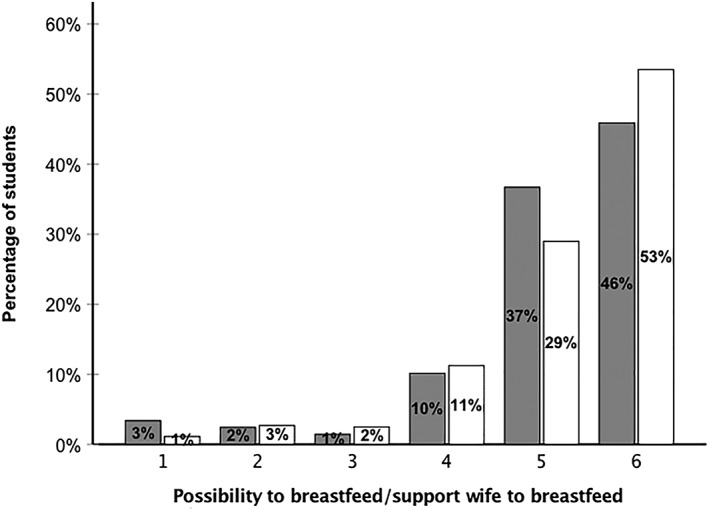
School-based breastfeeding education (SBBE) may help improve breastfeeding rates in the long-term by targeting children and adolescents' knowledge, attitudes, skills, and intentions. Breastfeeding rates in Lebanon are suboptimal. Psychosocial drivers of breastfeeding intention among the youth are unknown. We administered a survey to 658 high school students (448 females; 210 males) at two large Lebanese schools to understand intentions, intention drivers, and views on SBBE as means to guide SBBE programme design on the basis of the theory of planned behaviour. We collected information on demographics, intention to breastfeed/support wife to breastfeed future. Intention was predicted by attitude related to breastfeeding health outcomes and family normative beliefs-χ (25) = 115, P < .001 for males, and χ (39.3) = 186, P < .001 for females. Among females, intention was also positively associated with being breastfed, higher socio-economic status, and being more accepting of public breastfeeding. Seventy-eight per cent of students felt they were not learning enough about breastfeeding in school but were interested in SBBE through didactic teaching methods and interactive experiences. Findings indicate that breastfeeding intention among adolescent students is not merely influenced by the extent of knowledge but by more complicated psychosocial drivers that may differ by gender. Our findings also suggest a misalignment exists between what schools are providing with what students feel they need, thereby opening up a potential space for intervention.
以学校为基础的母乳喂养教育(SBBE)通过针对儿童和青少年的知识、态度、技能和意愿,可能有助于长期提高母乳喂养率。黎巴嫩的母乳喂养率不理想。青少年母乳喂养意愿的社会心理驱动因素尚不清楚。我们对黎巴嫩两所大型学校的658名高中生(448名女生;210名男生)进行了一项调查,以了解他们的意愿、意愿驱动因素以及对SBBE作为指导SBBE项目设计手段的看法,该设计基于计划行为理论。我们收集了有关人口统计学、母乳喂养/支持妻子未来母乳喂养意愿的信息。男性的意愿由与母乳喂养健康结果相关的态度和家庭规范信念预测——χ(25)=115,P<.001;女性的χ(39.3)=186,P<.001。在女性中,意愿还与母乳喂养、较高的社会经济地位以及更接受公共场所母乳喂养呈正相关。78%的学生认为他们在学校里对母乳喂养的了解不够,但通过教学方法和互动体验对SBBE感兴趣。研究结果表明,青少年学生的母乳喂养意愿不仅受知识程度的影响,还受可能因性别而异的更复杂的社会心理驱动因素的影响。我们的研究结果还表明,学校提供的内容与学生认为他们需要的内容之间存在脱节,从而为干预开辟了潜在空间。