Moukarzel Sara, Rehm Martin, Daly Alan J
Larsson-Rosenquist Foundation Mother-Milk-Infant Center of Research Excellence, University of California San Diego, La Jolla, California, USA.
Department of Education Studies, University of California San Diego, La Jolla, California, USA.
Matern Child Nutr. 2020 Oct;16(4):e13053. doi: 10.1111/mcn.13053. Epub 2020 Jul 7.
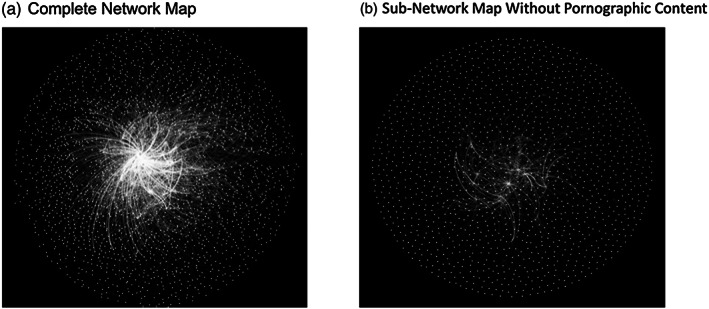
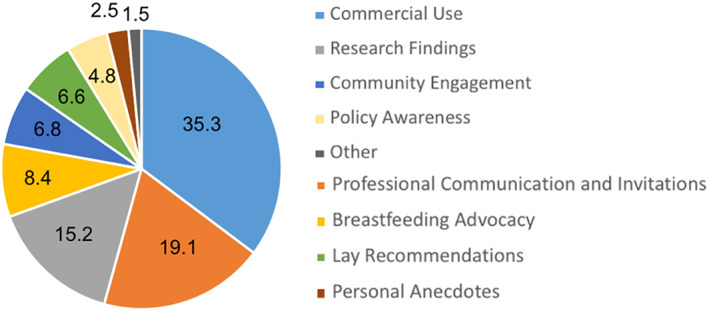
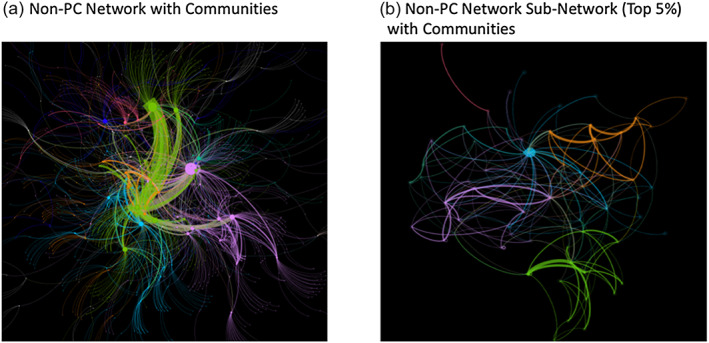
The importance of breastfeeding for maternal and infant health is well-established, yet complex and intertwined sociocultural barriers contribute to suboptimal breastfeeding rates in most countries. Large-scale campaigns for evidence dissemination and promotion through targeted interventions on social media may help overcome some of these barriers. To date, most breastfeeding research on social media only focuses on content analysis, and there remains limited knowledge about the social networks of online communities (who interacts with whom), influencers in the breastfeeding space and the diffusion of evidence-based knowledge. This study, grounded in social network theory, aims to better understand the breastfeeding communication landscape on Twitter including determining the presence of a breastfeeding network, communities and key influencers. Further, we characterize influencer interactions, roles and the content being shared. The study revealed an overall breastfeeding social network of 3,798 unique individuals (users) and 3,972 tweets with commonly used hashtags (e.g., #breastfeeding and #normalizebreastfeeding). Around one third of users (n = 1,324, 34%) exchanged pornographic content (PC) that sexualized breastfeeding. The non-PC network (n = 2,474 users) formed 144 unique communities, and content flowing within the network was disproportionately influenced by 59 key influencers. However, these influencers had mostly inward-oriented interaction (% composition, E-I index: 47% professionals, -0.18; 41% interested citizens, -0.67; 12% companies, -0.18), limiting opportunities for evidence-based dissemination to the lay public. Although more tweets about peer-reviewed research findings were sent compared with tweets about nonevidence-based lay recommendations, our findings suggest that it is the lay public who often communicated findings, which may be overcome through a targeted social network-based intervention.
母乳喂养对母婴健康的重要性已得到充分证实,但复杂且相互交织的社会文化障碍导致大多数国家的母乳喂养率未达最佳水平。通过在社交媒体上进行有针对性的干预来开展大规模的证据传播和推广活动,可能有助于克服其中一些障碍。迄今为止,大多数关于社交媒体上母乳喂养的研究仅侧重于内容分析,对于在线社区的社交网络(谁与谁互动)、母乳喂养领域的有影响力者以及循证知识的传播,了解仍然有限。本研究基于社会网络理论,旨在更好地理解推特上的母乳喂养传播格局,包括确定母乳喂养网络、社区和关键有影响力者的存在情况。此外,我们还对有影响力者的互动、角色以及所分享的内容进行了特征描述。该研究揭示了一个由3798个独特个体(用户)和3972条带有常用标签(如#母乳喂养和#使母乳喂养常态化)的推文组成的整体母乳喂养社交网络。约三分之一的用户(n = 1324,34%)分享了将母乳喂养色情化的色情内容(PC)。非PC网络(n = 2474用户)形成了144个独特的社区,网络内流动的内容受到59位关键有影响力者的影响过大。然而,这些有影响力者大多具有内向型互动(组成比例,E-I指数:47%为专业人士,-0.18;41%为感兴趣的公民,-0.67;12%为公司,-0.18),限制了向公众传播循证知识的机会。尽管与关于非循证的外行建议的推文相比,关于同行评审研究结果的推文更多,但我们的研究结果表明,通常是公众在传播研究结果,这可能通过有针对性的基于社交网络的干预来克服。