Mohebbi Zinat, Dehkordi Setareh Fazel, Sharif Farkhondeh, Banitalebi Ebrahim
School of Nursing, Shiraz University of Medical Sciences, Shiraz, Iran,
School of Nursing, Shiraz University of Medical Sciences, Shiraz, Iran.
Invest Educ Enferm. 2019 May;37(2). doi: 10.17533/udea.iee.v37n2e05.
This work sought to determine the effectiveness of an aerobic exercise program on the occupational stress of nurses.
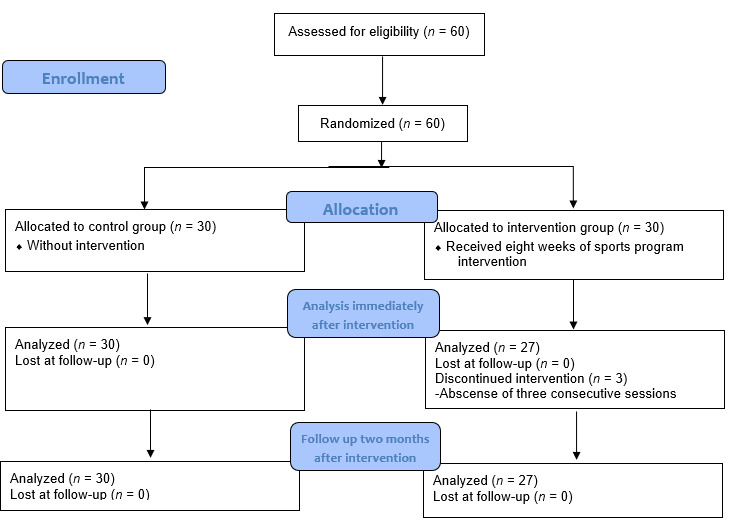
Prevention-type controlled clinical trial carried out with the participation of 60 nurses working in hospitals affiliated to Shahrekord University of Medical Sciences in Iran. Randomly, the nurses were assigned to the experimental group or to the control group. The intervention consisted in an aerobic exercise program lasting three months with three weekly sessions one hour each. The Health and Safety Executive (HSE) questionnaire measured occupational stress with 35 questions, each with five Likert-type response options, which can have a maximum score of 175 points; higher scores meant lower levels of occupational stress. The HSE was evaluated during three moments: upon registering, after finishing the exercise program (week 8), and two months after terminating the intervention (week 16).
The level of occupational stress was the same in the experimental and control groups during registration (86.2 vs. 86.3). Upon finishing the aerobic exercise program (week 8), the experimental group showed a higher score than the control group (119.7 vs. 86.2, p<0.01), with this score diminishing after two months of having ended the intervention (91.4 vs. 85.8, p=0.061).
The aerobic exercise program was associated to decreased work stress of nurses in the experimental group compared to the control group at eight weeks, but this difference did not persist when the experimental group did not continue with the program.
本研究旨在确定有氧运动计划对护士职业压力的有效性。
开展预防性对照临床试验,60名在伊朗沙赫雷克德医科大学附属医院工作的护士参与其中。护士被随机分配到实验组或对照组。干预措施为一项为期三个月的有氧运动计划,每周进行三次,每次一小时。健康与安全执行委员会(HSE)问卷通过35个问题测量职业压力,每个问题有五个李克特式回答选项,最高得分为175分;得分越高意味着职业压力水平越低。在三个时间点对HSE进行评估:登记时、运动计划结束后(第8周)以及干预结束两个月后(第16周)。
登记时,实验组和对照组的职业压力水平相同(86.2对86.3)。有氧运动计划结束时(第8周),实验组得分高于对照组(119.7对86.2,p<0.01),在干预结束两个月后该得分有所下降(91.4对85.8,p=0.061)。
与对照组相比,有氧运动计划在八周时使实验组护士的工作压力降低,但当实验组不再继续该计划时,这种差异并未持续。