Chapman Bethany, Helmrath Stefanie, Derakshan Nazanin
University of London, UK.
Health Psychol Open. 2019 Aug 23;6(2):2055102919871661. doi: 10.1177/2055102919871661. eCollection 2019 Jul-Dec.
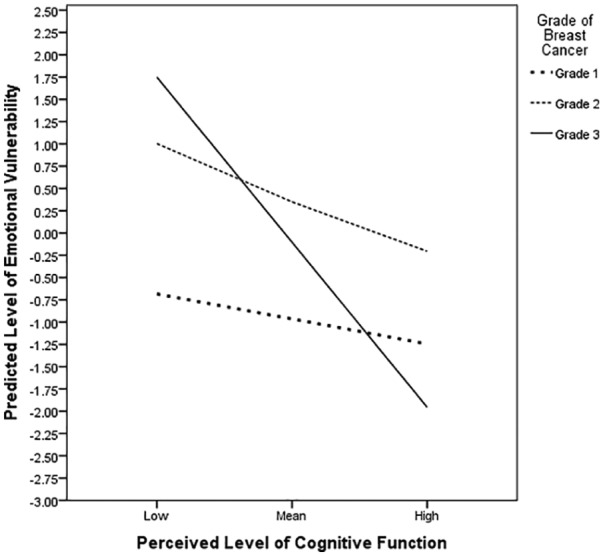
We investigated the relationship between perceived cognitive function and emotional vulnerability of breast cancer survivors while examining the moderating effect of various risk factors. Results confirmed that perceived cognitive function predicted emotional vulnerability with grade of breast cancer moderating this relationship. Age at diagnosis exhibited a trend towards significance for emotional vulnerability, and time since diagnosis as well as grade significantly predicted quality of life. Our findings imply that (younger) women with a higher breast cancer grade are at a greater risk for emotional and cognitive vulnerability and can benefit from interventions designed to reduce emotional vulnerability through training cognitive efficiency.
我们研究了乳腺癌幸存者感知到的认知功能与情绪易损性之间的关系,同时考察了各种风险因素的调节作用。结果证实,感知到的认知功能可预测情绪易损性,乳腺癌分级对这种关系具有调节作用。诊断时的年龄对情绪易损性呈现出显著趋势,诊断后的时间以及分级显著预测生活质量。我们的研究结果表明,(较年轻的)乳腺癌分级较高的女性在情绪和认知方面更易受到伤害,并且可以从旨在通过训练认知效率来降低情绪易损性的干预措施中受益。