Boscher Clémence, Joly Florence, Clarisse Bénédicte, Humbert Xavier, Grellard Jean-Michel, Binarelli Giulia, Tron Laure, Licaj Idlir, Lange Marie
Clinical Research Department, Centre François Baclesse, 14076 Caen, France.
INSERM U1086, ANTICIPE, Normandie Université, UNICAEN, 14000 Caen, France.
Cancers (Basel). 2020 Oct 16;12(10):3000. doi: 10.3390/cancers12103000.
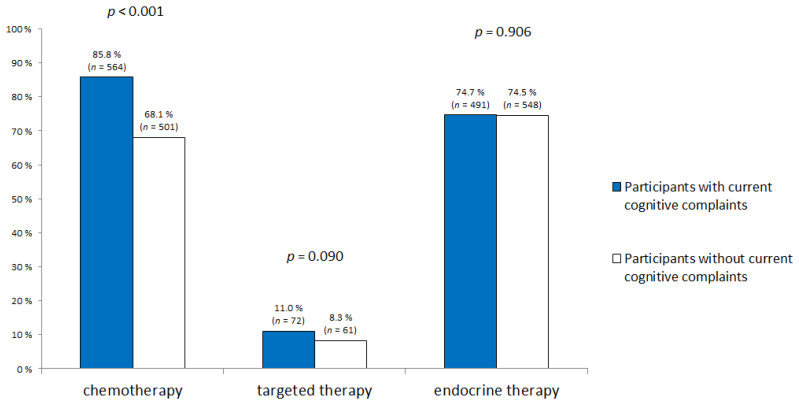
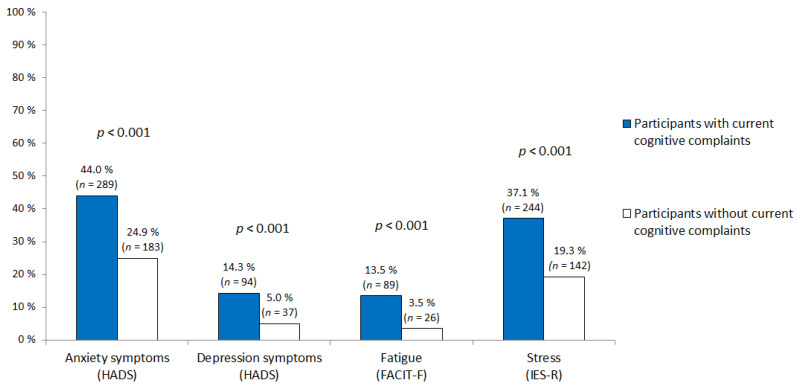
Cognitive complaints are common adverse effects in cancer patients. Identifying subjects at risk could make it possible to limit their impact. We aimed to explore the relationship between current cognitive complaints and demographic and psychological factors in a group of breast cancer survivors. Through an online survey, cancer survivors reported current cognitive complaints using the FACT-Cog questionnaire (Perceived Cognitive Impairment) and answered questions about their demographics, lifestyle and cancer-related characteristics. Anxiety, depression, fatigue and post-traumatic stress symptoms were also assessed. We used multivariable logistic regression models to explore the relationships between current cognitive complaints and social and psychological factors. Among the 1393 breast cancer survivors, 47.2% ( = 657) reported current cognitive complaints. Chemotherapy (OR = 2.26, 95%CI = 1.67-3.05), age (OR = 0.14, 95%CI = 0.07-0.27), sleep difficulties (OR = 2.41, 95%CI = 1.47-3.95), frequency of psychotropic treatments (OR = 1.70, 95%CI = 1.23-2.36), post-traumatic stress symptoms (OR = 2.05, 95%CI = 1.57-2.69) and employment status (OR = 1.64, 95%CI = 1.08-2.49) were strongly associated with current cognitive complaints. In this large study, about half of breast cancer survivors reported cognitive complaints, particularly after chemotherapy. Some risk factors should be detected early to reduce persistent cognitive complaints after cancer: mainly sleep difficulties, post-traumatic stress symptoms and psychotropic medications.
认知主诉是癌症患者常见的不良反应。识别有风险的患者可能有助于限制其影响。我们旨在探讨一组乳腺癌幸存者当前的认知主诉与人口统计学和心理因素之间的关系。通过在线调查,癌症幸存者使用FACT-Cog问卷(感知认知障碍)报告当前的认知主诉,并回答有关其人口统计学、生活方式和癌症相关特征的问题。还评估了焦虑、抑郁、疲劳和创伤后应激症状。我们使用多变量逻辑回归模型来探讨当前认知主诉与社会和心理因素之间的关系。在1393名乳腺癌幸存者中,47.2%(n = 657)报告有当前的认知主诉。化疗(OR = 2.26,95%CI = 1.67 - 3.05)、年龄(OR = 0.14,95%CI = 0.07 - 0.27)、睡眠困难(OR = 2.41,95%CI = 1.47 - 3.95)、精神药物治疗频率(OR = 1.70,95%CI = 1.23 - 2.36)、创伤后应激症状(OR = 2.05,95%CI = 1.57 - 2.69)和就业状况(OR = 1.64,95%CI = 1.08 - 2.49)与当前的认知主诉密切相关。在这项大型研究中,约一半的乳腺癌幸存者报告有认知主诉,尤其是在化疗后。应尽早发现一些风险因素以减少癌症后的持续性认知主诉:主要是睡眠困难、创伤后应激症状和精神药物。