Department of Biomedical Engineering, Case Western Reserve University, 10900 Euclid Avenue, Cleveland, OH 44106, USA.
Department of Biochemistry, Albert Einstein College of Medicine, Bronx, NY 10461, USA.
Sci Adv. 2019 Aug 28;5(8):eaax0801. doi: 10.1126/sciadv.aax0801. eCollection 2019 Aug.
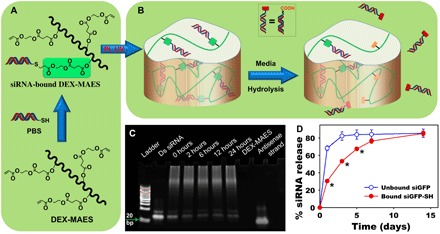
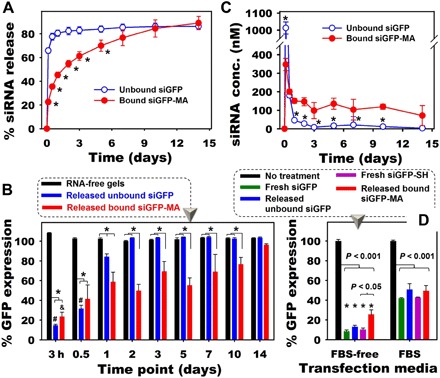
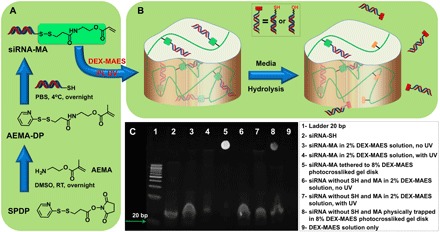
Small interfering RNA (siRNA) has found many applications in tissue regeneration and disease therapeutics. Effective and localized siRNA delivery remains challenging, reducing its therapeutic potential. Here, we report a strategy to control and prolong siRNA release by directly tethering transfection-capable siRNA to photocrosslinked dextran hydrogels. siRNA release is governed via the hydrolytic degradation of ester and/or disulfide linkages between the siRNA and hydrogels, which is independent of hydrogel degradation rate. The released siRNA is shown to be bioactive by inhibiting protein expression in green fluorescent protein-expressing HeLa cells without the need of a transfection agent. This strategy provides an excellent platform for controlling nucleic acid delivery through covalent bonds with a biomaterial and regulating cellular gene expression, which has promising potential in many biomedical applications.
小干扰 RNA(siRNA)在组织再生和疾病治疗方面有许多应用。有效的局部 siRNA 传递仍然具有挑战性,这降低了其治疗潜力。在这里,我们报告了一种通过直接将具有转染能力的 siRNA 连接到光交联葡聚糖水凝胶上来控制和延长 siRNA 释放的策略。siRNA 的释放是通过 siRNA 与水凝胶之间的酯键和/或二硫键的水解降解来控制的,这与水凝胶的降解速率无关。所释放的 siRNA 通过抑制表达绿色荧光蛋白的 HeLa 细胞中的蛋白质表达来证明其具有生物活性,而无需转染试剂。该策略通过与生物材料的共价键提供了一种控制核酸传递的优异平台,并调节细胞基因表达,在许多生物医学应用中具有广阔的应用前景。