Institute of Movement and Neurosciences, German Sport University, Cologne, Germany.
Department of Biomedical Engineering, Ben-Gurion University of the Negev, Beer-Sheva, Israel.
PLoS One. 2019 Sep 6;14(9):e0220748. doi: 10.1371/journal.pone.0220748. eCollection 2019.
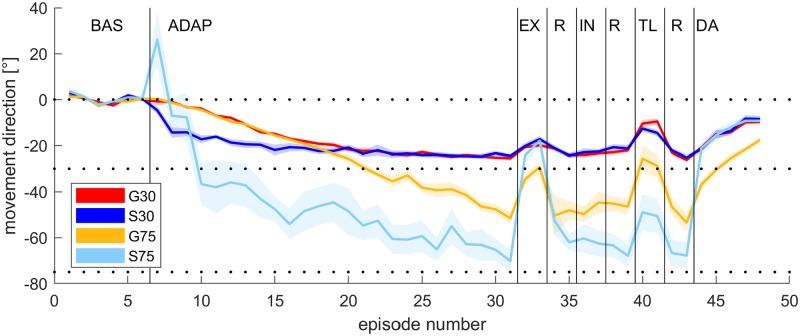
Previous studies compared the effects of gradual and sudden adaptation on intermanual transfer to find out whether transfer depends on awareness of the perturbation. Results from different groups were contradictory. Since results of our own study suggest that awareness depends on perturbation size, we hypothesize that awareness-related intermanual transfer will only appear after adaptation to a large, sudden perturbation but not after adaptation to a small sudden perturbation or a gradual perturbation, large or small. To confirm this, four groups (S30, G30, S75, G75) of subjects performed out-and-back reaching movements with their right arm. In a baseline block, they received veridical visual feedback of hand position. In the subsequent adaptation block, feedback was rotated by 30 deg (S30, G30) or 75 deg (S75, G75). This rotation was either introduced suddenly (S30, S75) or gradually in steps of 3 deg (G30, G75). After the adaptation block, subjects did an awareness test comprising exclusion and inclusion conditions. The experiment concluded with an intermanual transfer block, in which movements were performed with the left arm under rotated feedback, and a washout block again under veridical feedback. We used a hierarchical Bayesian model to estimate individual movement directions and group averages. The movement directions in different conditions were then used to calculate group and individual indexes of adaptation, awareness, unawareness, transfer and washout. Both awareness and transfer were larger in S75 than in other groups, while unawareness and washout were smaller in S75 than in other groups. Furthermore, the size of awareness indices correlated to intermanual transfer across subjects, even when transfer was normalized to final adaptation level. Thus, we show for the first time that the amount of intermanual transfer directly relates to the extent of awareness of the learned perturbation.
先前的研究比较了逐渐适应和突然适应对手间转移的影响,以确定转移是否依赖于对扰动的意识。来自不同组的结果相互矛盾。由于我们自己的研究结果表明,意识取决于扰动的大小,我们假设与意识相关的手间转移只会出现在适应大的、突然的扰动后,而不会出现在适应小的、突然的扰动或逐渐的扰动后,无论大小。为了证实这一点,四组(S30、G30、S75、G75)被试者使用右臂进行往返伸手运动。在基线块中,他们收到了手部位置的真实视觉反馈。在随后的适应块中,反馈以 30 度(S30、G30)或 75 度(S75、G75)旋转。这种旋转要么是突然的(S30、S75),要么是逐渐的,每次 3 度(G30、G75)。适应块后,被试者进行了包含排除和包含条件的意识测试。实验结束时,进行了手间转移块,在该块中,被试者使用左手在旋转的反馈下进行运动,然后再次在真实的反馈下进行冲洗块。我们使用分层贝叶斯模型来估计个体运动方向和组平均值。然后,使用不同条件下的运动方向来计算组和个体适应、意识、无意识、转移和冲洗的指标。S75 组的意识和转移都大于其他组,而无意识和冲洗都小于其他组。此外,意识指标的大小与被试者之间的手间转移相关,即使转移被归一化为最终的适应水平。因此,我们首次表明,手间转移的量与对所学习的扰动的意识程度直接相关。