Smithsonian Tropical Research Institute, Balboa Ancon, República de Panamá.
Instituto de Investigaciones Científicas y Servicios de Alta Tecnología, Panamá, República de Panamá.
PLoS One. 2019 Sep 6;14(9):e0222145. doi: 10.1371/journal.pone.0222145. eCollection 2019.
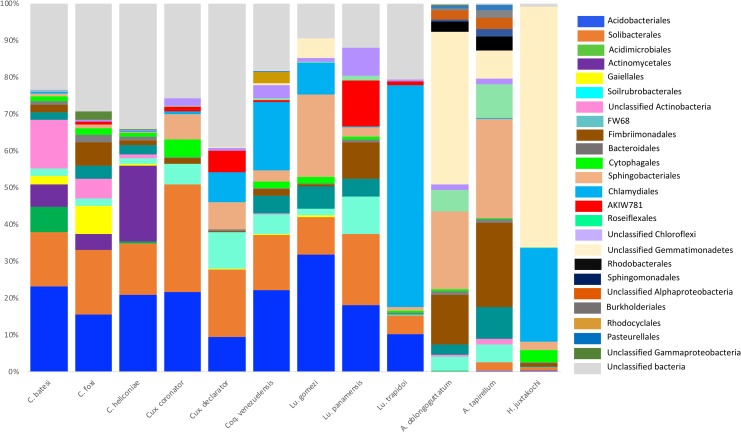
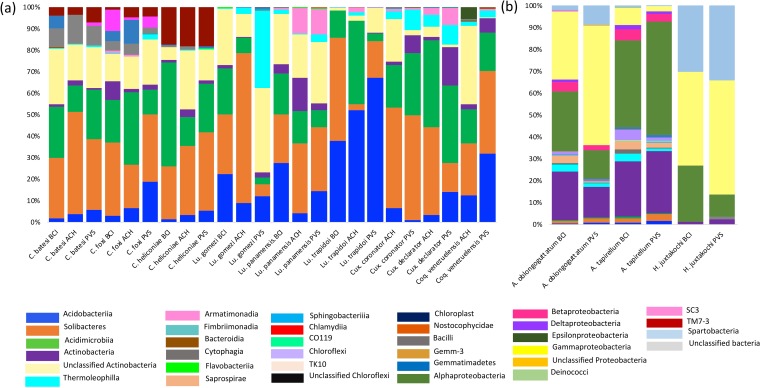
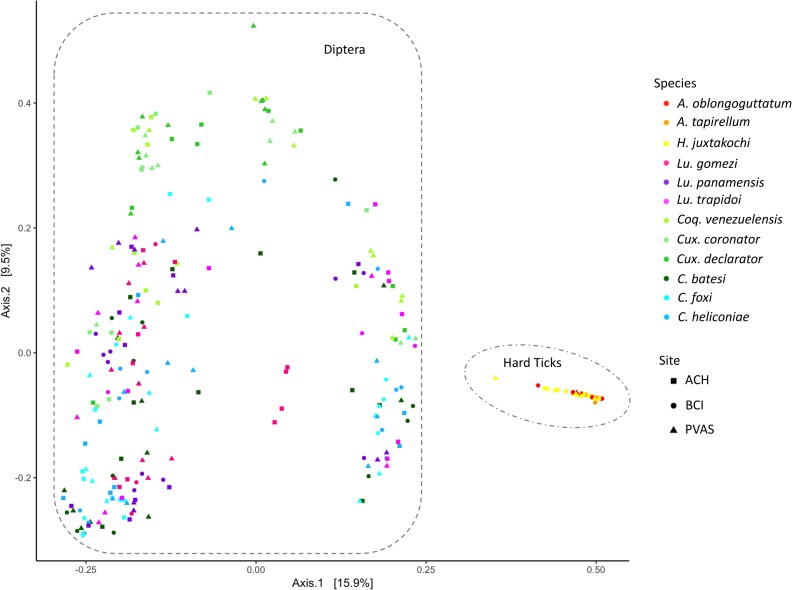
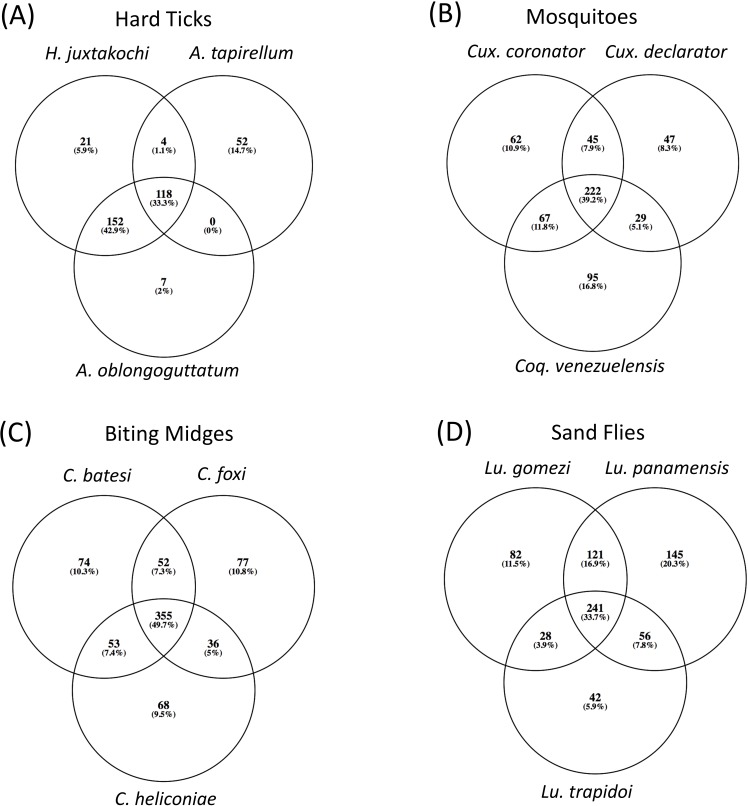
The microbiome plays a key role in the biology, ecology and evolution of arthropod vectors of human pathogens. Vector-bacterial interactions could alter disease transmission dynamics through modulating pathogen replication and/or vector fitness. Nonetheless, our understanding of the factors shaping the bacterial community in arthropod vectors is incomplete. Using large-scale 16S amplicon sequencing, we examine how habitat disturbance structures the bacterial assemblages of field-collected whole-body hematophagous arthropods that vector human pathogens including mosquitoes (Culicidae), sand flies (Psychodidae), biting midges (Ceratopogonidae) and hard ticks (Ixodidae). We found that all comparisons of the bacterial community among species yielded statistically significant differences, but a difference was not observed between adults and nymphs of the hard tick, Haemaphysalis juxtakochi. While Culicoides species had the most distinct bacterial community among dipterans, tick species were composed of entirely different bacterial OTU's. We observed differences in the proportions of some bacterial types between pristine and disturbed habitats for Coquillettidia mosquitoes, Culex mosquitoes, and Lutzomyia sand flies, but their associations differed within and among arthropod assemblages. In contrast, habitat quality was a poor predictor of differences in bacterial classes for Culicoides biting midges and hard tick species. In general, similarities in the bacterial communities among hematophagous arthropods could be explained by their phylogenetic relatedness, although intraspecific variation seems influenced by habitat disturbance.
微生物组在人类病原体的节肢动物媒介的生物学、生态学和进化中起着关键作用。通过调节病原体的复制和/或媒介的适应性,媒介与细菌的相互作用可能会改变疾病传播的动态。尽管如此,我们对塑造节肢动物媒介中细菌群落的因素的理解并不完整。本研究使用大规模 16S 扩增子测序,研究了生境干扰如何构建野外采集的、携带人类病原体的吸血节肢动物(包括蚊子(蚊科)、沙蝇(白蛉科)、吸血蠓(蠓科)和硬蜱(硬蜱科))的整体细菌组合。研究结果表明,所有物种间的细菌群落比较都存在统计学上的显著差异,但硬蜱 Haemaphysalis juxtakochi 的成虫和若虫之间没有观察到差异。虽然库蠓属(Culicoides)物种在双翅目中的细菌群落最具特色,但蜱种则由完全不同的细菌 OTU 组成。在未受干扰和受干扰的栖息地之间,Coquillettidia 蚊子、Culex 蚊子和 Lutzomyia 沙蝇的某些细菌类型的比例存在差异,但它们在节肢动物组合内和之间的关联不同。相比之下,生境质量对库蠓属吸血蠓和硬蜱种的细菌类群的差异预测能力较差。一般来说,吸血节肢动物之间的细菌群落相似性可以用它们的系统发育关系来解释,尽管种内变异似乎受到生境干扰的影响。