Human Performance Laboratory, University of Salford, Greater Manchester, UK.
Sports Med. 2019 Dec;49(12):1837-1859. doi: 10.1007/s40279-019-01171-0.
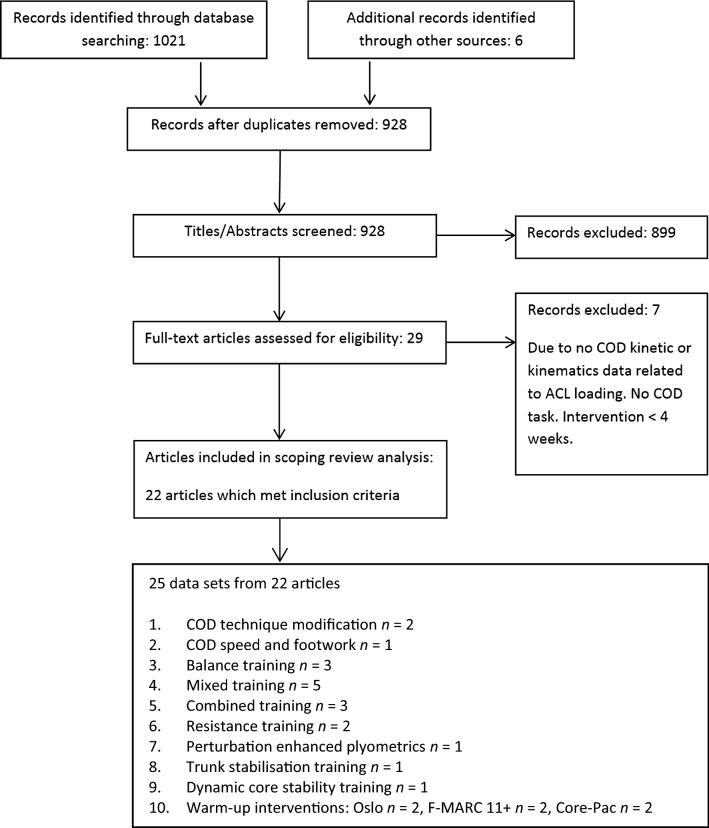
Change of direction (COD) manoeuvres are associated with anterior cruciate ligament (ACL) injury risk due to the propensity to generate large multiplanar knee joint loads. Given the short- and long-term consequences of ACL injury, practitioners are interested in methods that reduce knee joint loads and subsequent ACL loading. An effective strategy to reduce ACL loading is modifying an athlete's movement mechanics to reduce knee joint loading. The purpose of this scoping review was to critically appraise and comprehensively synthesise the existing literature related to the effects of training interventions on COD biomechanics associated with increased knee joint loads and subsequent ACL loading, and identify gaps and recommend areas for future research. A review of the literature was conducted using Medline and Sport DISCUS databases. Inclusion criteria consisted of pre-post analysis of a COD task, a minimum 4-week training intervention, and assessments of biomechanical characteristics associated with increased ACL loading. Of the 1,027 articles identified, 22 were included in the scoping review. Based on current literature, balance training and COD technique modification are the most effective training modalities for reducing knee joint loading (small to moderate effect sizes). One study reported dynamic core stability training was effective in reducing knee joint loads, but further research is needed to definitively confirm the efficacy of this method. Perturbation-enhanced plyometric training, the F-MARC 11 + soccer specific warm-up, Oslo Neuromuscular warm-up, and resistance training are ineffective training modalities to reduce COD knee joint loads. Conflicting findings have been observed for the Core-Pac and mixed training programme. Consequently, practitioners should consider incorporating balance and COD technique modification drills into their athletes' training programmes to reduce potentially hazardous knee joint loads when changing direction. However, training intervention studies can be improved by investigating larger sample sizes (> 20), including a control group, acknowledging measurement error when interpreting their findings, and considering performance implications, to confirm the effectiveness of training interventions and improve adherence.
变向(COD)动作与前交叉韧带(ACL)损伤风险相关,因为它们容易产生多平面膝关节负荷。鉴于 ACL 损伤的短期和长期后果,从业者对降低膝关节负荷和随后 ACL 负荷的方法感兴趣。一种减少 ACL 负荷的有效策略是改变运动员的运动力学,以减少膝关节负荷。本综述的目的是批判性地评估和全面综合与训练干预对增加膝关节负荷和随后 ACL 负荷相关的 COD 生物力学的影响的现有文献,并确定差距和为未来研究提出建议。使用 Medline 和 Sport DISCUS 数据库进行文献回顾。纳入标准包括 COD 任务的前后分析、至少 4 周的训练干预以及与增加 ACL 负荷相关的生物力学特征的评估。在确定的 1027 篇文章中,有 22 篇被纳入范围综述。根据当前的文献,平衡训练和 COD 技术修正是减少膝关节负荷(小到中等效应量)最有效的训练方式。一项研究报告说,动态核心稳定性训练在减少膝关节负荷方面是有效的,但需要进一步的研究来明确证实这种方法的疗效。扰动增强的增强式训练、F-MARC 11+足球专项热身、奥斯陆神经肌肉热身和阻力训练是减少 COD 膝关节负荷的无效训练方式。Core-Pac 和混合训练方案的研究结果存在矛盾。因此,从业者应考虑将平衡和 COD 技术修正训练纳入运动员的训练计划中,以减少改变方向时可能产生的危险膝关节负荷。然而,通过研究更大的样本量(>20)、包括对照组、在解释研究结果时承认测量误差以及考虑绩效影响,可以提高训练干预研究的水平,以确认训练干预的有效性并提高依从性。