Rönnblom Lars, Leonard Dag
Department of Medical Sciences, Rheumatology, Uppsala University, Uppsala, Sweden.
Lupus Sci Med. 2019 Aug 13;6(1):e000270. doi: 10.1136/lupus-2018-000270. eCollection 2019.
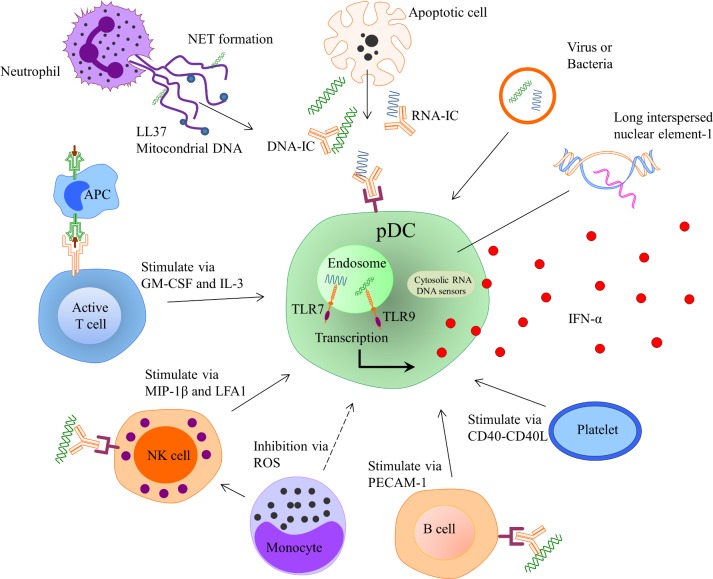
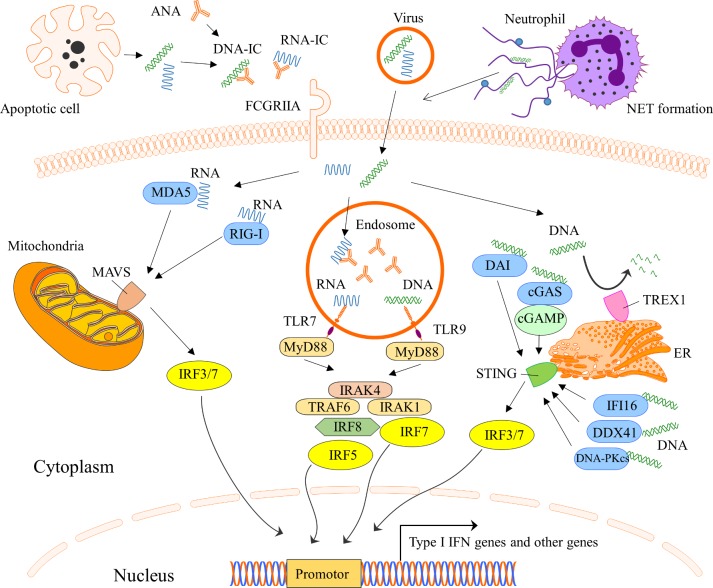
SLE is characterised by an activation of the interferon (IFN) system, which leads to an increased expression of IFN-regulated genes. The reasons behind the IFN signature in SLE are (1) the existence of endogenous IFN inducers, (2) activation of several IFN-producing cell types, (3) production of many different IFNs, (4) a genetic setup promoting IFN production and (5) deficient negative feedback mechanisms. The consequences for the immune system is a continuous stimulation to an immune response, and for the patient a number of different organ manifestations leading to typical symptoms for SLE. In the current review, we will present the existing knowledge of the IFN system and pathway activation in SLE. We will also discuss how this information can contribute to our understanding of both the aetiopathogenesis and some organ manifestations of the disease. We will put forward some issues that are unresolved and should be clarified in order to make a proper stratification of patients with SLE, which seems important when selecting a therapy aiming to downregulate the IFN system.
系统性红斑狼疮(SLE)的特征是干扰素(IFN)系统激活,这会导致IFN调节基因的表达增加。SLE中IFN特征背后的原因包括:(1)内源性IFN诱导剂的存在;(2)多种产生IFN的细胞类型的激活;(3)多种不同IFN的产生;(4)促进IFN产生的基因构成;(5)缺陷的负反馈机制。对免疫系统而言,其后果是持续刺激免疫反应,对患者而言则是导致SLE典型症状的多种不同器官表现。在本综述中,我们将介绍SLE中IFN系统及通路激活的现有知识。我们还将讨论这些信息如何有助于我们理解该疾病的病因发病机制和一些器官表现。我们将提出一些尚未解决且应予以阐明的问题,以便对SLE患者进行恰当分层,这在选择旨在下调IFN系统的治疗方法时似乎很重要。