Lane Cassandra, Naylor Patti-Jean, Tomlin Dona, Kirk Sara, Hanning Rhona, Masse Louise, Olstad Dana Lee, Prowse Rachel, Caswell Susan, Jarvis Sherry, Milford Todd, Raine Kim
School of Medicine and Public Health, Faculty of Health and Medicine, University of Newcastle, 1 University Drive, Callaghan, NSW 2308, Australia.
Institute of Applied Physical Activity and Health Research, School of Exercise Science, Physical and Health Education, University of Victoria, PO Box 3015, STN CSC, Victoria V8W 3P1, BC, Canada.
Prev Med Rep. 2019 Aug 7;16:100967. doi: 10.1016/j.pmedr.2019.100967. eCollection 2019 Dec.
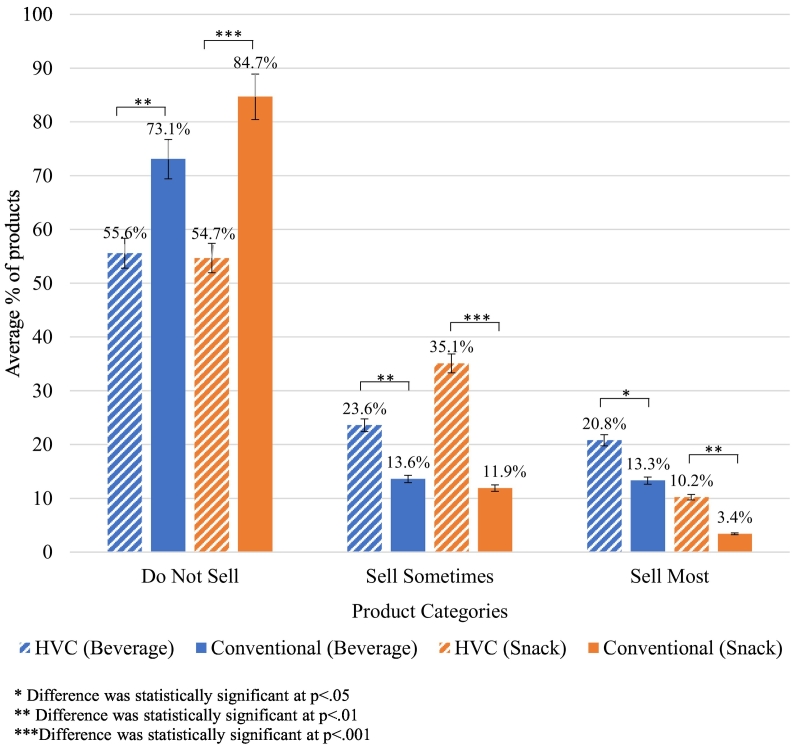
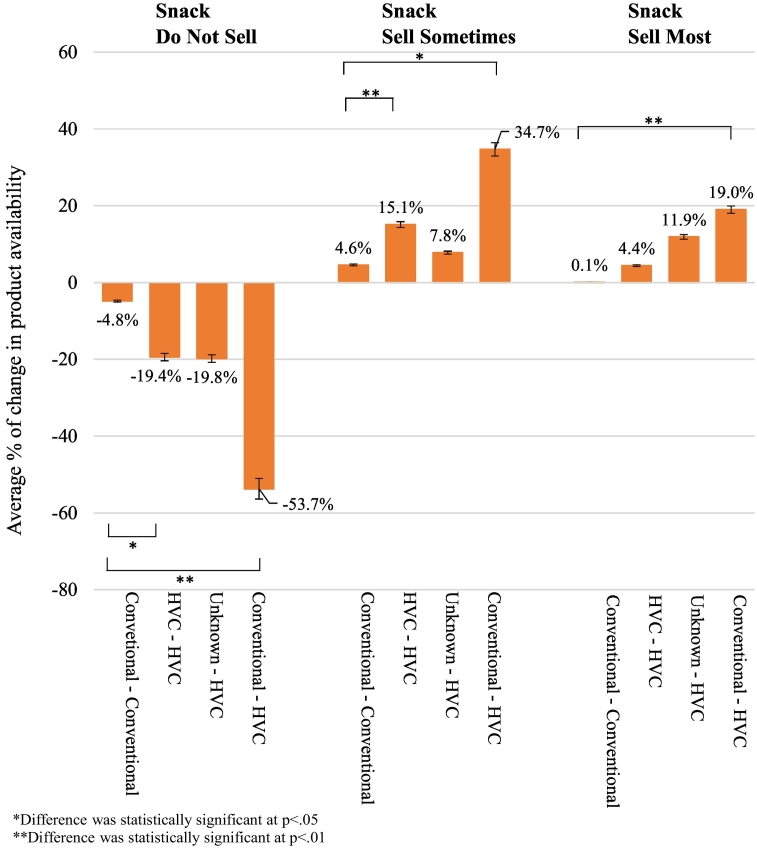
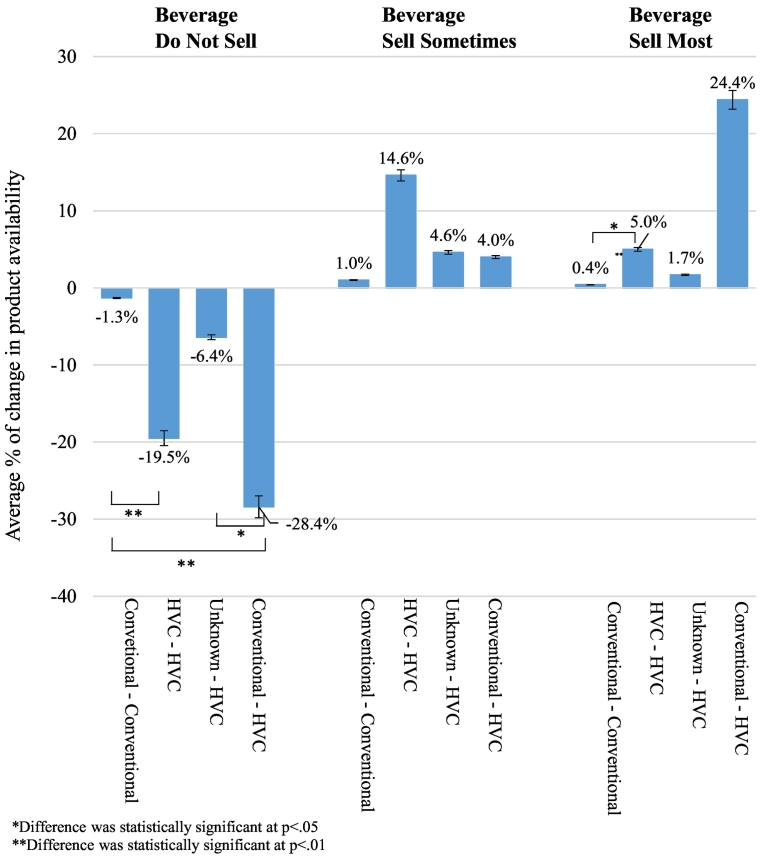
This study explored the influence of healthy vending contracts (HVC) on the nutritional quality of vending machine products in 46 Canadian publicly funded recreation and sport facilities. A quasi-experimental comparison design was used to examine the difference in nutritional quality of snack and beverage vending machine products at baseline (December 2015-May 2016) and 18-month follow-up. Staff Surveys assessed facility contract type (HVC or conventional) and vending machine audits identified product nutritional quality. Products were categorized by provincial guidelines as Do Not Sell (DNS), Sell Sometimes (SS) or Sell Most (SM). ANOVA compared categories cross-sectionally (HVC vs conventional) and repeated measures ANOVA compared them longitudinally (HVC-HVC, vs conventional-conventional and conventional-HVC). Approximately one quarter of contracts (24% beverage and 28% snack) had health stipulations at baseline or follow-up. Cross-sectionally, facilities with HVC at any time period had significantly lower percentage DNS (beverage: 56% vs 73%, = 0.001; snack: 55% vs 85%, < 0.001), higher SS (beverage: 24% vs 14%, = 0.003; snack: 35% vs 12%, < 0.001) and higher SM Products (beverage: 21% vs 13%, = 0.030; snack: 10% vs 3%, < 0.003). Longitudinally, facilities with consistent HVC or that changed to HVC showed greater decreases in DNS products over time ( < 0.050). Although less healthy products were still highly prevalent, facilities with HVC or that changed to HVC had fewer unhealthy products available in their vending machines over time compared to those without HVCs. Healthy vending contracts appear to be an effective change strategy.
本研究探讨了健康自动售货合同(HVC)对加拿大46个由公共资金资助的娱乐和体育设施中自动售货机产品营养质量的影响。采用准实验比较设计,以检验在基线期(2015年12月至2016年5月)和18个月随访时零食和饮料自动售货机产品营养质量的差异。员工调查评估了设施合同类型(HVC或传统合同),自动售货机审计确定了产品营养质量。产品根据省级指导方针分为禁止销售(DNS)、有时销售(SS)或多数销售(SM)。方差分析用于横断面比较类别(HVC与传统合同),重复测量方差分析用于纵向比较(HVC-HVC、传统合同-传统合同以及传统合同-HVC)。大约四分之一的合同(24%的饮料合同和28%的零食合同)在基线期或随访时有健康规定。横断面来看,在任何时间段采用HVC的设施中,DNS产品的百分比显著更低(饮料:56%对73%,P = 0.001;零食:55%对85%,P < 0.001),SS产品百分比更高(饮料:24%对14%,P = 0.003;零食:35%对12%,P < 0.001),SM产品百分比也更高(饮料:21%对13%,P = 0.030;零食:10%对3%,P < 0.003)。纵向来看,一直采用HVC或转变为HVC的设施随着时间推移,DNS产品的减少幅度更大(P < 0.050)。尽管不太健康的产品仍然非常普遍,但与没有HVC的设施相比,采用HVC或转变为HVC的设施随着时间推移,其自动售货机中不健康产品的供应更少。健康自动售货合同似乎是一种有效的变革策略。