Hubert Department of Global Health, Emory University, Atlanta, GA, USA.
McKing Consulting Corporation, Atlanta, GA, USA.
Am J Clin Nutr. 2019 Dec 1;110(6):1456-1464. doi: 10.1093/ajcn/nqz201.
To accurately assess micronutrient status, it is necessary to characterize the effects of inflammation and the acute-phase response on nutrient biomarkers.
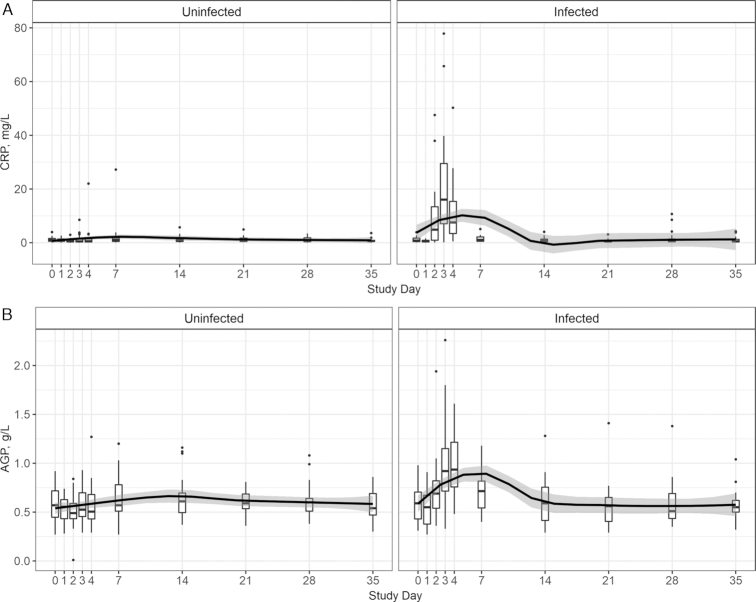
Within a norovirus human challenge study, we aimed to model the inflammatory response of C-reactive protein (CRP) and α-1-acid glycoprotein (AGP) by infection status, model kinetics of micronutrient biomarkers by inflammation status, and evaluate associations between inflammation and micronutrient biomarkers from 0 to 35 d post-norovirus exposure.
Fifty-two healthy adults were enrolled into challenge studies in a hospital setting and followed longitudinally; all were exposed to norovirus, half were infected. Post hoc analysis of inflammatory and nutritional biomarkers was performed. Subjects were stratified by inflammation resulting from norovirus exposure. Smoothed regression models analyzed the kinetics of CRP and AGP by infection status, and nutritional biomarkers by inflammation. Linear mixed-effects models were used to analyze the independent relations between CRP, AGP, and biomarkers for iron, vitamin A, vitamin D, vitamin B-12, and folate from 0 to 35 d post-norovirus exposure.
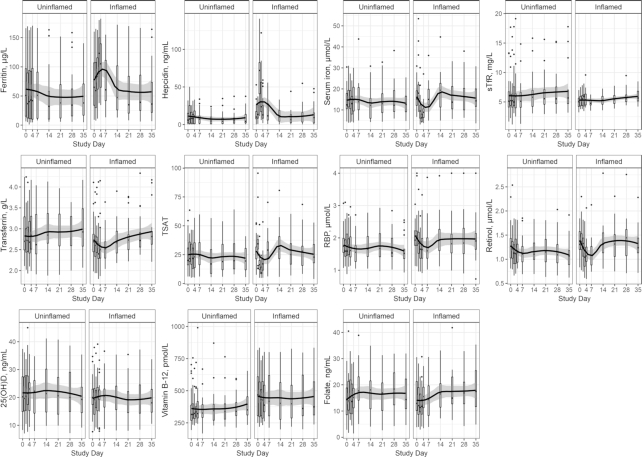
Norovirus-infected subjects had median (IQR) peak concentrations for CRP [16.0 (7.9-29.5) mg/L] and AGP [0.9 (0.8-1.2) g/L] on day 3 and day 4 postexposure, respectively. Nutritional biomarkers that differed (P < 0.05) from baseline within the inflamed group were ferritin (elevated day 3), hepcidin (elevated days 2, 3), serum iron (depressed days 2-4), transferrin saturation (depressed days 2-4), and retinol (depressed days 3, 4, and 7). Nutritional biomarker concentrations did not differ over time within the uninflamed group. In mixed models, CRP was associated with ferritin (positive) and serum iron and retinol (negative, P < 0.05).
Using an experimental infectious challenge model in healthy adults, norovirus infection elicited a time-limited inflammatory response associated with altered serum concentrations of certain iron and vitamin A biomarkers, confirming the need to consider adjustments of these biomarkers to account for inflammation when assessing nutritional status. These trials were registered at clinicaltrials.gov as NCT00313404 and NCT00674336.
为了准确评估微量营养素状况,有必要描述炎症和急性期反应对营养生物标志物的影响。
在诺如病毒人体挑战研究中,我们旨在通过感染状态来模拟 C 反应蛋白(CRP)和α-1 酸性糖蛋白(AGP)的炎症反应,通过炎症状态来模拟微量营养素生物标志物的变化,并评估从诺如病毒暴露后 0 到 35 天的炎症与微量营养素生物标志物之间的关联。
52 名健康成年人在医院环境中参加了挑战研究,并进行了纵向随访;所有人都接触过诺如病毒,其中一半人被感染。对炎症和营养生物标志物进行了事后分析。根据诺如病毒暴露引起的炎症将受试者分层。采用平滑回归模型分析感染状态下 CRP 和 AGP 的动力学,以及炎症状态下营养生物标志物的动力学。线性混合效应模型用于分析从诺如病毒暴露后 0 到 35 天内 CRP、AGP 与铁、维生素 A、维生素 D、维生素 B-12 和叶酸生物标志物之间的独立关系。
感染诺如病毒的受试者在暴露后第 3 天和第 4 天的 CRP [16.0(7.9-29.5)mg/L]和 AGP [0.9(0.8-1.2)g/L]的峰值浓度最高。在炎症组中,与基线相比有差异(P<0.05)的营养生物标志物为铁蛋白(升高第 3 天)、hepcidin(升高第 2、3 天)、血清铁(降低第 2-4 天)、转铁蛋白饱和度(降低第 2-4 天)和视黄醇(降低第 3、4 天和 7 天)。在非炎症组中,营养生物标志物的浓度在整个时间内没有差异。在混合模型中,CRP 与铁蛋白(正相关)和血清铁和视黄醇(负相关,P<0.05)相关。
使用健康成年人的实验性感染挑战模型,诺如病毒感染引起了有限时间的炎症反应,与某些铁和维生素 A 生物标志物的血清浓度变化有关,这证实了在评估营养状况时需要考虑对这些生物标志物进行调整以应对炎症。这些试验在 clinicaltrials.gov 上注册,编号分别为 NCT00313404 和 NCT00674336。