ARC Centre of Excellence for Translational Photosynthesis, Hawkesbury Institute for the Environment, Western Sydney University, Penrith NSW Australia.
Department of Forest and Ecosystem Science, The University of Melbourne, Creswick, Vic., Australia.
J Exp Bot. 2019 Nov 18;70(21):6447-6459. doi: 10.1093/jxb/erz386.
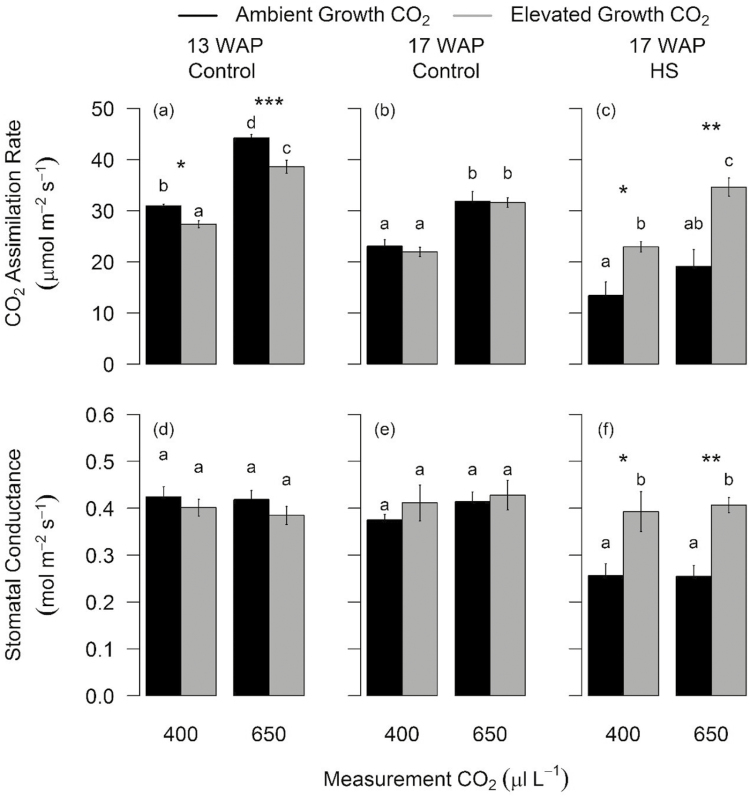
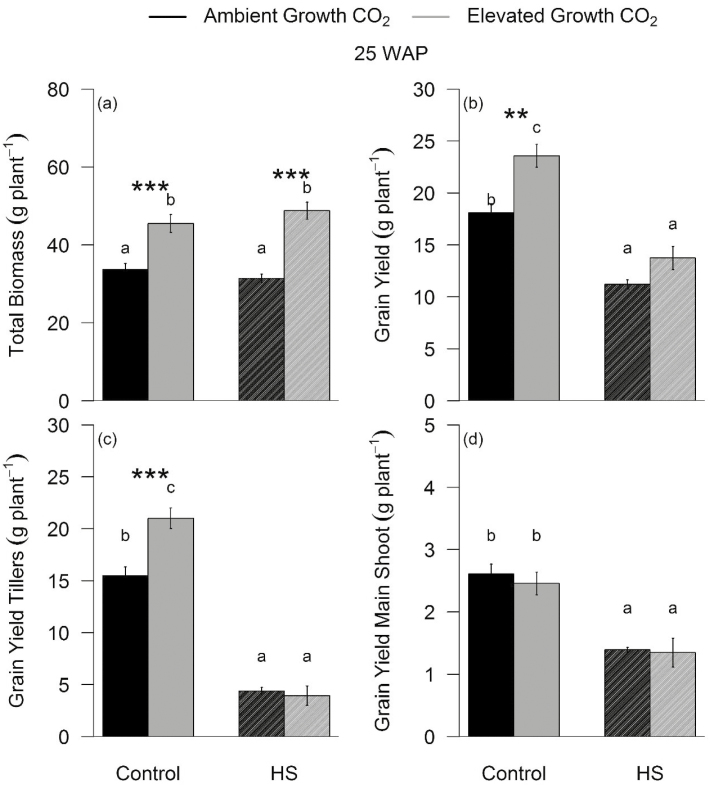
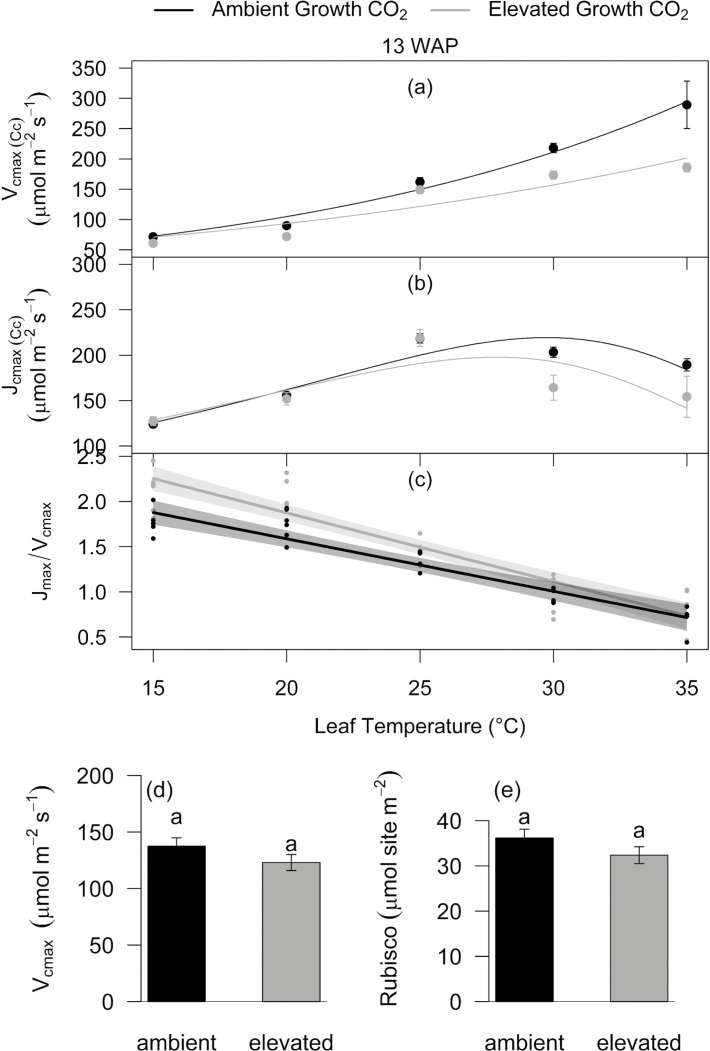
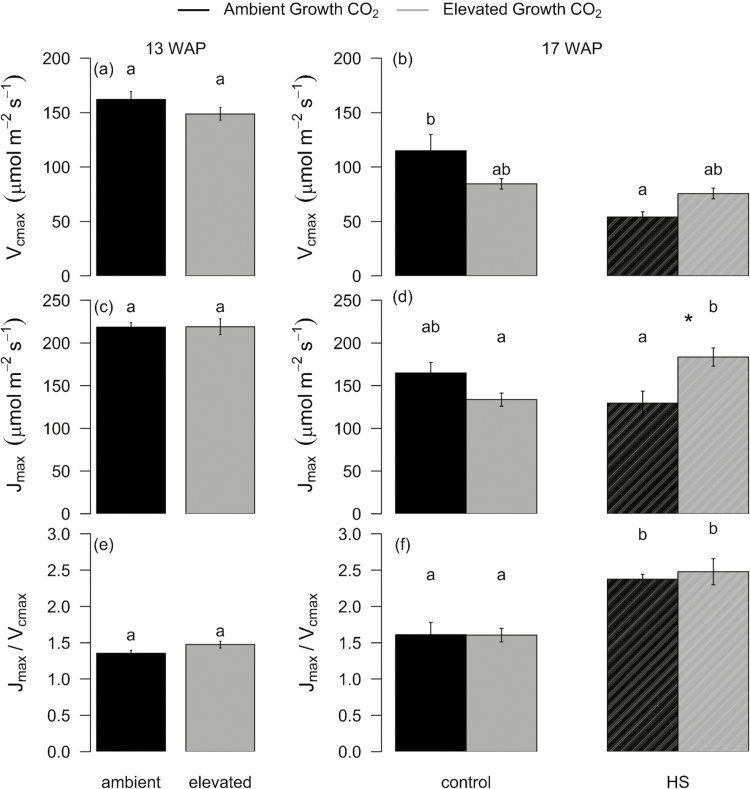
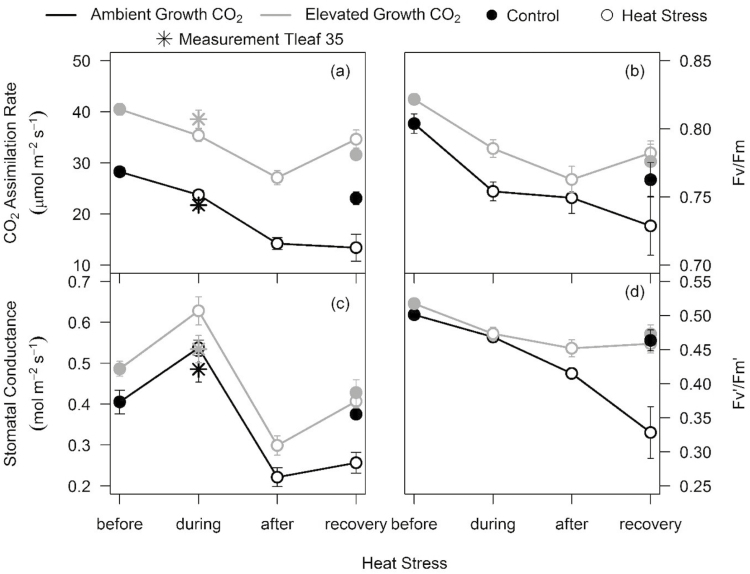
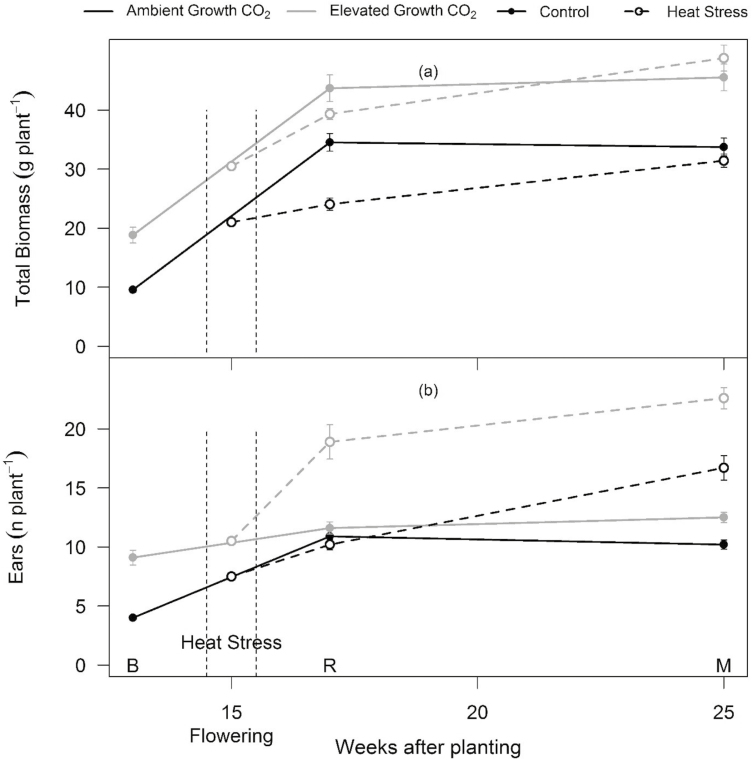
Hot days are becoming hotter and more frequent, threatening wheat yields worldwide. Developing wheat varieties ready for future climates calls for improved understanding of how elevated CO2 (eCO2) and heat stress (HS) interactively impact wheat yields. We grew a modern, high-yielding wheat cultivar (Scout) at ambient CO2 (aCO2, 419 μl l -1) or eCO2 (654 μl l-1) in a glasshouse maintained at 22/15 °C (day/night). Half of the plants were exposed to HS (40/24 °C) for 5 d at anthesis. In non-HS plants, eCO2 enhanced (+36%) CO2 assimilation rates (Asat) measured at growth CO2 despite down-regulation of photosynthetic capacity. HS reduced Asat (-42%) in aCO2- but not in eCO2-grown plants because eCO2 protected photosynthesis by increasing ribulose bisphosphate regeneration capacity and reducing photochemical damage under HS. eCO2 stimulated biomass (+35%) of all plants and grain yield (+30%) of non-HS plants only. Plant biomass initially decreased following HS but recovered at maturity due to late tillering. HS equally reduced grain yield (-40%) in aCO2- and eCO2-grown plants due to grain abortion and reduced grain filling. While eCO2 mitigated the negative impacts of HS at anthesis on wheat photosynthesis and biomass, grain yield was reduced by HS in both CO2 treatments.
炎热的天气变得越来越热,越来越频繁,威胁着全球小麦的产量。开发适应未来气候的小麦品种需要更好地了解高浓度二氧化碳(eCO2)和热应激(HS)如何相互作用影响小麦产量。我们在温室中以环境 CO2(aCO2,419 μl l -1)或 eCO2(654 μl l-1)生长现代、高产的小麦品种(Scout),温室温度保持在 22/15°C(白天/夜晚)。一半的植物在开花期受到 HS(40/24°C)的影响,持续 5 天。在非 HS 植物中,eCO2 尽管光合作用能力下调,但仍能提高生长 CO2 下测量的 CO2 同化率(Asat)(+36%)。HS 在 aCO2 而非 eCO2 生长的植物中降低了 Asat(-42%),因为 eCO2 通过增加核酮糖二磷酸再生能力并减少 HS 下的光化学损伤来保护光合作用。eCO2 刺激所有植物的生物量(+35%)和非 HS 植物的籽粒产量(+30%)。HS 后植物生物量最初减少,但由于后期分蘖,在成熟时恢复。由于谷物败育和谷物灌浆减少,HS 同样降低了 aCO2-和 eCO2-生长的植物的籽粒产量(-40%)。虽然 eCO2 减轻了开花期 HS 对小麦光合作用和生物量的负面影响,但在两种 CO2 处理中,HS 都降低了籽粒产量。