Hernández-Vaquero Daniel, Noriega-Fernandez Alfonso, Roncero-Gonzalez Sergio, Perez-Coto Ivan, Sierra-Pereira Andres A, Sandoval-Garcia Manuel A
Department of Orthopaedics, School of Medicine, University of Oviedo, Asturias, Spain.
Department of Orthopaedics, St Agustin University Hospital, Aviles, Spain.
J Orthop Translat. 2018 Nov 22;18:84-91. doi: 10.1016/j.jot.2018.10.006. eCollection 2019 Jul.
One of the possible causes of dissatisfaction reported by many patients after total knee replacement (TKR) is the lack of agreement between component size and bone structure. To avoid this complication and facilitate the procedure, preoperative planning with digitized templates is recommended. Surgical navigation indicates the best position and the most adequate size of arthroplasty and may therefore replace preoperative radiographic measurement. The objective of the study was to check agreement between the sizes of TKR components measured before surgery with digitized templates, the size recommended by the navigation and sizes actually implanted.
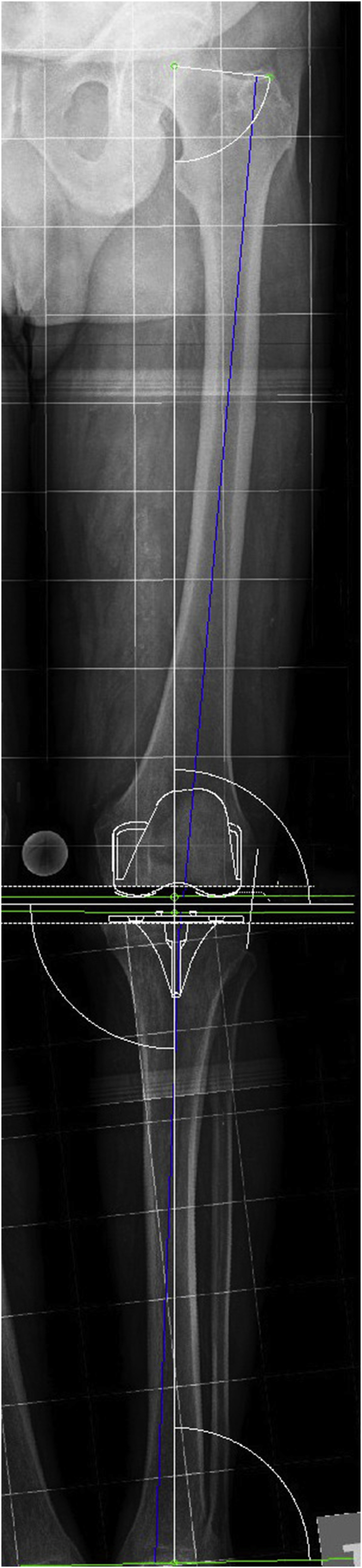
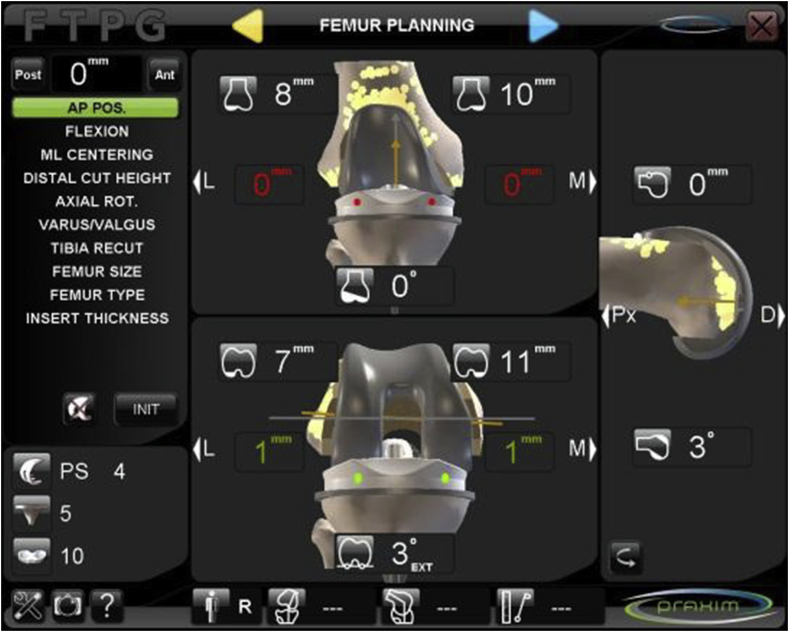
In 103 patients scheduled for TKR, preoperative full-limb radiography was performed to measure the mechanical and anatomical axes of the limb, femur and tibia. The most adequate size of the femoral and tibial components was planned by superimposing digitized templates. The size recommended in navigation and the size of the finally implanted components were also recorded.
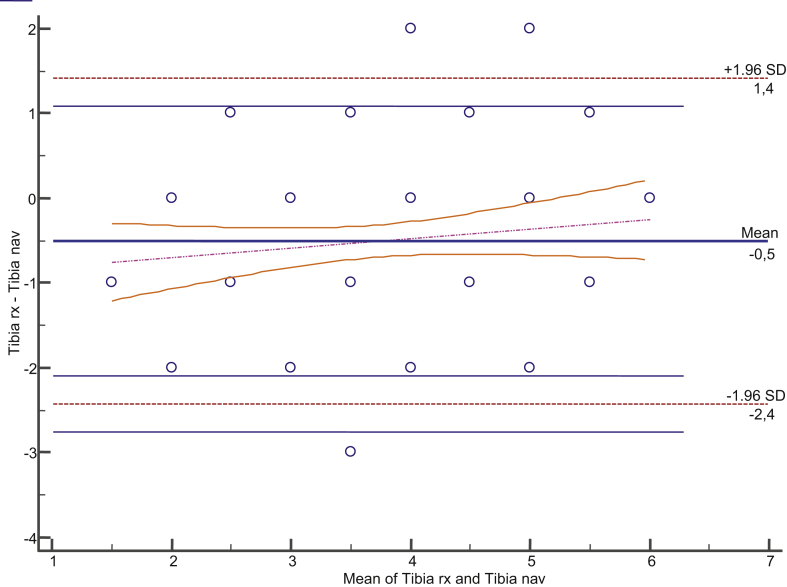
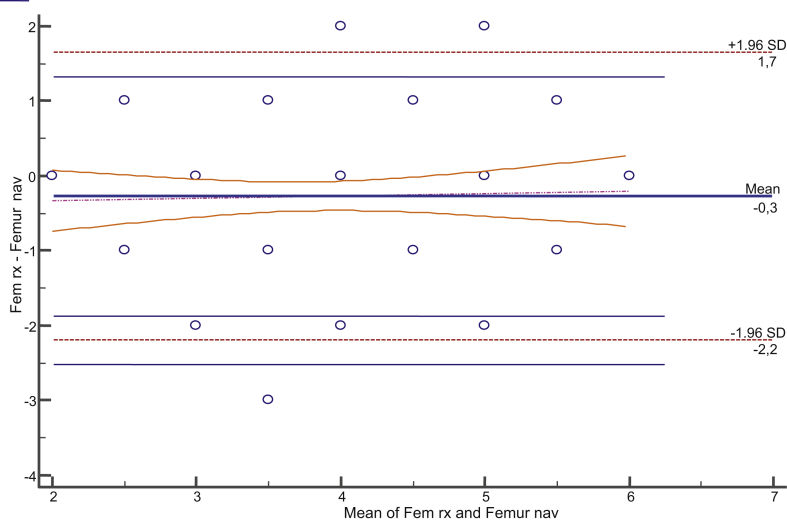
A high level of agreement was found between the sizes of femoral and tibial components measured by X-rays and in navigation (0.750 and 0.772, respectively) (intraclass correlation and Cronbach's alpha). Agreement between the sizes recommended by X-rays and navigation and those finally implanted was 0.886 for the femur and 0.891 for the tibia. Agreement levels were not different in cases with prior deformities of limb axis.
The high level of agreement found in component sizes between radiographic measurement with digitized templates and navigation suggests that preoperative X-ray measurement is not needed when navigation is used for placement of implants during TKR.
Computer-assisted surgery may avoid preoperative measurement with templates in TKR.
全膝关节置换术(TKR)后许多患者报告的不满原因之一是假体组件尺寸与骨骼结构不匹配。为避免这种并发症并简化手术过程,建议使用数字化模板进行术前规划。手术导航可指示关节置换术的最佳位置和最合适尺寸,因此可能取代术前的影像学测量。本研究的目的是检查术前使用数字化模板测量的TKR组件尺寸、导航推荐的尺寸与实际植入尺寸之间的一致性。
对103例计划进行TKR的患者进行术前全下肢X线摄影,以测量下肢、股骨和胫骨的机械轴和解剖轴。通过叠加数字化模板规划股骨和胫骨组件的最合适尺寸。还记录了导航推荐的尺寸和最终植入组件的尺寸。
X线测量和导航测量的股骨和胫骨组件尺寸之间存在高度一致性(分别为0.750和0.772)(组内相关系数和Cronbach's α系数)。X线和导航推荐的尺寸与最终植入尺寸之间的一致性,股骨为0.886,胫骨为0.891。肢体轴先前有畸形的病例中一致性水平无差异。
数字化模板影像学测量与导航之间组件尺寸的高度一致性表明,在TKR手术中使用导航植入假体时无需术前X线测量。
计算机辅助手术可避免TKR术前使用模板进行测量。