Yariv Inbar, Shapira Channa, Duadi Hamootal, Fixler Dror
Faculty of Engineering and the Institute of Nanotechnology and Advanced Materials, Bar Ilan University, Ramat Gan 5290002, Israel.
ACS Omega. 2019 Aug 22;4(10):14301-14306. doi: 10.1021/acsomega.9b01976. eCollection 2019 Sep 3.
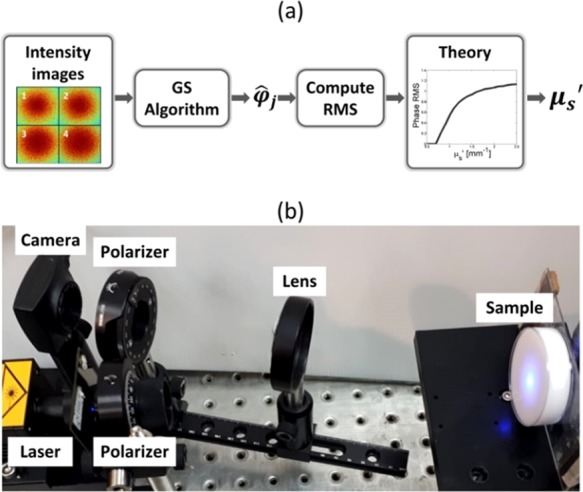
Characterizing materials is preferably done by multiple wavelengths. In opaque materials, the scattering poses a challenge due to the additional complexity to the spectroscopic measurements. We have previously demonstrated an iterative multiplane method for characterizing materials using the reflection from turbid media. Initial studies were performed in the red wavelength regime (632.8 nm) which is optimal for biomedical applications. However, in order to differentiate between materials, it is better to use multiple wavelengths, as spectroscopy may detect the material fingerprint. In this paper, our iterative multiplane optical property extraction (IMOPE) technique is presented in the blue regime (473 nm). Agar-based solid phantom measurements were conducted and compared to our theoretical model. Compatibility between experiments in the red and blue wavelengths shows the robustness of our technique.
对材料进行表征最好采用多个波长。在不透明材料中,散射给光谱测量带来了额外的复杂性,从而构成了一项挑战。我们之前已经展示了一种用于利用混浊介质反射来表征材料的迭代多平面方法。最初的研究是在对生物医学应用而言最为理想的红色波长范围(632.8纳米)内进行的。然而,为了区分不同材料,最好使用多个波长,因为光谱学可能会检测到材料的特征。在本文中,我们在蓝色波长范围(473纳米)内展示了我们的迭代多平面光学特性提取(IMOPE)技术。进行了基于琼脂的固体模型测量,并将其与我们的理论模型进行了比较。红色和蓝色波长实验之间的兼容性表明了我们这项技术的稳健性。