Ha Yoonkyung, Hwang Inho, Ba Hoa Van, Ryu Sangdon, Kim Younghoon, Kang Sun Moon, Kim Jinhyoung, Kim Yunseok, Cho Soohyun
Animal Products Utilization Division, National Institute of Animal Science, RDA, Wanju 55365, Korea.
Department of Animal Science, Chonbuk National University, Jeonju 54896, Korea.
Food Sci Anim Resour. 2019 Aug;39(4):655-667. doi: 10.5851/kosfa.2019.e58. Epub 2019 Aug 31.
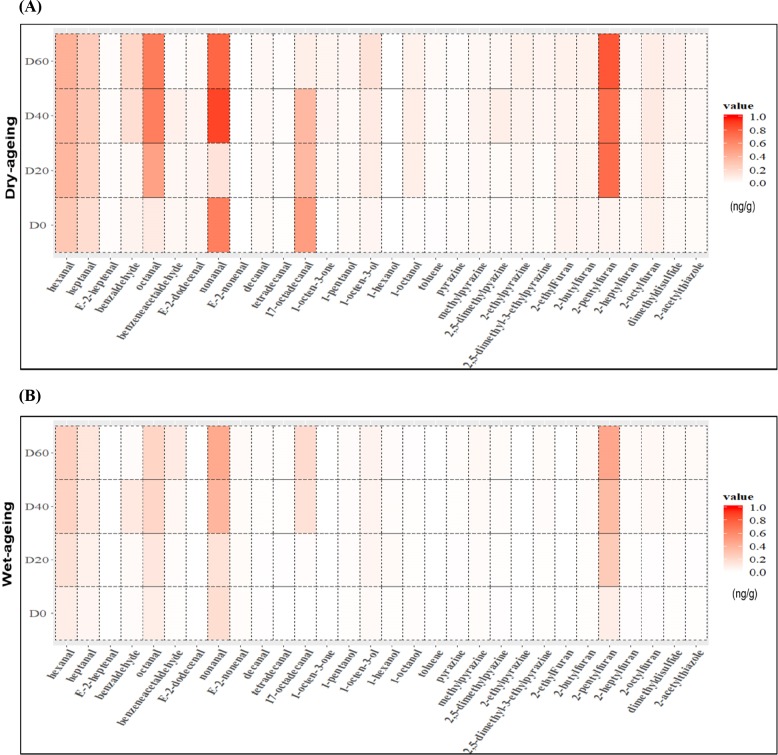
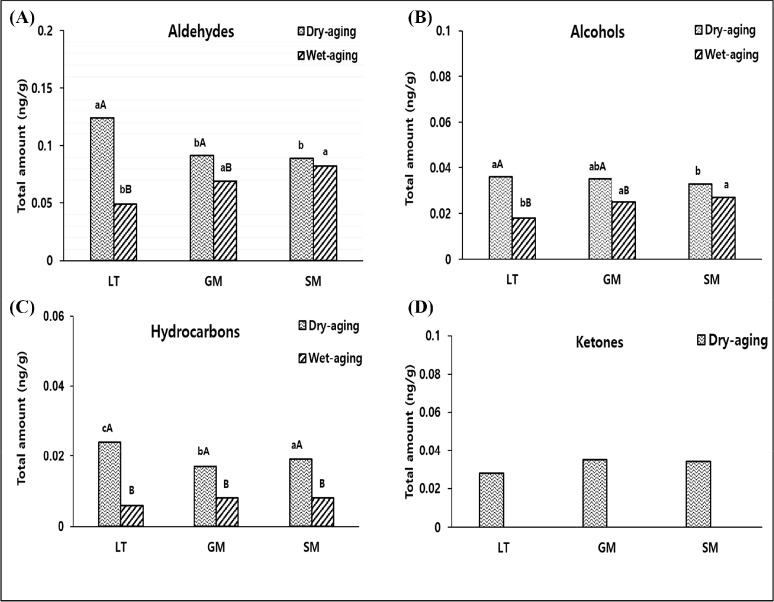
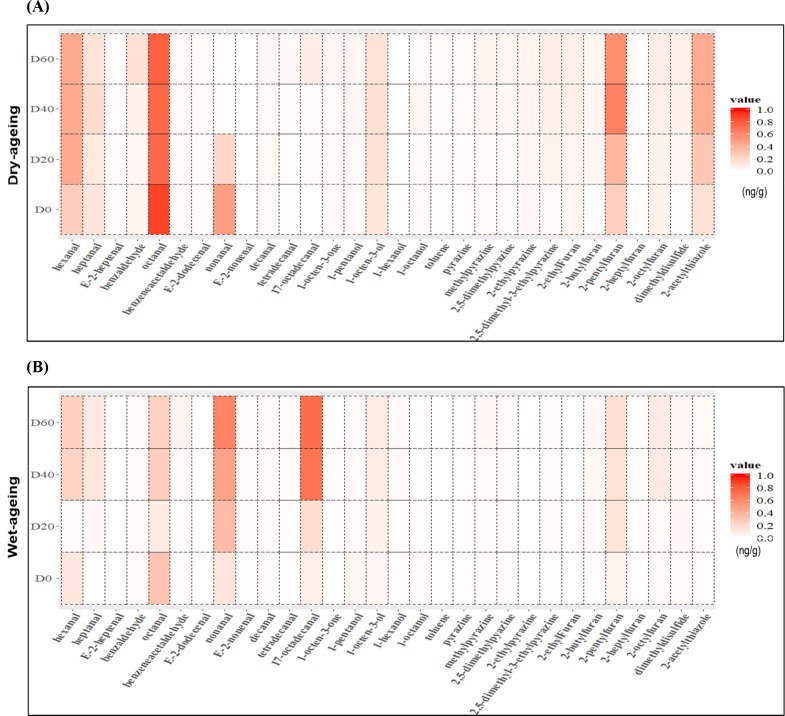
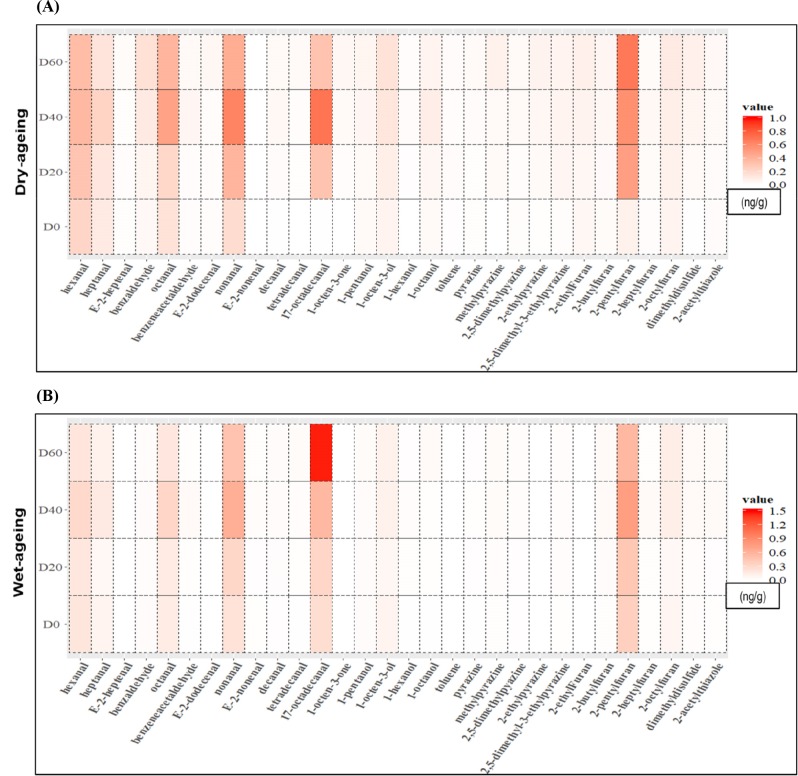
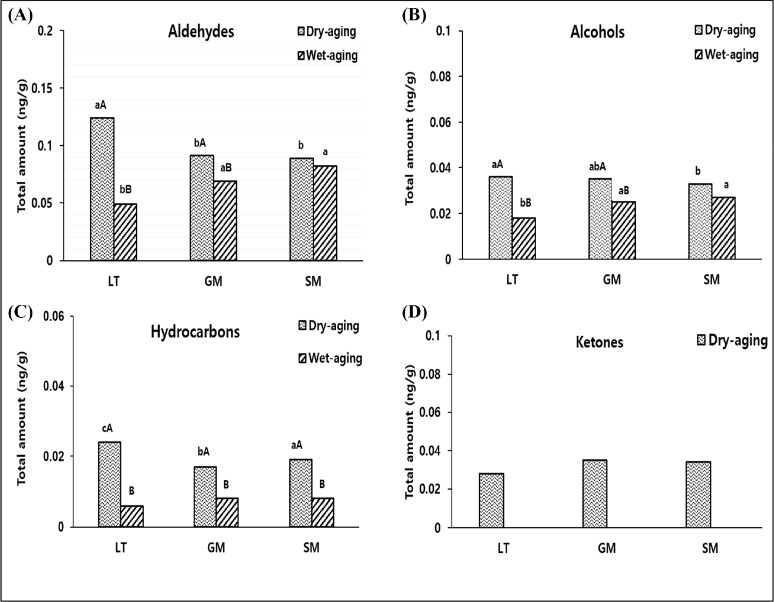
The present study aimed at investigating the effects of dry- and wet-aging methods on flavor compounds and sensory properties of low fat Hanwoo beef muscles. All the beef samples were obtained from 2-grade carcasses of Hanwoo cows. The beef samples used in the dry- and wet-aging methods were prepared in the forms of quarter beef (bone-in) and cuts (boneless), respectively. The dry-aging was carried out at 2°C-4°C and humidity of 65%-85%, while the wet-aging was done at 1°C for 0, 20, 40, and 60 d. At each aging time, three muscles: (LT), (GM) and (SM) were taken from the corresponding quarters and cuts, and used for the flavor compounds and sensory analyses. Results showed that both aging methods significantly increased the concentrations of flavor compounds and total amount of all classes of the flavor compounds as the aging time increased (p<0.05). In the dry-aging method, the GM and SM muscles presented significantly higher total amounts of pyrazines and sulfur-containing compounds compared to the LT muscle (p<0.05). Both the aging methods improved the eating quality attributes, indicating by increased scores of sensorial attributes with increased aging time for all the muscles studied (p<0.05). However, compared to the wet-aging, the dry-aging method resulted in significantly higher scores of tenderness and flavor for the GM and SM muscles after 40 to 60 d. Thus, postmortem aging, especially the dry-aging method could be used to improve eating quality attributes (tenderness and flavor) of low fat beef muscles such as GM and SM.
本研究旨在探讨干腌和湿腌方法对低脂韩牛牛肉肌肉风味化合物和感官特性的影响。所有牛肉样品均取自韩牛二级胴体。用于干腌和湿腌方法的牛肉样品分别制成四分体牛肉(带骨)和切块(去骨)的形式。干腌在2°C - 4°C、湿度65% - 85%的条件下进行,而湿腌在1°C下进行0、20、40和60天。在每个腌制时间,从相应的四分体和切块中取出三块肌肉:(腰大肌)、(臀中肌)和(半膜肌),用于风味化合物和感官分析。结果表明,随着腌制时间的增加,两种腌制方法均显著提高了风味化合物的浓度和各类风味化合物的总量(p<0.05)。在干腌方法中,臀中肌和半膜肌的吡嗪类和含硫化合物总量显著高于腰大肌(p<0.05)。两种腌制方法均改善了食用品质属性,表现为在所研究的所有肌肉中,随着腌制时间的增加,感官属性得分升高(p<0.05)。然而,与湿腌相比,干腌方法在40至60天后使臀中肌和半膜肌的嫩度和风味得分显著更高。因此,宰后腌制,尤其是干腌方法可用于改善低脂牛肉肌肉如臀中肌和半膜肌的食用品质属性(嫩度和风味)。